Barcelona is a wonderful, cosmopolitan city, sitting on the coast nestled among Spanish wine regions. Penedes, where sparkling Cava is made, is to the southwest and Priorat with its Garnacha wines, is just beyond. In fact if people make a trip anywhere in Spain for wine tasting, they would do well to make a stop in Barcelona, because of its many attractions.
In fact there are so many points of interest in Barcelona that it would take more than one article to talk about them all. So we will start with its architecture. The range of the city’s architecture is wide, with Gothic structures such as its cathedral to contemporary buildings such as the Torre Glóries. But the school of architecture known as Modernism was dominant in Barcelona in the late 19th and early 20th centuries, and one man was dominant among the Modernist architects: Antonio Gaudi.
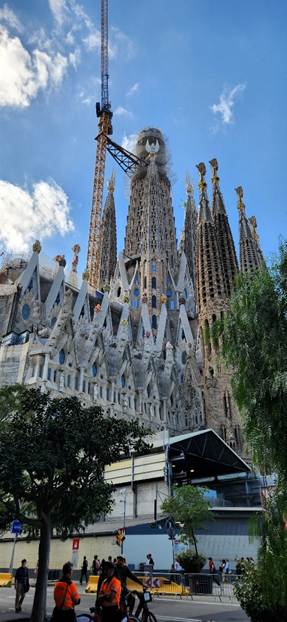
It is virtually impossible to visit Barcelona and not see Gaudi’s masterpiece, the Sagrada Familia basilica. It towers above rest of the city and is now the tallest church in the world. We say “now” because it is still under construction. Gaudi began work on it in 1883 and it was only a quarter finished at his death in 1926. Its spectacular soaring towers and fanciful decoration make it instantly recognizable. Tickets are needed to enter the basilica, but it’s free to walk around it in wonderment.
If that were all that Gaudi had designed, he would be a noted architect. But there are Gaudi creations all around Barcelona. Among the most famous are the Parque Güell, an urban park full of whimsical creatures covered in bright tiles that has delighted children (and former children) for more than a century. Another is the Casa Batlló, with its colorful tiled front and its curved balconies. Crowds assemble in front of every Gaudi building just to gawk.
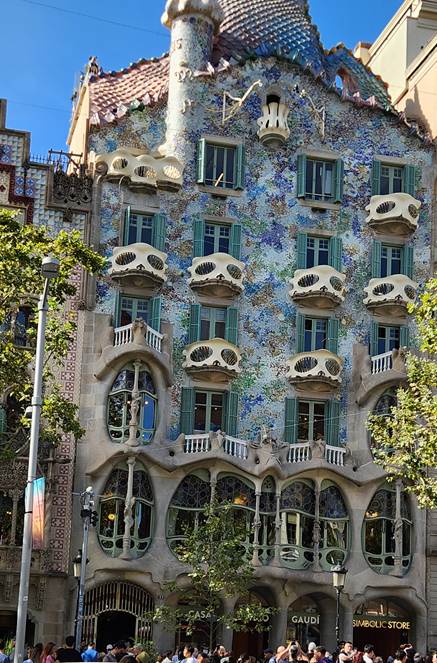
Gaudi is the most renowned Modernist architect but he was hardly the only one. One of the best ways to take it all in is a stroll along the Passeig de Gràcia, Barcelona’s central thoroughfare. There you will indeed find work by Gaudi, the aforementioned Casa Batlló. For instance, immediately next door is the Casa Amatller by Josep Puig. It is as angular and neo-Gothic as Gaudi’s work is free and curvilinear. The contrast is both eye-catching and representative of the diversity of Modernism.
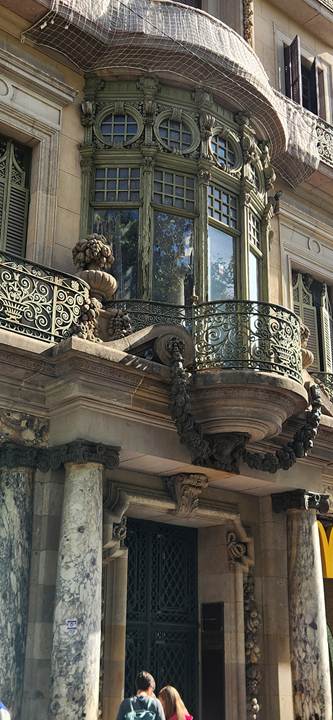
There are classical colonnades, very Spanish grillwork and massive office buildings one beside the other as you walk along the Passeig. Some of them are occupied and functioning as intended, others are essentially museums because of their beauty. Sometimes, it’s enough just to sit on a bench and soak it all in, from the entirety of this fabulous street to ornate details that transform a building front into a work of art. And Barcelona’s almost perpetual blue skies make it all sparkle.