Sète, France

Nestled on the Mediterranean coast between Marseille and France’s Spanish border is a tiny village called Sète.  It is a port for some cruise ships these days, but for the most part it is a simple fishing village with a lot of charm and history.

The harbor in Sète.

The Sétois have made their living from the sea from time immemorial.  When you visit, you can’t avoid the sight of fishing boats along the quais in the main harbor.  Nor can you miss all the restaurants that line the street facing the docks.  Each one has a placard out front advertising the fresh fish and seafood that is available within.  Sometimes we choose a cold meal of shellfish pulled from local waters.  Sète is famous for its oysters.  Of course, a warm meal such as a coquille St. Jacques is quite delicious too.
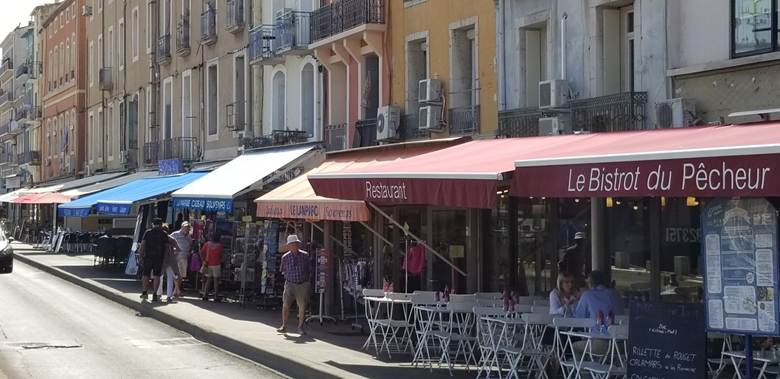
One seafood restaurant after the other.

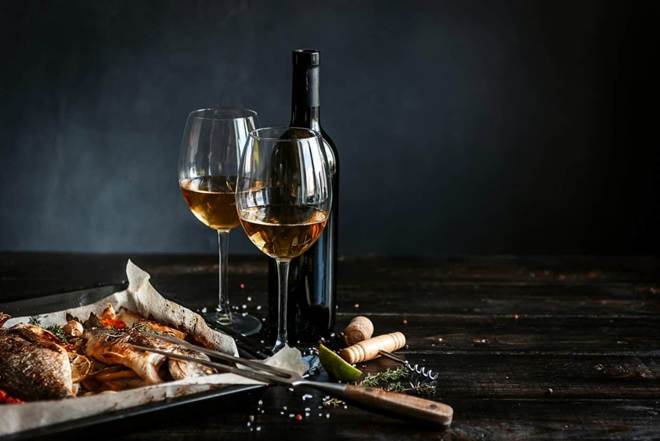
You’ll want to wash all that marine life down with a white wine.  No, they don’t make wine in Sète.  You’d have to drive a mile or two inland to see the vines.  A local picpoul is not very expensive but tastes just great on a sunny day in the south of France.  And it seems as though every day is sunny in Sète.

Sète was established when the Canal du Midi was built in the 17th century.  Yes, there was a village there in Roman times, but the canal terminates in Sète, so commercial traffic reached the Mediterranean there.  The canal is only used by pleasure boaters these days, but the port remains.  It was a bombing target in World War II.  The famous ship the Exodus left from Sète for Palestine with its weary Jewish survivors as passengers. 

Today, smaller cruise ships make it a port of call.  In part, that’s because of the attractiveness of the town itself.  But also, it’s an entryway into the Languedoc.  The medieval village of Pézenas is less than an hour’s drive away, as is the bustling city of Béziers.  And, oh yes, there is wine tasting nearly everywhere inland.

For fans of French popular music, Sète has a particular attraction.  The singer-songwriter Georges Brassens was born and lived his life there.  His songs express humor, a little sexiness and the heart and soul of France at a difficult time in its history.  Brassen’s love of Sète comes through in many of his songs as well.  Just a bit away from the port there’s a museum dedicated to his life.  It’s a worthwhile visit even if you don’t know Brassens or even like French popular music.  His biography is so intertwined with the village that to know one is to know the other.  At the museum there are many examples of the lives the Sétois lived and of how they think of themselves to the current day.

Sète is a good base for exploring the Languedoc.  If somewhere else in the Languedoc is one’s home base, then Sète makes a fine day trip.  Either way, it’s a small treasure to be cherished.
Barbieri & Kempe Wines

A visit to Barbieri &Kempe can seem like déjà vu.  It can also be a little like double vision.  Let us explain.

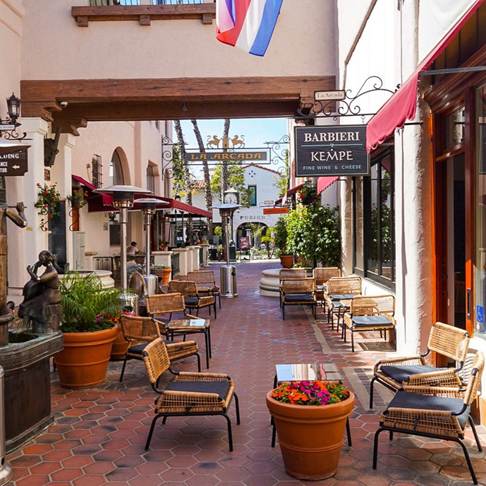
Barbieri & Kempe has taken over the space in downtown Santa Barbara that once housed the tasting room of Sanford Winery.  (They also have a tasting room in Los Olivos, but we haven’t been there.)  Even though Sanford (and now Barbieri & Kempe) were located in a high-end outdoor shopping mall, there was a sense of refinement and exclusivity when Sanford was there.  Barbieri & Kempe brings a different vibe: friendly, inviting visitors to stay a while and enjoy the experience.  Even though the interior is well-appointed, their terrace (with statues of laughing dolphins adding to the atmosphere) beckons to visitors.

The terrace at Barbieri & Kempe. Photo courtesy of Breezit.

Once seated, you find out that the Barbieri & Kempe tasting room isn’t for one winery, but two that share the space.  Then you find out that Paolo Barbieri and Erin Kempe are a couple, with each producing and bottling wines under their own names.    Paolo is also a Master Sommelier and began making wine in his garage.  Erin worked in restaurants and met Paolo that way.  She assisted him in his early winemaking efforts until she gained the confidence to put her own name on wines she produced.  Dinnertime at their house must be interesting: “My wine tonight or yours?”

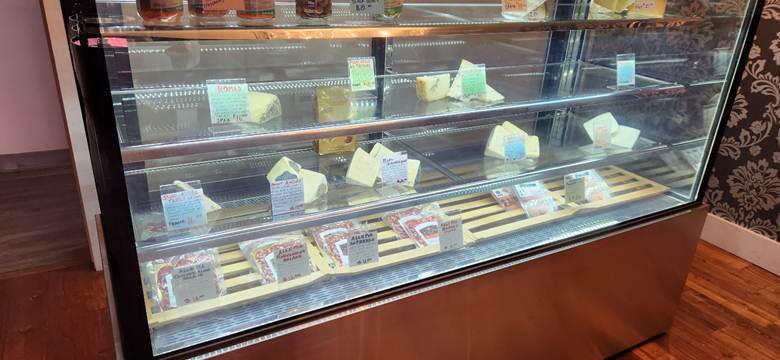
The cheeses at Barbieri and Kempe.

The wine tasting experience is enhanced by the possibility of ordering cheese with your pours.  Barbieri & Kempe is also a cheese chop with a nice selection of California and international cheeses available as a tasting plate or to buy at retail.  Perhaps in recognition of Signor Barbieri’s Italian roots, there are also Italian salamis for sale.

There’s an openness to the way tastings are offered at Barbieri & Kempe that says, “We are what we are and we are where we are.  We hope you like our wines.”    Overall, we did enjoy them, in particular the Grenache-Syrah-Mourvèdre blend from Ms. Kempe and in particular her Illumina Bordeaux blend. In general, they both cover a wide range of varietals.  There is a fair amount of overlap in the grapes each of them uses for their wines, with both of them offering rosés, reds and whites. 

We have often praised in-town tasting.  You miss the sight of the vines, but you spend more time tasting and less time driving.  The atmosphere at Barbieri & Kempe is very urban, with the hubbub of a shopping center and all the passers-by.  Somehow, that seems to add to the experience, not detract.  We found Barbieri & Kempe’s wines enjoyable, if not the most representative of Central Coast wines that we have tasted.  But we at Power Tasting are not wine critics; we comment on the wine tasting experience.  And we enjoyed our time sampling this couple’s wines at their Santa Barbara site.

Good Wine, Good Meals

We love wining and dining.  We have found that around the world, where people make good wine, they like to eat well, too.  Robert Mondavi famously said that the good life includes wine, art and food.  So the meals we eat in Wine Country are as important as the wines we taste.  Well, almost as important.

Photo courtesy of Stella Blu.

When we go wine tasting in areas we’re familiar with, it’s difficult to try new places, because we just can’t bear to forego a meal in the places we’ve loved in the past.  In Napa Valley, for example, how could we not have a meal at Mustards?  We remember the quenelles de brochet and boeuf bourguignon at Bistro Jeanty and have to try them again.  We could skip a Thomas Keller restaurant, but why?  Unless we’re staying for a week – and we don’t take trips that long – we seem never to have time for a new restaurant.

It’s a little different when we visit regions we’ve never been to before.  We read up on what the best known restaurants are and make reservations online.  But then we’re in a little village where there’s a bistro that just screams out “Eat here!” in our minds.  So, since most of Europe closes for a few hours at midday, we eat a delicious lunch and don’t have the appetite for the famous places where we had reservations.

There are certain meals that we’ve eaten in this way that are so memorable that we frequently tease our taste buds with reminiscences.  The foie gras in Colombier in Languedoc.  The crêpe filled with mushrooms in Morgon in Beaujolais.  Salad on the beach in Marsala in Sicily.  Lamb shanks in Sainte-Cécile-les-Vignes in Provence.  And on and on.  We’re salivating just writing about these meals.  The lesson is: When faced with temptation to dine at a place you’re never been but looks like you want to, give in and eat.

But fine dining is only a part of the culinary adventure while wine tasting.  Prior shopping at a cheese shop in Burgundy or a salumeria in Tuscany, followed by a picnic at the edge of a vineyard is as great a way to dine as there is in the world.  A stop at Oakville Grocery can accomplish the same thing in Napa Valley.  We used to wash it all down with a bottle of the local wine, but we’ve become a little wiser about our consumption nowadays.  These days, it’s never more than a glass.

There is a time and a place for a burger at McDonald’s, but it’s not when we’re in Wine Country.  Way out in the countryside, it’s usually easier to find a café where the locals go than a fast-fooder.  Dining in the same place as the people who make the wine you’re tasting adds a little understanding of the place that goes along with knowledge of the terroir and the grapes.

So Mangia! Bon appétit! Eat up!

Asking Questions

A major part of Power Tasting’s mission is to empower wine tasters from being intimidated when they visit wineries.  For some people we’ve met, the most intimidating aspect of wine tasting is asking questions of their servers about the wines they’re being served (and the ones they’re not being served), winemaking practices, the vineyards and so many other topics that make the study of wine so interesting.  Some are fearful of seeming ignorant and, at the other extreme, of sounding too snobbish.  But how are you to learn without asking for more information?

Photo courtesy of Metro Wines Asheville.

So here are a few tips on how to ask questions at a winery.

  • Age is a factor, as is the question.  It’s really a matter of context.  A young adult, just of legal age to consume alcohol, can ask very basic questions without worry.  If that person asks, “What makes some wine red and others white”, any server with a conscience should give a simple but thorough answer. An older person might get a sidewise glance!   There are things that a 21-year old can do that a 41-year old can’t.  But you already knew that.
  • Only ask questions to gain information you don’t have.  If the intent is to show off how much you already know about wine, you’d be better off being quiet.  After all, who are you trying to impress?  The server?  Your companion?  People at the next table?  They don’t care that you have a diploma from some wine academy and, if you don’t have a certificate, why would you act like that?
  • Ask questions that will add to your appreciation of the wines you are tasting.  For example, it’s legitimate to ask what grapes were used to make a certain wine.  Also, we frequently ask about the percentage of alcohol.  Even if it’s well-balanced and not a “hot” wine, we sip less of a wine that’s 15% plus than of a Champagne, say, that’s only 12%.
  • If you are considering joining the winery’s club, ask a lot of questions.  It’s quite fair to ask how many shipments there will be, about the shipping cost, whether you can customize the selection and, of course, how much the annual shipments will cost.  After all, you are thinking about making a commitment that will cost hundreds of dollars, if not more.  It’s always a good idea to know what you’re buying.
  • It depends on how busy the server is.  When everyone tasted standing at the bar, it was easy to see how much work your server had to do.  Now, when so many wine tastings are seated affairs, you might think your server is dedicated just to you, but he or she has other people to pour for.  So if the server seems to be rushing from one table to another, it’s only fair to minimize your questioning.  That’s not to say you can’t ask, but you might not get all the information you’d like.