Wine Tasting vs. Tasting Wine

This occurred at a recent college reunion in New York, but it could have happened at any large gathering in any location.  There was an event advertised as a wine tasting. About 500 people showed up at an outdoor plaza, under a tent on a hot summer day.  The organizers had chosen fifteen or so wines, half red and half white (with one rosé thrown in for balance) from California, France, Italy, Australia and Spain.  The wines were served at various stations, reds and whites intermixed, laid out in flimsy plastic cups for the taking.  The white wines were on ice but someone had heard that red wines were to be served at room temperature.  Well, the “room” in this case was a tent under the sun, so the reds were roughly 90o.

This may have been an opportunity to taste a lot of wine, but it wasn’t a wine tasting.

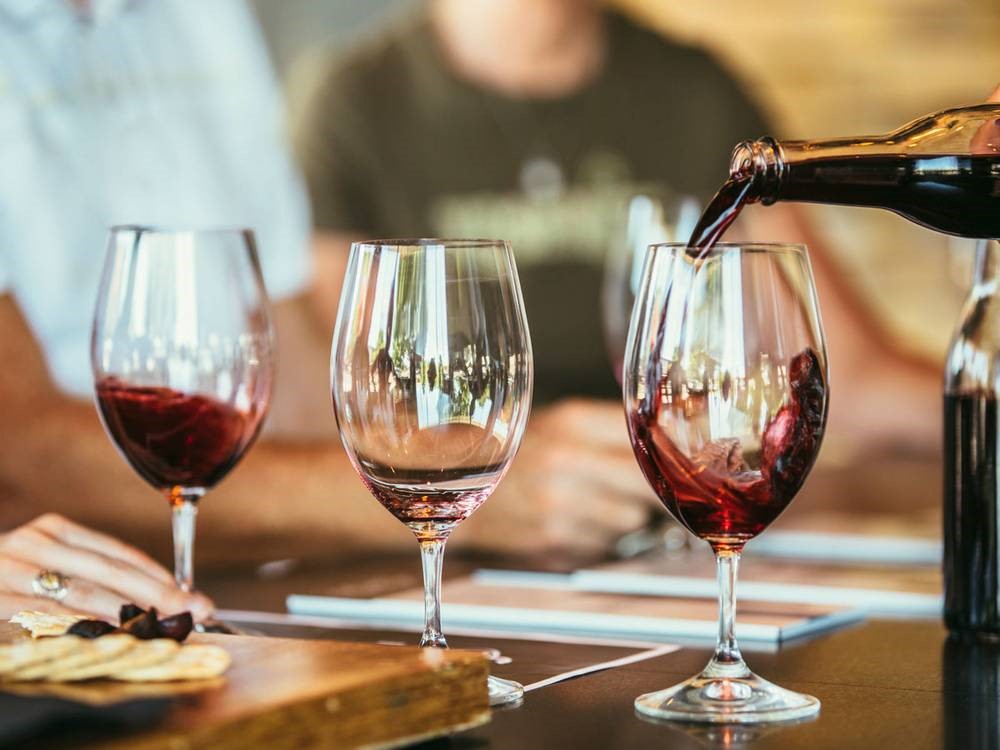
Photo courtesy of C. E. Lovejoy’s Market

  • A wine tasting has form.  That is not to say that wine tasting must be formal.  In fact, some of the best are very informal, spent with friends over a dinner or a barbecue.  But there must be some reason for drinking certain wines that gives the event some continuity and a reason for comparing the various ones being served.  They may all be from a single producer, as happens in tasting rooms on a wine tasting trip.  Or the same grapes from multiple producers in the same region.  Or from different regions around the world.  Or just different approaches to accompanying the meal being served.  But a wine tasting is not: “Here are five different wines.  Try them and say which one you like.”
  • A wine tasting has structure.  Generally, that structure is from lightest to heaviest, topped off with a dessert wine.  But it could also be from cheapest to most expensive (best done in a blind tasting).  It might be fun to match up hillside wines against those from the valley-floor, of the same grapes.  There has to be some reason to say, “Drink this one first, then this one, then this…”
  • A wine tasting has content.  It might be fun to line up Petrus, Screaming Eagle and Grange next to each other.  We’ve never been invited to a wine tasting like that and truly never expect to be.  But in every tasting there ought to be some wines that are worth the attention for savoring and contemplation.  What’s the point of a selection of plonk from around the world?  That’s not to say that an unknown wine can’t shine among the big names; we’ve often been delightfully surprised by the Davids taking down the Goliaths.  Still, the wines involved in a tasting should be carefully selected with some thoughtfulness about their quality.
  • A wine tasting has class.  Oh, make that glass.  While it is true that we’ll be happy to take some Chateau Margaux in a Dixie Cup, for the most part we want to enjoy wine in a well-made glass, not a plastic beaker better used for biological specimens.  That shows respect both for the wines and for those invited to taste them.

At the event in New York, once it was clear that a real wine tasting wasn’t on offer that day, we poured three samples of a cold white wine into a single cup and cooled off under that hot sun.


I Don’t Like It

When you go into an American winery’s tasting room, in Long Island, California or elsewhere, you are likely to be offered tastes of a significant number of wines.  Some will be on a less expensive list of the winery’s most popular wines and others may be on the “reserve” list, which they consider to be their best wines.

A few visitors may have such a broad appreciation for wine (or maybe a lack of appreciation) that they like everything they try.   Most other people will like some wines and not others.  And unfortunately, there may be some tasting rooms where some people don’t like anything.  We’re sorry to say that in the past there were some wineries in Long Island that fell into the latter category, but in recent tastings we have found at least a few praiseworthy wines at all the wineries we visited.  Still, there were none where we liked everything.  With scant exception, the same can be said of almost every winery we have ever visited in the United States.

This is not necessarily a bad thing.  No winemaker can please everyone and, we suspect, few even try.  They aim to please themselves and we, the consumers, can either go along with them or buy someone else’s wine.  When we are standing at the bar in a tasting room, we ought to use wines we don’t like as learning experiences.

  • Be polite. Remember what your mother told you and if you have nothing nice to say, say nothing at all.  Pour out your wine and maybe ask the person you’re with what they thought.  Move on.
  • Is the wine okay? Maybe the wine has just gone bad. On more than one occasion, we’ve been served corked wine in a tasting room, especially on busy days when the server may have been too rushed to check the bottle.  The wineries are grateful if you point out that one of their purveyors is selling them tainted corks.
  • Ask yourself why you don’t like it. Maybe the wine is just not made in a style you like.  For instance, we prefer deeper, rich Pinot Noir’s than the thin, acid ones that are popular in some regions.  That doesn’t make us right, but it does validate the consistency of our taste. The point is to identify what it is about a wine you don’t like, so you can avoid wines like it in the future.  It can be even more instructive if one person likes a wine and the other doesn’t.  That enables both to pinpoint the offending (or positive) characteristics of the wine.
  • Try to remember other wines from that winery. They might just have had a bad year.  For example, there is a world-renowned winemaker in Napa Valley whose 2011 offerings just didn’t make it in our opinion.  It was a tough harvest across the region, so this winery wasn’t able to overcome the reduced quality of their grapes.  They still make great wine in other years.
  • And if you don’t like anything…Not everyone who grows or buys grapes knows what to do with them. Because you are a wise and discerning wine taster, this winery must simply be sub-par.  Oh, wait, there’s somebody down the bar buying a case.  Well, there’s no accounting for taste, yours or theirs.

At the very least, figuring out what you don’t like will save you time and money in a wine store when you get home.  Unfortunately, it may also cut you off from some good wines that might come with another harvest.  Still, one of the reasons to go wine tasting is to figure out what you like…and what you don’t.

This Side of the Bar

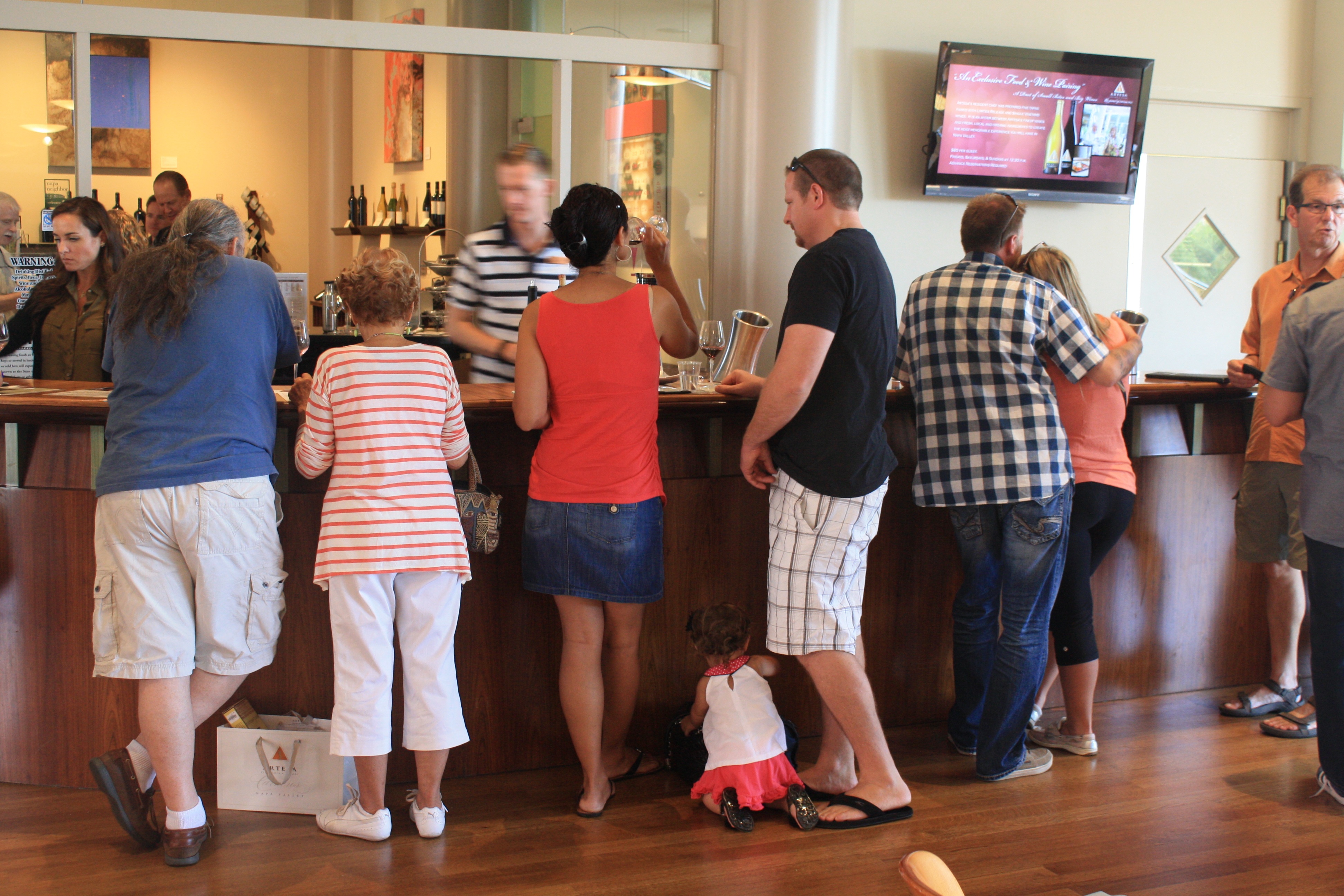
Part of Power Tasting’s manifesto, as we say on our Welcome page, states: “We want to empower the visitor to get the maximum advantage out of each visit, not to be intimidated by wine snobs on either side of the bar”.  In most wineries, the servers are friendly and in be best of cases, educational.  Some are wine snobs, but fortunately, they are rare.

Photo courtesy of touringandtasting.com

However, the other people tasting wine with you are much more of a mixed bag.  The majority are just folks out for a pleasant day, going about their own business.  However, there are certain types we have encountered who offer both challenges and opportunities.  As a general statement, we see more of them while we are tasting in Napa Valley, because there are so many wineries and it is so well known.  Here we offer some tips on how to deal with the various sorts that you might meet in your wine tasting travels.

  • The Party-ers: If you are in Napa Valley on a weekend, especially at wineries that offer a food menu and tables,  you are then likely to run into a loud group who would rather drink than taste.  If they are not your kind of crowd, maybe you ought to skip tasting on weekends.  But if Saturday and Sunday are your only chance to go, try to get away from them.  The servers are alert to this type and try to isolate them, but it’s hard to avoid them.  So if they are inside, take your glass to the terrace.  If you can’t get away completely, try to find a quiet corner.
  • Bachelorette Parties: A special case of the party-ers is a group of young women who pull up in a limo, previously over-served, celebrating one of their group’s impending nuptials.  (Of course that sounds sexist, but we’ve never seen a bachelor party doing the same thing.  At bars, for sure, but not wineries.)  Our best advice is to give up and go somewhere else, but if that’s not practical then by all means have nothing to do with this group.  They can only detract from your experience and you can’t add to theirs.
  • People You Saw Earlier: It is inevitable that you’ll run into some the same people as you go from winery to winery.  After all, they’re doing what you’re doing, in the same part of the world.  And since they’re going to the same tasting rooms as you are, they are likely to have similar tastes.  It might be interesting to recognize them, ask for  recommendations of other wineries you might enjoy and give them some in return.
  • The Dreaded Wine Snobs: Some people like to share information; others want to lecture.  In a tasting room, a little alcohol loosens the latter sort’s inhibitions as well as their tongues.  The moment you hear something like, “This is good but the tannins don’t measure up to the 1996”, find a reason to do something more important, like examining the t-shirts and coasters.  If you engage these people in conversation, you’ll be stuck for a half an hour listening to someone, no matter how knowledgeable he or she might be, who is more interested in an audience than a conversation.

Wine drinking and tasting are by nature social experiences and for the most part, the people you’ll run into in wineries will be convivial and in some instances informative.  A little conversation can be interesting; too much can spoil your wine tasting experience.

Advice for First-Timers

Maybe you’ve heard this question from some friends: “I’ve got a business meeting in San Francisco and my Significant Other is coming with me.  We’d like to spend some time going wine tasting.  You’ve been there a lot, so what would you suggest?”  We’ve gotten that a lot.  In fact, the reason we started Power Tasting, in part, was to answer questions like that.

There are a lot of questions to ask your friend first, among which are

  • Are you driving or will someone else drive for  you?
  • Are you going just for the day or are you staying over?
  • Are there particular wines you especially like or dislike?

So let’s assume that these hypothetical friends are going to drive up for the day and are pretty open about what they will taste.   Moreover, they’re not going to be constrained about paying for top-quality tasting.  We would recommend a day-trip to Napa Valley.  Why Napa?  Because that’s where American wine as we know it today got started.  We love Sonoma County and some parts of Santa Clara County – also short distances from San Francisco – but if your friends have never been wine tasting in California, they really ought to start with the most famous American wine locale of them all.

Photo courtesy of Eater San Francisco.

Here’s how we would respond:

  • Take it easy.  If you’re not used to sipping wine all day, you need to respect your limits –  don’t wait until you’ve reached them.  This is especially true because you’re going to be behind the wheel.
  • Restrict yourself to the southern end of the Napa Valley.  There are a lot of great wineries on the southern (i.e. Carneros and Napa appellations) end so you can minimize your driving time.  That’s doubly important, since you’d like to avoid the traffic and not spend too much time driving with alcohol in your bloodstream.
  • Try to taste a wide selection of wines.  You could do all Cabernet Sauvignon or Chardonnay, but what’s the point?  So, for example, Etude winery is one of the closest to San Francisco and you can taste top-end Chardonnay, Pinot Noir and Cabernet Sauvignon there.  Not far away is Domaine Carneros, for more Pinot Noir and especially for sparking wines.  We’d also recommend getting into the main valley; Trefethen is close by and has a lot of top-end wines to offer.
  • Stop for lunch.  For one thing, if you’re tasting wine, you ought to have some food. For another, Napa Valley is almost as famous for its restaurants as it is for its wines.  Mustards on Route 29 has been a destination restaurant for decades.  Or you could drive into Napa town, where there are many places to eat.  There’s also the Boonfly Café on Route 121, near Domaine Carneros.
  • Enjoy the views.  There’s more to Wine Country than wine.  Everywhere you go, it’s beautiful.  If you’ll excuse a bit of American pride, Napa Valley is among the most beautiful.  If you do go to Domaine Carneros, you’ll have one of the loveliest vistas while sipping Champagne…(oops, California sparkling) on the terrace.  Maybe give yourself a little time to drive around on some of the little side roads.  Route 29 is too full of traffic to be taking in the views.
  • And above all else, have fun.  Don’t be over-awed or try to do everything in a day.  You can always come back.

Clef du Vin

The wine taster’s best friend!  A miracle of modern science!  A tool for bringing out the cork dork in all of us!  It’s the Clef du Vin (pronounced CLAY do van.  For that last word, if you’re American, start saying “van” and just when you get to the “n”, swallow it.)  So what is this wonder?

The original Clef du Vin

It’s a metal gizmo about three inches long when fully opened, shaped a little like a flattened mouse.  The tail of this mouse is a chain about as long as the device itself.  The blade isn’t sharpened; it’s just a thin piece of steel with a small copper disk at the end.  Actually, what we have just described and shown here is the original Clef du Vin; there are versions today that are short steel rods with a bit of copper at the end.  It’s the steel and copper combination that’s key element of the Clef du Vin.

The Peugeot “Travel” Clef du Vin

Calling it the key element is a play on words, since “wine key” is the English translation of Clef du Vin.  But enough of what it is.  What does it do?  Well, it simulates the aging of wine when you plunk the bi-metal tip into wine.  It accomplishes this feat through the laws of physics.  Two metals plus an acid form a battery.  So steel and copper in wine (the acid) creates a very weak battery with a very weak charge.  Each second in the Clef du Vin is in the wine equates to a year of bottle aging, or so it seems.

Of course, the question is: Does it really work?  Well, who knows for sure.  This we can say: wines with again potential do taste better – sometimes a lot better – when treated with a Clef du Vin.  The tannins are definitely softened, the flavors more vibrant, the mouth-feel more mellow.  But if a wine has reached its potential, there is no discernible difference.

One story is enough of an illustration.  In 2013, we were at one of Napa Valley’s most renowned wineries, maker of one of the most highly rated wines in the valley.  The server was extolling the virtues of the recently released 2011 wines.  You may remember that 2011 was an unusually poor vintage in Northern California.  Many wineries did not release their premier wines that year, but this winery did.  At first sip, the wine didn’t seem to live up to its billing, but with five seconds’ use of the Clef du Vin the wine came alive in the glass.  We offered to let the server try it and she called all her colleagues over, saying “You’ve gotta try this!”.

Is that wine going to taste exactly the same today, with five years of aging?  Maybe Robert Parker can remember exactly what a wine tasted like back then, but we can’t nor do we know anyone else with that level of taste memory.  But the Clef du Vin did demonstrate that this was a wine with potential and worth buying.

When first available in the US, the Clef du Vin sold for $100.  Now you can find one on the Web for $50.00 or less.  If you do buy one for use on wine tasting excursions, be sure to bring along a paper towel to wipe it off and a plastic baggie to carry it in.  And try not to make too big a show when you use it; you’ll attract enough attention as it is just dipping something into your wine.  The Clef du Vin certainly adds a layer of interest to your wine tasting experience.

Rainy Day Tasting

One of the great things about touring in Wine Country is that you can generally expect lovely weather, if a bit hot.  Making great wine requires plentiful sunshine, so that’s what you’re likely to get when you go wine tasting.  However, into every vineyard a little rain must fall; after all, the grapes need water too.  So if you wake up to find it pouring and the weatherman says it’s likely to continue all day, what are you to do?  You’ve come to taste wine and perhaps today is the only day you have to indulge yourself.  You could just give up and go home, but why?  Pretty much all tasting rooms are indoors, after all.  (Iron Horse Winery in Sebastopol in Sonoma County, is the maker of some pretty good sparkling wines and is the exception.  Their tasting “room” is outdoors, so maybe it’s not a super choice for a rainy day.)

So if you’re facing a day of fine wine mixed with rainwater, here are a few things to keep in mind.

  • Drive extra safely.  Aside from the usual caution you should exercise while mixing alcohol and driving, you should take extra care.  Many Wine Country roads are rather windy, narrow and have no guard rails.  Even if you are exercising due care, the person driving that on-coming or overtaking car may not be doing the same thing. Or maybe this is the day to hire a driver.

Old Zinfandel vines at Ridge Lytton Springs winery.

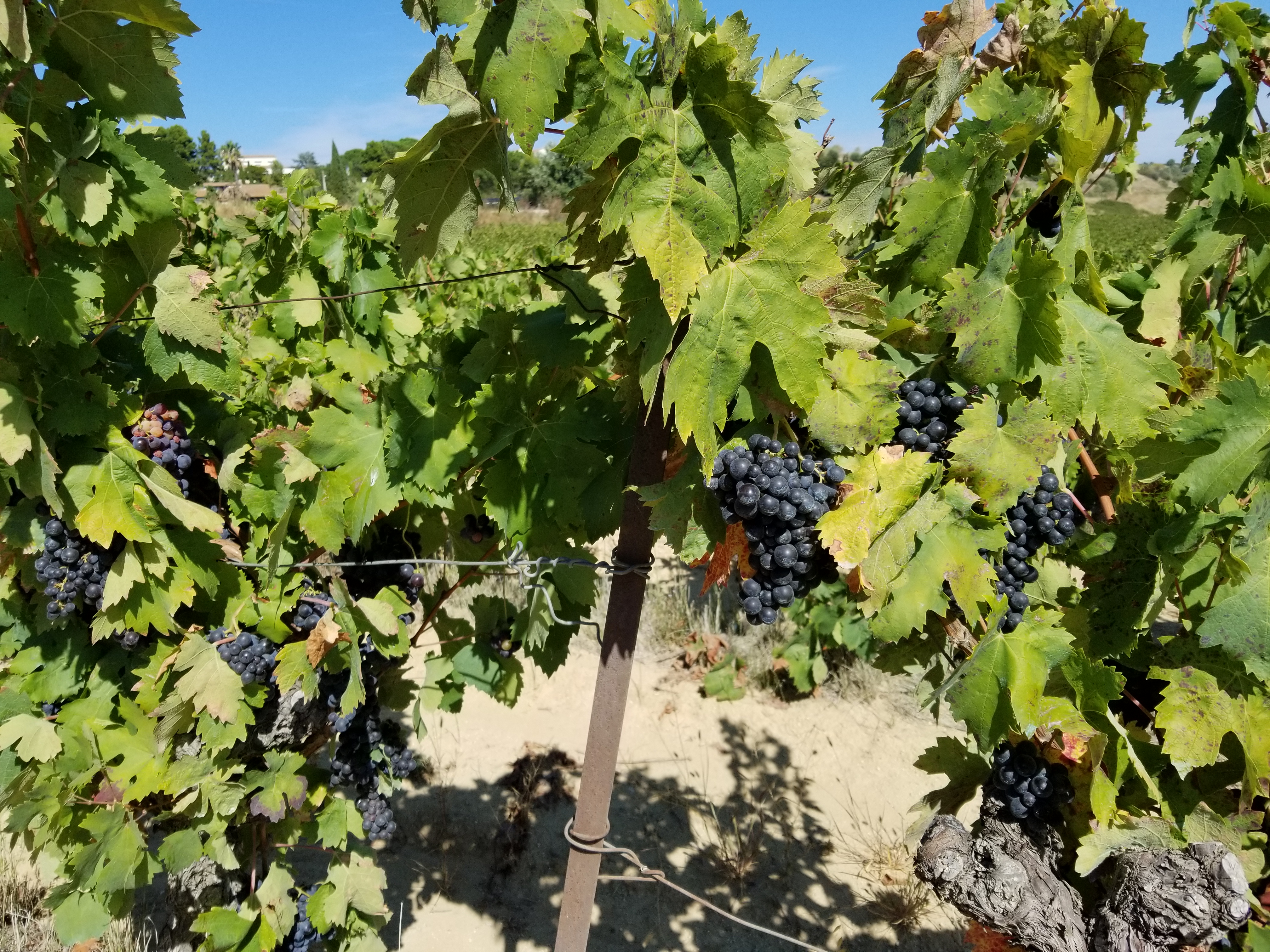
  • Enjoy the special majesty of the vineyards.  Of course, it’s best to see the vineyards just before harvest, with the leafy vines hanging with ripe fruit.  But maybe you picked an overcast day in February because that’s when you happened to be there.  We think that bare vines under gray skies have an allure of their own, especially stumpy, non-trellised old Zinfandel, as shown in the photo above.  You may not get this sight very often, so enjoy it while you have it.
  • Take advantage of slow days in the tasting rooms.  Rainy days don’t generally attract big crowds, so you get the chance to spend more time with knowledgeable servers.  Not only do you get their undivided (well, less divided) attention, but they may be just a little more inclined to find something special to pour for you.  Anyone who ventures out in bad weather is pretty likely to be a dedicated wine taster, so it’s the servers’ pleasure to reward you just for showing up.
  • Bring an umbrella.  Sure, you knew that, but maybe you don’t have one in your luggage.  Most hotels have a supply and they are happy to loan you one.  (Be considerate and return it when you’re finished with it.)  Plan B might be to look for an umbrella in your first tasting room’s gift shop, emblazoned with the logo of that winery.

Overall, the message is to make the most of a bad day and enjoy your tastings anyway.

If You Don’t Speak the Language

What do California, Australia, South Africa and New Zealand have in common?  They are all places where great wine is made and the people speak English.  If you are anglophone and your wine tasting travels take you to those places, you’ll have no problems.  But if you want to taste Barolos or Riojas or Burgundies or Zweigelts, you may have a few problems.  It helps that English is the world’s second language, so that you’re likely to find a server or guide who can talk to and understand you.

In most cases, larger wineries with commercial tasting rooms generally hire people who can work with tourists, which means that someone there will be able to converse (at least somewhat) in English.  However, much of the fun of wine tasting is meeting small producers of fine wines that you can’t find back home.  These are farmers and winemakers in important but less traveled corners of Wine Country.  We well remember sitting in an Italian vineyard owner’s kitchen, waiting for his daughter to arrive, so she could explain the wines he was making and serving to us.

The tasting room at Ricasoli in Tuscany, where the staff speak English very well.  Photo courtesy of barone Ricasoli.

So if you are planning to taste the wines in regions where English isn’t always available, here are some tips.

  • Avoid the problem.  If you can’t speak their language and they can’t speak yours, you can still taste their wine or go to another winery.  When you walk into a winery’s doors, look around for signs in English; that’s always a good tip-off that English is spoken there.  If there are no signs, you can simply ask if there is someone who speaks English.  Better still, learn how to ask that question in their language (a good suggestion for getting around any country, not just Wine Country).  Really, “Parlez–vous  anglais?” and “Habla ingles?” aren’t that hard to remember.
  • Pick up a little wine vocabulary.  We bet you knew that wine is vin in French and Spanish (thought pronounced differently) and vino in Italian.   It’s wein in German.  There, that’s half the battle.  The French call red wine rouge, the Italians rosso and the Spanish tinto; white is blanc, bianco and blanco respectively.  Now get down the words for “good”: bon in French, buono in Italian, bueno in Spanish.  That wasn’t so hard, was it?  You are now prepared to be a wine taster in three of the largest producing countries in Europe.
  • Use whatever languages you have.  Maybe you studied Spanish in high school and you’re tasting wines in Italy.  The languages are very similar, thanks to those long-ago Roman conquerors.  So even if you remember only a few words and phrases, give them a shot.  That may be just enough for a local person to get the gist of what you’re trying to say.  Once when we were in Italy we were in a situation where we didn’t speak their language and they had only a smidgen of English.  But we all spoke French!  So we spent our time conversing in a third, common language.
  • Smile at all times and look a little helpless.  In our travels, we have encountered very few people who make or sell wine who aren’t quite nice.  If you try to be nice in return, they will usually want you to try and to enjoy their wines. They’ll think of you as their guests.  We were in Valpolicella in Northern Italy at a winery where the owner and sole person on site could only say to us – rather loudly – RI-PA-SSO and AM-A-RONE.  We sipped and said, “si, si” and we got along famously.


Tasting the Greats

In some areas of Wine Country, you go tasting and you know not to expect much.  In other places, you anticipate sipping some fine wines, but the discovery of which ones will appeal to you awaits the tasting.  And then there are occasions, not many, when you know in advance that you will soon be tasting something superb.  You might have an appointment at one of the premier cru chateaux in Bordeaux, say Mouton Rothschild.  Or perhaps it’s Opus One in the Napa Valley or Biondi Santi, the home of Brunello in Tuscany.  The top of the top.

If you love wine, these are very special experiences, akin to visiting the Louvre or the Grand Canyon.  These wines are known to be the finest of their type and as you approach one of these special wineries, your sense of anticipation rises to a crescendo.  You know you are about to have a very special wine tasting. This is a life experience in itself.  With all that, don’t let your emotions carry you away.  This is still just wine, a pleasing part of your life for sure but not, for most of us, central to it.  Here are some tips for making the most of a very special occasion without being overwhelmed by it.

Chateau d’Yquem.  Photo courtesy of LVMH.

  • Don’t complain.  The tasting is probably expensive.  There may be a wait for a tour group to arrive.  Outside the United States, you may have some difficulty understanding your guide or server.  You probably won’t get a chance to taste the 1982 vintage.  Put all that out of your mind and recognize that even the greatest châteaux are run by wine people, not corporate efficiency experts.  Don’t spoil your visit thinking about what it’s not.  Make the most of what it is.
  • Savor the entire experience.  It’s not just about tasting the wine.  Often the tasting comes with a tour but if not, make arrangements to have one.  Learning how the best make wine gives you some background for the lesser but still very good wineries you will visit in the future.  There is something about seeing the Rothschilds’ cellars or 100-year old casks that are still in use that is simply thrilling.  Soak up the furnishings, the art work, the views of top-tier vineyards.  If you enjoy wine tasting as much as we do, this will be the summa.  Enjoy it to the fullest.
  • In what seems like contradictory advice, remember that it’s just wine.  A press is a press, a barrel is a barrel and bottle is a bottle.  The makers of plonk do it the same way as Robert Mondavi did, just with less skill, lesser materials and poorer grapes.  It has been our experience that it is a pleasure to see someone do something as well as it can be done, regardless of what it is.  But keep it in context.  What you will see in these great wineries is the making of a fine beverage, not the cure for diseases or a flight to the moon.  By keeping that perspective, you will enjoy this experience without diminishing the pleasure of other wine tasting adventures yet to come.
  • Appreciate the wine when you taste it.  You won’t get a lot in your glass and you may not be able to afford to taste some of these wines again, so sip slowly.  Absorb the aromas.  Think about the flavors opening up in your mouth. Think of where you are and look around to print that moment in your memory.  Try to remember the taste, as hard as that may be.  We have long said that it’s your mouth and your taste buds, so there is no one to tell you what’s good and what’s not.  But honestly, if you don’t enjoy these wines, it’s probably you, not the wine.

Traveling Around California

Here’s a really bad idea: drive all over California visiting one wine tasting region after the other.   It could be tiring and after a while, you can’t remember what you tasted and where.  We did it and the reason we did it wasn’t wine tasting; Steve had a client that wanted him to visit all of its offices around the state and we just took advantage of being there to taste each region’s wines.  We’re not going to present a travelogue here, but we will offer tips on how to take the most advantage of your travels in California if this ever happens to you.

  • Plan your route before you go.  California is famous for its road system, so take advantage of it.  Figure out how you want to go, with help from tools like Google Maps.  (What did we do before we had it, anyway?)  But beware of Google Maps navigation when you’re driving.  California is also famous for its traffic jams, so it may take you longer than you thought (always add an hour, says Lucie) and you may be taken on an obscure route just to avoid a five-minute tie-up.  You will probably be on some unfamiliar highways to begin with; taking a detour into the back roads of farming regions is a great way to get really, really lost.
  • Find out about the wineries in the areas you’ll be going to.  There are world famous wine growing regions in California.  And then there are some that aren’t that good and may not have the terroir to achieve much in the future, either.  On the other hand, there may be some little gems hidden away in wine growing regions you’ve never heard of.  But how to find them?  Just looking up the region on the Web will usually get you a list of wineries that are members of the local vinicultural association, but that will tell you that they’re all wonderful, even if they aren’t.  Look up reviews; the San Jose Mercury, the Los Angeles Times and the San Francisco Chronicle usually offer pretty good guidance.  The reviews on www.wine-searcher.com are also good sources of information, although you do need to go through wineries one at a time.

Lake County in springtime.  Photo courtesy of Wikipedia.

  • Keep your expectations in check.  Overall, most of the wineries in most of the unknown regions you might find along your way might not make very good wine.  Of course, tastes vary, and you could well find something that appeals to you at an obscure winery.  Just “appeals to you” and not “bowls you over” may be the best you’re going to get, so don’t be disappointed.  Let’s face it, Santa Clara and Temecula aren’t Napa and Sonoma.  It might be more of a downer if a certain wine growing region were a destination, but if they’re something to do because you’re in the area, enjoy what you can and chalk the rest up to experience. It always feel good anyway to be in a Wine Country.
  • Find out where to eat.  A general rule is that where you can taste wine, you can find great restaurants.  But general rules, like all others, are made to be broken. Do not expect to see restaurants amongst the wineries; there are usually none at all.   There are some regions where it’s tough to find a restaurant or a deli to get a decent sandwich, much less a fine meal.  So when you get off the freeway, either use the app “PCS Places” and search for restaurants around, or ask at the first gas station or drug store you see where you can get something to eat, something you must do if you’re going to take on a bit of alcohol.  (While you’re there, buy a bag of pretzels or chips, it might be a life saver!) You’ll be glad you asked and saved yourself miles of driving. Here’s a tip: there are a lot of people of Mexican descent in California and a lot of Mexican restaurants all over the state.  Even in the middle of nowhere, you often can find some good Mexican food, like we did in Central Valley.  We bought lunch from a Mexican food truck and it was delicious.

Going Back, Again

We have in the past offered tips on tasting wines you may never have heard of.  But what about wines, and wineries for that matter, that you know very well?  If there are particular sectors of Wine Country that you visit repeatedly, how do you get the most from revisiting a winery that you have been so many times before?  In fact, why go back at all?

The best answer to these questions is that although you may know a wine well, each year renders a new variation on an old theme.  Even if you are familiar with a producer’s wines, you don’t know these wines.  So just updating your understanding of a favorite winery is reason enough.

But unless there has been a major renovation or a radical departure in winemaking philosophy, the experience at any given winery is and should be the same, time after time.  Have you ever seen a movie more than once?  Re-read a book?  Ordered the same meal at a restaurant?  It isn’t that one time was better than another but each experience was different.  The same applies to wine tasting.

We recently took this concept a bit far.  We had some non-wine related reasons to be in Napa Valley and didn’t have time for serious tasting.  In fact, we barely had time for tasting at all.  But the road home took us past a favorite winery, Etude, so we decided just to stop for a quick visit before going along our way.  We were there for several weekends in a row.  Aside from a slight “you again?” look from the staff, we were warmly welcomed each time.  In fact, we feel as though the welcome was even warmer as the weeks passed.  We were showing them that we really love their wines.

Etude Winery’s tasting room

So if you are going back to a favorite winery, here are a few ideas to make the experience even more worthwhile.

  • Get to know the servers.  If you are going to see Susan or Jeannie or Angel over and over, it’s only polite to learn their names and greet them as people, not just a means to getting wine in your glass.  Any good wine tasting experience should include a sense that your patronage is appreciated; that works both ways.  And there might just be a little something unusual that was left, say, from a trade tasting that you might be invited to try.
  • Don’t bother tasting everything.  It is quite likely that there are one or two wines in particular that bring you back over and over.  Focus on those.  If possible, ask if they have older vintages available so that you can accurately compare the wine you remember with the one that they are now releasing.  In our repeated visits to Etude, Lucie went right for the Heirloom Pinot Noir (their top end) and Steve only sampled the Cabernet Sauvignons.
  • Try something different.  Despite what we just said, it’s worthwhile sipping something you didn’t care that much on previous visits.  Maybe it was just a bad harvest.  It happens.  Or maybe it was what you had for lunch the last time that ruined your palate for a specific wine.  That happens, too.  If you still don’t like it, then your taste buds are confirmed and little is lost.  But if you do enjoy it this time, you’ve expanded your appreciation of this winery’s production.
  • Revisit the wineries where you are a member of their wine clubIn this way, there is no charge for a tasting and they will probably give you refills of your favorite wine (within reason and safety limitations).  You’re not a member?  Then join right on the spot.  If this winery makes wines that bring you back time after time, you will probably enjoy having their wines shipped to your home.  It’s not a lifetime commitment, and you can quit after a few deliveries.  (It’s poor form to quit immediately.)  But we have found that cutting the cord with true favorites is hard to do, and so we remain members.

Revisiting a well-liked winery is sort of like having a favorite pub.  “Welcome back, pal.  What’ll ya have?”