Arles is a town in the south of France that many people know something about even if they haven’t been there. The opera Carmen is set there and the composer, Georges Bizet, reset the music in his Arlésienne Suites. Van Gogh lived in Arles and he painted a famous picture of a bridge, which is still there. His famous painting Starry Night shows the sky over Arles. (By the way, the town is pronounced Ahrl.)
Much of what makes Arles a worthwhile destination comes from the past and is still there today. In particular, Arles boasts a lot of remains of the ancient Roman Empire. They took the area we call southern France today, well before Julius Caesar claimed to have conquered all of Gaul. The Romans were civic-minded builders and so erected an arena and a theater that not only still stand but are still in use.
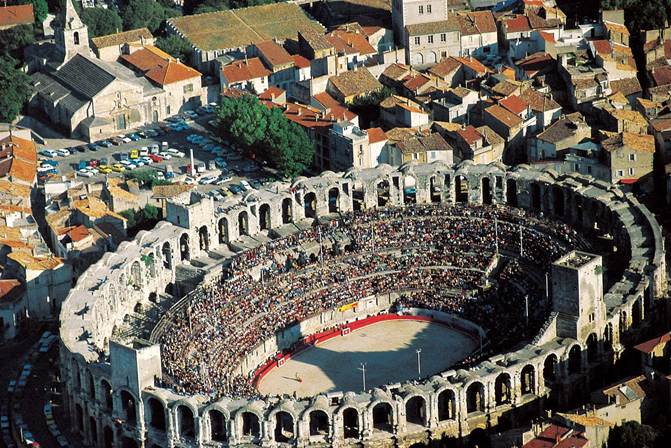
The arena, or more properly the amphitheater, was once the scene of gladiatorial combat. We suppose the 20,000 people that the arena could hold watched wild animals killing innocent civilians. Today, the Arles arena still seats 20,000 people who watch wild toreadors killing innocent animals. Oh, yes, bullfighting is all the rage in current-day Arles. (Remember the townspeople singing “To-re-a-dor-o”? Minus the music, that’s for real.) They also have concerts, and have even staged mock gladiatorial shows. When nothing is going on, visitors can tour the arena, which is better preserved than the Coliseum in Rome.
Nearby is the Roman theater. Alas, it is not as well preserved as the amphitheater but it too is still in use. There were once fine statues surrounding the theater. Their remains are mostly in the Arles Archaeological Museum. The finest of all, the Venus of Arles, has been shipped to Paris and is displayed in the Louvre.
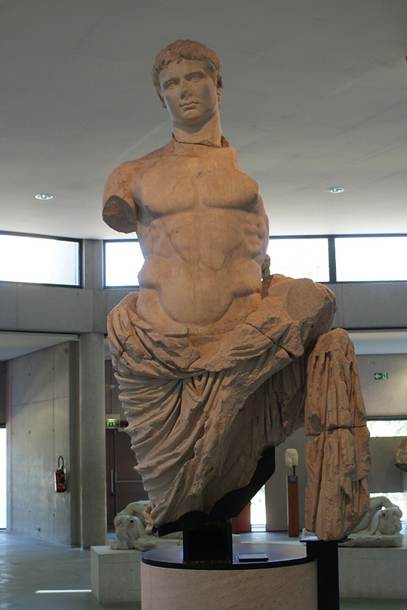
The Archaeological Museum contains a lot of pottery and coins, but also many important artistic pieces that the Romans used to decorate Arles. The best known of these is a 3-meter tall statue of the Emperor Augustus (well, most of him). This one definitely adorned the theater back in the day and gives some idea, just from its sheer scale, of the past grandeur of the theater and of Arles itself.
Of course, there’s a great deal more to Arles than ancient history. As with any French town (or village or city for that matter) there are cafés, shops and parks. Once we saw all the ancient stuff, we stopped for a very pleasant lunch. One little tip: Arles is in the heart of Provence. For those who are interested in shopping for Provençal fabrics, we found that the enterprising street vendors have tablecloths and such of quite high quality and rather reasonable prices.
Arles is on the Rhône river. That means that the vineyards of the Rhône valley aren’t very far away. Arles can serve as a base for wine tasting forays into the countryside or a fine Place to Visit when anyone wants a break from wine tasting.