It Tastes Different

When we go wine tasting, we not only sip.  We buy. Oh, not cases, but a bottle or two where we taste something particularly enjoyable.  If we’re really impressed we join the winery’s club.  Once at home, we put the wine in the rack to let it settle.  We may not get around to opening the bottles for months or even years.
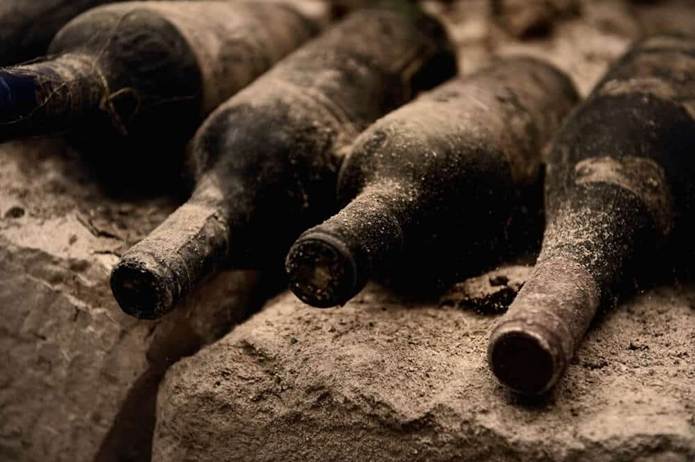
Photo courtesy of Ultra Wine Racks.

And when we do, we often seem to remember that the wine tasted different at the winery.  We don’t have connoisseur-level taste memory, but we do have a sense of what we drank – and liked enough to buy – once before.  What’s in our glass back home somehow just isn’t the same.

Of course, that’s as it should be.  The wine we drank in a tasting room was, for the most part, recently bottled from a vintage at most three years before and more likely only two.  The mere fact that we put the wine down in our “cellar” gave it more time for the tannins to blend in and maybe for some sediment to drop out.  Age alone doesn’t make a wine great, but it does in many but not all instances, change it.  The wines we tend to value the most are the ones that sit longest, so change is expected.

There are other reasons for the difference between what we tasted then and now that are more psychological.  For one thing, it is rare that we buy the first wine we taste at a winery.  That one is likely to be a white, which we purchase and drink less frequently.  But the Sauvignon Blanc they often serve first at a winery primes our taste buds for the Cabernet Sauvignon or Grenache that we care about more greatly.  At home, we don’t often open more than the bottle we are going to have with dinner that night, so we only have the one taste in our mouths.  That doesn’t make it worse, just different.

Generally, that bottle at home is an accompaniment to a meal.  In the tasting room, wine is the star; it’s why we are there in the first place.  But when the bottle shares the table with, say, a roast beef there are several taste experiences vying for our tongues’ attention.  There are times when the wine steals the show, but the experience of that wine is different than it was back where we bought it.

Moreover, the meal that the wine accompanies changes our perception of its taste.  The California Cab or Italian Barolo is going to match up differently with a steak versus a pasta, for two examples.  That’s really a good thing and it’s why some people are so interested in wine pairing.  We’re less picky than other people, but we recognize that some bottles fit better with some meals than others.  The reverse is also true: The choice of food changes our enjoyment of the wine.

So don’t fret if the wine you remember so well from that tasting trip a few years ago isn’t exactly what you thought it would be.  Enjoy it for what it is at the winery and then again for what it is at your dinner table.
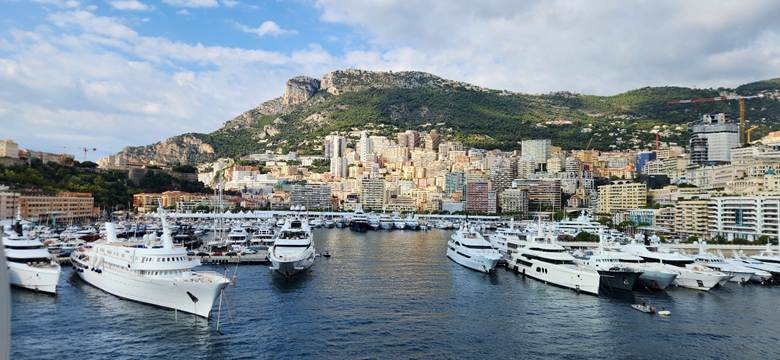
Monte Carlo

They don’t make wine in Monte Carlo, nor in the rest of Monaco as far as we know.  But nestled between Northern Italy and Southern France, there is plenty of winemaking all around it.  Monaco is a tiny enclave that would be relatively unknown if it weren’t for the fact that their prince married a glamorous Hollywood star. That was 70 years ago, and people still haven’t gotten over it.  The cathedral, not one of Europe’s finest, is visited frequently just because they were married there.

Today, Monaco’s lax tax requirements attract superstars of sports, film and finance.  The people who actually work there generally commute from France.

Monte Carlo and its yachts.

For a visitor who would like to do more than gamble, Monte Carlo does have its attractions.  The port is full of eye-popping yachts, undoubtedly owned by the aforementioned tax evaders. We believe a few oligarchs also take advantage of berthing there.  As a typical visitor, all you can do is look and envy for a little while.

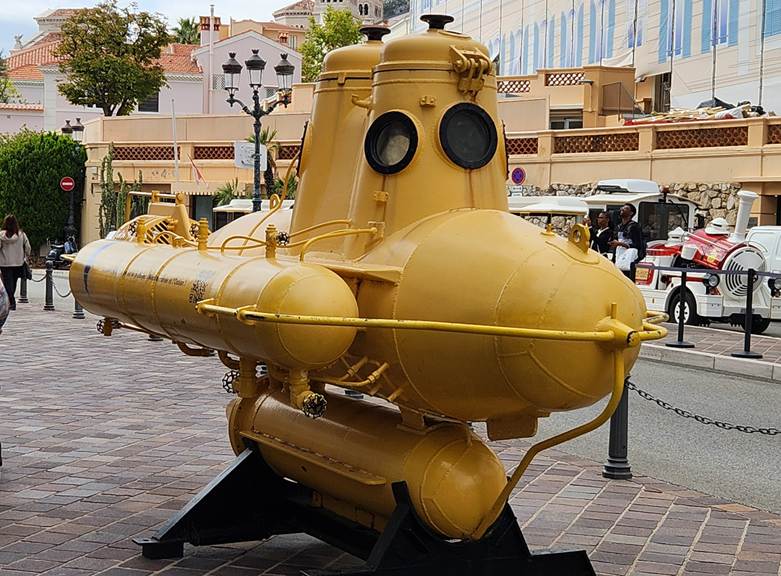
The Yellow Submarine in front of the Monaco Oceanographic Museum.

Monte Carlo is a center of the study of oceanography, dating to 1910 when the then Prince Albert became interested in the oceans and founded the Oceanographic Museum that is still there in an ornate palatial building.  Even if staring at sea-related objects is not your thing, it is worth seeing the building, perched on a cliff over the Mediterranean.  Jacques-Yves Cousteau, famed for his voyages on the Calypso, was director of the museum for more than 30 years.  One fun tidbit for a visitor is the yellow submarine (yes, that Yellow Submarine) in front of the museum.

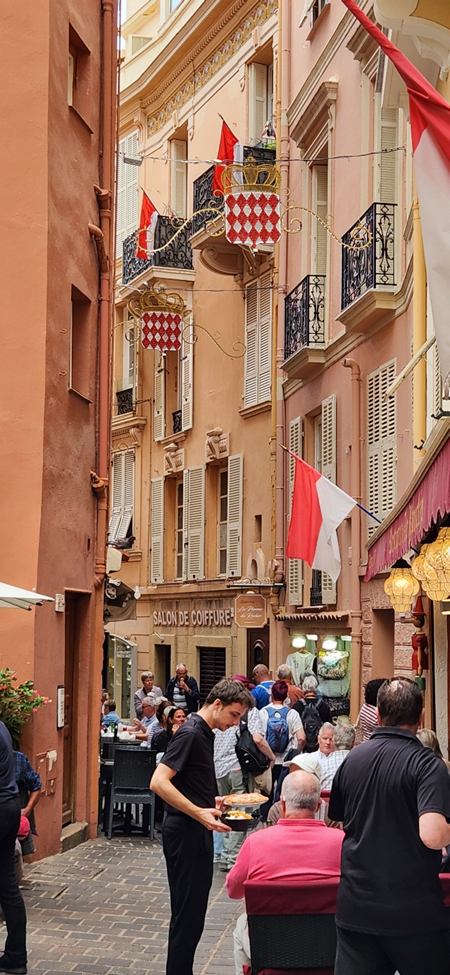
The narrow streets of Vieux Monte Carlo.

We particularly enjoyed the sector called Vieux (“Old”) Monte Carlo.  It is actually the historic town of Monaco, also known as Monaco-Ville or Le Rocher (the “Rock”).  The latter nickname is fairly evident given its perch above the city and sea.  The streets are quite narrow and are festooned with Monegasque flags and the colors of the Grimaldi’s the princely family.  There is pleasure in wandering around, stopping here for a coffee, there for a glass of wine or beer, and dining en plein air at one of the numerous cafés in the sector.

Of course there is the casino.  With gambling legalized in so many US states these days, the thrill of wasting money on the turn of a card is not so rare these days.  But there’s nothing in Las Vegas or Atlantic City to rival the Old World grandeur of the casino in Monte Carlo.  Baccarat has never been our thing, so once we went in and saw the beauty of the gambling den, we left.

Monte Carlo sits athwart the Italian and French Rivieras, which are reason enough to be in this part of the world…to say nothing of the vineyards inland.  If you happen to be in that part of the world, it pays to visit “the Rock”, if only to say you’ve been there.

G&C Lurton Vineyard

We were spending a day tasting wine in the town of Healdsburg in Sonoma County.  We often take a day away from driving through vineyards to take advantage of the tasting rooms (and restaurants) in town.  As we walked along Healdsburg Avenue, the main drag there, we spied an awning advertising the names Ehret and Lurton, obviously a tasting room for two labels just below.

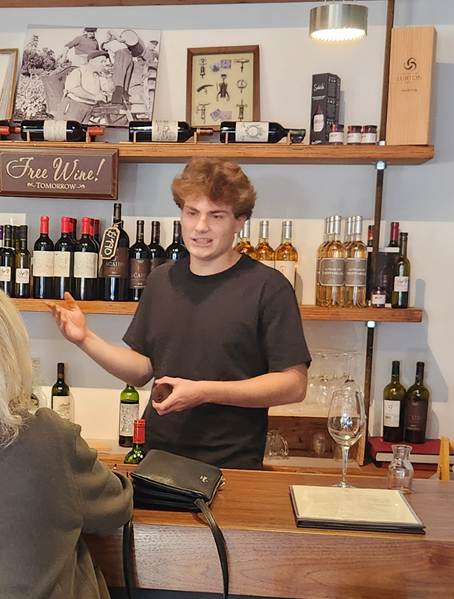
Jean-Joseph explains the wines at Lurton.

Ehret meant nothing to us, but Lurton did (well, might have). G&C Lurton makes some classified wines, specifically Dufort-Vivens, a second growth Margaux and Haut-Bages Liberal, a fifth growth from Pauillac.  Were they actually offering tastes of these notable wines in the heart of California viniculture?  Indeed they do…and more.

The explanation begins back in France.  Gonzague Lurton (the G in G&C) decided to make American wine that would represent a combination of California terroir and Bordelais winemaking skill.  He purchased land in Chalk Hill, just south of Healdsburg, and planted Bordeaux grapes there and called his vineyard Acaibo.  He then decided to open a tasting room featuring his wines from both his growing locations.  Tastings are also available at the vineyard, but we haven’t taken advantage of this.

Gonzague and his wife Claire (who also has a long history in winemaking) induced their nephew, Jean-Joseph Cogombles to work in the tasting room.  Thus it came to pass that we were served both Bordeaux and Sonoma wines by a family member.  Jean-Joseph is a young man who is surely destined for a life in wine; we found his wine knowledge to be at the sommelier level.

The tasting room is spacious, with tables scattered around it.  There is also a bar at the back, and that is where we sat on a slow day (we were the only tasters present) and enjoyed the wines Jean-Jospeh served.  Frankly, we preferred the French wines more, but it wasn’t a fair competition.  Top tier Bordeaux is going to have an advantage over relatively newly planted American vines.

But the contrast was worth exploring.  The Acaibo wine we tried was lush and aggressively forward, as befits a California Bordeaux blend (Cabernet Sauvignon, Cabernet Franc and Merlot).  Let’s say simply that it has potential.  Interestingly, the name Acaibo is a term in the local Native American language for three waters, mirroring the three grapes.

A visit to G&C Lurton in Healdsburg is not a typical Sonoma County tasting experience.  We got to use our French, though Jean-Jospeh speaks clear if accented English.  The opportunity to compare a famed winemaker’s products from two distant parts of Wine Country side by side is unique.  We would certainly return on another trip to Healdsburg.

Oh, and about Ehret.  They’re a Knights Valley winery with a bar of their own at right angles to Lurton’s.  We never got to taste their wines but may on another occasion.

Sète, France

Nestled on the Mediterranean coast between Marseille and France’s Spanish border is a tiny village called Sète.  It is a port for some cruise ships these days, but for the most part it is a simple fishing village with a lot of charm and history.

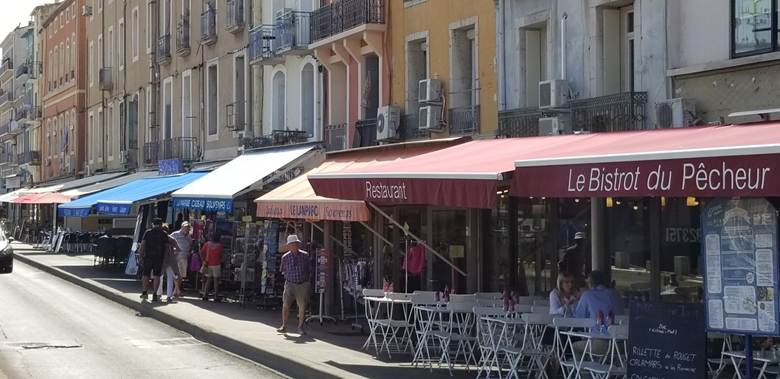
The harbor in Sète.

The Sétois have made their living from the sea from time immemorial.  When you visit, you can’t avoid the sight of fishing boats along the quais in the main harbor.  Nor can you miss all the restaurants that line the street facing the docks.  Each one has a placard out front advertising the fresh fish and seafood that is available within.  Sometimes we choose a cold meal of shellfish pulled from local waters.  Sète is famous for its oysters.  Of course, a warm meal such as a coquille St. Jacques is quite delicious too.

One seafood restaurant after the other.

You’ll want to wash all that marine life down with a white wine.  No, they don’t make wine in Sète.  You’d have to drive a mile or two inland to see the vines.  A local picpoul is not very expensive but tastes just great on a sunny day in the south of France.  And it seems as though every day is sunny in Sète.

Sète was established when the Canal du Midi was built in the 17th century.  Yes, there was a village there in Roman times, but the canal terminates in Sète, so commercial traffic reached the Mediterranean there.  The canal is only used by pleasure boaters these days, but the port remains.  It was a bombing target in World War II.  The famous ship the Exodus left from Sète for Palestine with its weary Jewish survivors as passengers. 

Today, smaller cruise ships make it a port of call.  In part, that’s because of the attractiveness of the town itself.  But also, it’s an entryway into the Languedoc.  The medieval village of Pézenas is less than an hour’s drive away, as is the bustling city of Béziers.  And, oh yes, there is wine tasting nearly everywhere inland.

For fans of French popular music, Sète has a particular attraction.  The singer-songwriter Georges Brassens was born and lived his life there.  His songs express humor, a little sexiness and the heart and soul of France at a difficult time in its history.  Brassen’s love of Sète comes through in many of his songs as well.  Just a bit away from the port there’s a museum dedicated to his life.  It’s a worthwhile visit even if you don’t know Brassens or even like French popular music.  His biography is so intertwined with the village that to know one is to know the other.  At the museum there are many examples of the lives the Sétois lived and of how they think of themselves to the current day.

Sète is a good base for exploring the Languedoc.  If somewhere else in the Languedoc is one’s home base, then Sète makes a fine day trip.  Either way, it’s a small treasure to be cherished.

Barbieri & Kempe Wines

A visit to Barbieri &Kempe can seem like déjà vu.  It can also be a little like double vision.  Let us explain.

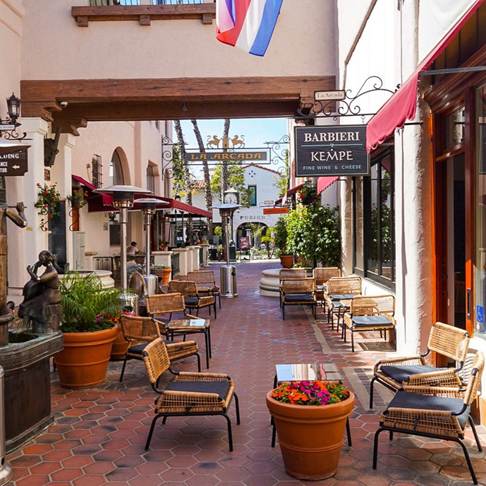
Barbieri & Kempe has taken over the space in downtown Santa Barbara that once housed the tasting room of Sanford Winery.  (They also have a tasting room in Los Olivos, but we haven’t been there.)  Even though Sanford (and now Barbieri & Kempe) were located in a high-end outdoor shopping mall, there was a sense of refinement and exclusivity when Sanford was there.  Barbieri & Kempe brings a different vibe: friendly, inviting visitors to stay a while and enjoy the experience.  Even though the interior is well-appointed, their terrace (with statues of laughing dolphins adding to the atmosphere) beckons to visitors.

The terrace at Barbieri & Kempe. Photo courtesy of Breezit.

Once seated, you find out that the Barbieri & Kempe tasting room isn’t for one winery, but two that share the space.  Then you find out that Paolo Barbieri and Erin Kempe are a couple, with each producing and bottling wines under their own names.    Paolo is also a Master Sommelier and began making wine in his garage.  Erin worked in restaurants and met Paolo that way.  She assisted him in his early winemaking efforts until she gained the confidence to put her own name on wines she produced.  Dinnertime at their house must be interesting: “My wine tonight or yours?”

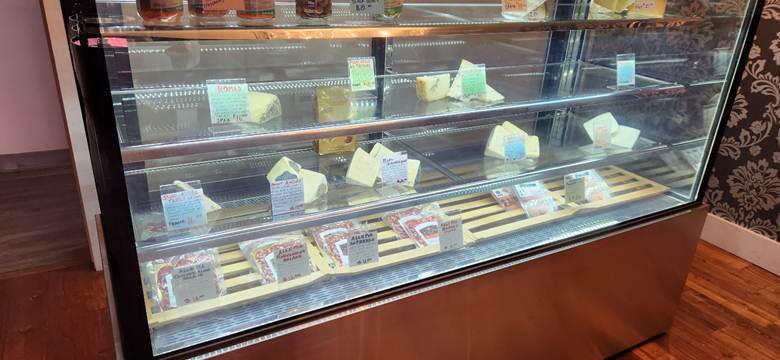
The cheeses at Barbieri and Kempe.

The wine tasting experience is enhanced by the possibility of ordering cheese with your pours.  Barbieri & Kempe is also a cheese chop with a nice selection of California and international cheeses available as a tasting plate or to buy at retail.  Perhaps in recognition of Signor Barbieri’s Italian roots, there are also Italian salamis for sale.

There’s an openness to the way tastings are offered at Barbieri & Kempe that says, “We are what we are and we are where we are.  We hope you like our wines.”    Overall, we did enjoy them, in particular the Grenache-Syrah-Mourvèdre blend from Ms. Kempe and in particular her Illumina Bordeaux blend. In general, they both cover a wide range of varietals.  There is a fair amount of overlap in the grapes each of them uses for their wines, with both of them offering rosés, reds and whites. 

We have often praised in-town tasting.  You miss the sight of the vines, but you spend more time tasting and less time driving.  The atmosphere at Barbieri & Kempe is very urban, with the hubbub of a shopping center and all the passers-by.  Somehow, that seems to add to the experience, not detract.  We found Barbieri & Kempe’s wines enjoyable, if not the most representative of Central Coast wines that we have tasted.  But we at Power Tasting are not wine critics; we comment on the wine tasting experience.  And we enjoyed our time sampling this couple’s wines at their Santa Barbara site.

Good Wine, Good Meals

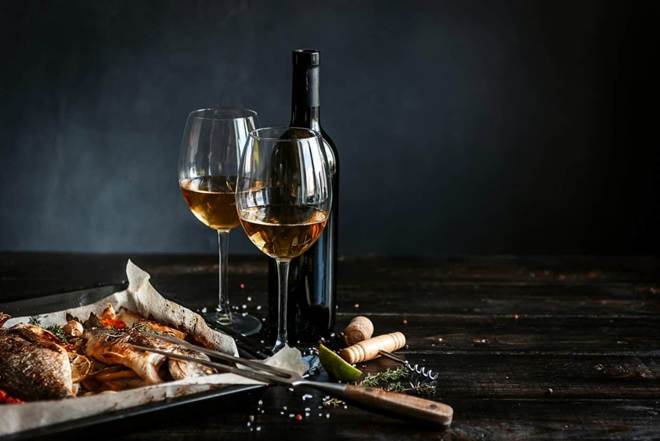
We love wining and dining.  We have found that around the world, where people make good wine, they like to eat well, too.  Robert Mondavi famously said that the good life includes wine, art and food.  So the meals we eat in Wine Country are as important as the wines we taste.  Well, almost as important.

Photo courtesy of Stella Blu.

When we go wine tasting in areas we’re familiar with, it’s difficult to try new places, because we just can’t bear to forego a meal in the places we’ve loved in the past.  In Napa Valley, for example, how could we not have a meal at Mustards?  We remember the quenelles de brochet and boeuf bourguignon at Bistro Jeanty and have to try them again.  We could skip a Thomas Keller restaurant, but why?  Unless we’re staying for a week – and we don’t take trips that long – we seem never to have time for a new restaurant.

It’s a little different when we visit regions we’ve never been to before.  We read up on what the best known restaurants are and make reservations online.  But then we’re in a little village where there’s a bistro that just screams out “Eat here!” in our minds.  So, since most of Europe closes for a few hours at midday, we eat a delicious lunch and don’t have the appetite for the famous places where we had reservations.

There are certain meals that we’ve eaten in this way that are so memorable that we frequently tease our taste buds with reminiscences.  The foie gras in Colombier in Languedoc.  The crêpe filled with mushrooms in Morgon in Beaujolais.  Salad on the beach in Marsala in Sicily.  Lamb shanks in Sainte-Cécile-les-Vignes in Provence.  And on and on.  We’re salivating just writing about these meals.  The lesson is: When faced with temptation to dine at a place you’re never been but looks like you want to, give in and eat.

But fine dining is only a part of the culinary adventure while wine tasting.  Prior shopping at a cheese shop in Burgundy or a salumeria in Tuscany, followed by a picnic at the edge of a vineyard is as great a way to dine as there is in the world.  A stop at Oakville Grocery can accomplish the same thing in Napa Valley.  We used to wash it all down with a bottle of the local wine, but we’ve become a little wiser about our consumption nowadays.  These days, it’s never more than a glass.

There is a time and a place for a burger at McDonald’s, but it’s not when we’re in Wine Country.  Way out in the countryside, it’s usually easier to find a café where the locals go than a fast-fooder.  Dining in the same place as the people who make the wine you’re tasting adds a little understanding of the place that goes along with knowledge of the terroir and the grapes.

So Mangia! Bon appétit! Eat up!

Asking Questions

A major part of Power Tasting’s mission is to empower wine tasters from being intimidated when they visit wineries.  For some people we’ve met, the most intimidating aspect of wine tasting is asking questions of their servers about the wines they’re being served (and the ones they’re not being served), winemaking practices, the vineyards and so many other topics that make the study of wine so interesting.  Some are fearful of seeming ignorant and, at the other extreme, of sounding too snobbish.  But how are you to learn without asking for more information?

Photo courtesy of Metro Wines Asheville.

So here are a few tips on how to ask questions at a winery.

  • Age is a factor, as is the question.  It’s really a matter of context.  A young adult, just of legal age to consume alcohol, can ask very basic questions without worry.  If that person asks, “What makes some wine red and others white”, any server with a conscience should give a simple but thorough answer. An older person might get a sidewise glance!   There are things that a 21-year old can do that a 41-year old can’t.  But you already knew that.
  • Only ask questions to gain information you don’t have.  If the intent is to show off how much you already know about wine, you’d be better off being quiet.  After all, who are you trying to impress?  The server?  Your companion?  People at the next table?  They don’t care that you have a diploma from some wine academy and, if you don’t have a certificate, why would you act like that?
  • Ask questions that will add to your appreciation of the wines you are tasting.  For example, it’s legitimate to ask what grapes were used to make a certain wine.  Also, we frequently ask about the percentage of alcohol.  Even if it’s well-balanced and not a “hot” wine, we sip less of a wine that’s 15% plus than of a Champagne, say, that’s only 12%.
  • If you are considering joining the winery’s club, ask a lot of questions.  It’s quite fair to ask how many shipments there will be, about the shipping cost, whether you can customize the selection and, of course, how much the annual shipments will cost.  After all, you are thinking about making a commitment that will cost hundreds of dollars, if not more.  It’s always a good idea to know what you’re buying.
  • It depends on how busy the server is.  When everyone tasted standing at the bar, it was easy to see how much work your server had to do.  Now, when so many wine tastings are seated affairs, you might think your server is dedicated just to you, but he or she has other people to pour for.  So if the server seems to be rushing from one table to another, it’s only fair to minimize your questioning.  That’s not to say you can’t ask, but you might not get all the information you’d like.

Old and New

Some of our wine tasting trips are certain to be full of novelty.  That’s because we are visiting winemaking regions where we’ve never been before.  Most recently for us, that was our travel to Penedes in Spain, as reported in a previous issue of Power Tasting.  But mostly, we return year after year to certain areas in California, New York and France.  (Even the great Robert Parker specialized.)  Every time we go wine tasting, we face the same dilemma: Do we re-visit old favorites or do we find wineries that we’ve never been to before.

There are several attractions to going back where we have been before.  For one, we like to stop in at wineries where we are members of their clubs.  Tastings are free for us at these tasting rooms, which is appealing in these days of high-priced degustations.  But just as important, we know that we are going to have wines we enjoy.  How do we know?  Because those wines are waiting for us back at home.

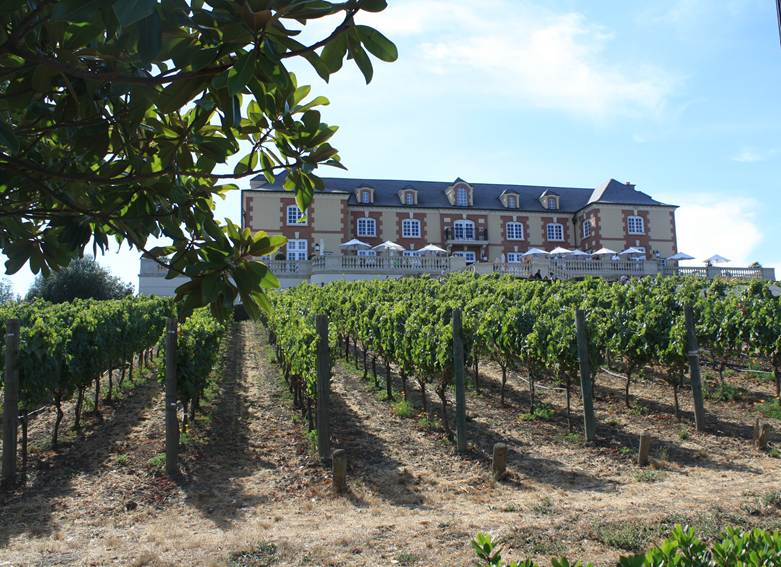
Domaine Carneros in Napa Valley, known for its sparkling wines, but where we prefer their Pinot Noirs.

Then why go out of our way to taste those wines?  Because we never get to taste them side by side.  We recently visited a winery where we regularly buy Pinot Noir as club members.  Tasting each of the wines one after the other, sip at a time, we discovered nuances in wines we knew we liked that weren’t apparent to us before.  We also found a Pinot Noir on their list that we hadn’t previously tried and realized that we really liked it.

Beyond the wines, we know that as members of the club, we will receive an especially warm welcome.  In many instances, we have known the servers and staff for years.  Even those we don’t know seem to go out of their way to give a better explanation of what they pour and maybe find a little something that isn’t generally served to the general public.

On the other hand, we experience a special excitement when we discover a winery we hadn’t heard of before.  There’s a sense of “Where have you been all my wine tasting life?”  In areas we know well, we may have driven past that winery for years, only happening to stop by on one trip. Finding a wine or two that we truly enjoy is like getting a birthday present when it isn’t our birthday.

It is also a unique experience when we visit a famous winery in the US or abroad that we had only read about before.  There is a feeling we get when tasting wine made by a French aristocrat in his château, that can’t be replicated elsewhere.  That’s a real château, not a faked-up Napa palace!  And if the wine has been known to be great since 1855, so much the better.

There is an old expression, “New friends are like silver; old friends are like gold.”  This applies to wine tasting as well.  We’ll keep our old favorites and visit them again and again.  But we’ll continue to seek out new wines and tasting experiences as well.

Revisit: Dry Creek Vineyard

In this issue at the start of 2026, Power Tasting begins a new feature that we are calling Revisits.  There has been so much change in the wine tasting experience in recent years, largely spurred by the pandemic.  The great majority of wine tastings are by reservation only and are sit-down affairs.  In some wineries, this has been a positive improvement.  In others it has taken away from the overall experience.  Power Tasting will continue to review wineries as we discover them, anywhere in the world.  But now we will report on ones we have reviewed in the past as well.

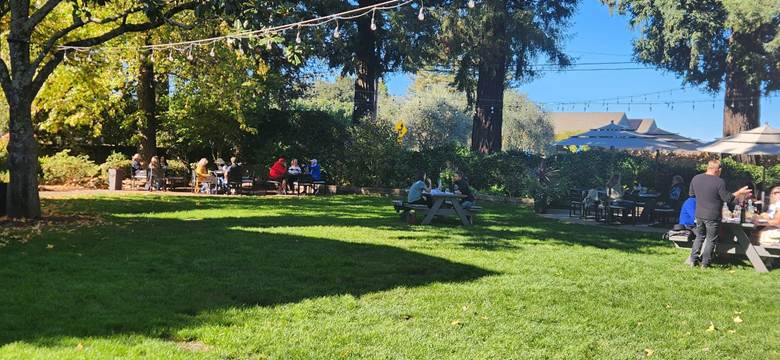
There is very little evident change in visiting Dry Creek Vineyard, where we have been stopping for decades, as well as being club members.  The spacious lawn, with it picnicking facilities is still there, under the same spreading trees that somehow always seem to have leaves, no matter the season.  With the Dry Creek General Store just up the road, we often take advantage of the picnic tables with the lunches we’ve brought with us. Oh, yes, and with a glass of wine to wash them down.

The building housing the tasting room is still a vine-covered stone building, though maybe the vines have spread a little further up the walls.

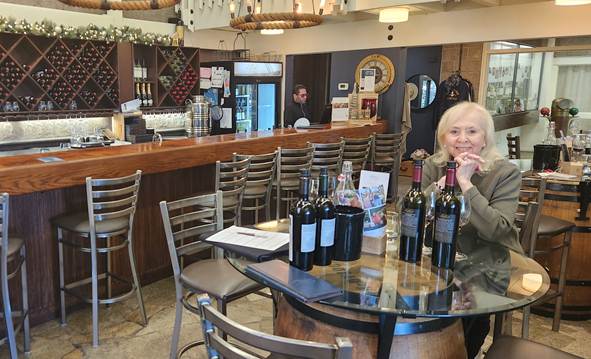
The tasting room also is little changed, except that instead of standing at the bar, visitors can sit on stools at the bar or at tables made of a glass top on a wine barrel.  We always found the servers to be knowledgeable about Dry Creek’s wines and that hasn’t changed.

Also unchanged is the huge selection of quality wines.  Where else could one person do a tasting of only Zinfandels and another only of Bordeaux varietals.  As club members, we are familiar with most of them, but rarely get to try them side-by-side. And yes, we still prefer the Wallace Ranch Zin and the Endeavor Bordeaux blend.

There is still a nautical theme to the tasting room, which is somewhat discordant in a place surrounded by vines and 20 miles from the Pacific.  But it’s pretty.

Yes they do ask for reservations, but we’re pretty sure they could accommodate small parties at all times.  So all in all, if you enjoyed Dry Creek in the past, you won’t find much difference.  And if you haven’t tasted wine at Dry Creek, it’s very much worth your while to stop by.

When a Winery Changes

In these on-line pages, we have from time to time bemoaned the loss of a winery or the decision by some winemakers to discontinue making wines we used to love.  This past year has seen a number of winery closures in California, notably including Paraduxx and Newton in Napa Valley.  (Fortunately, new owners bought Newton and are re-opening it.  Still, this is another example of change in Wine Country.)

For the wine tasting visitor, these losses – and to be fair, additions as well – are not novel events.  Wine production has been changing as long as wine has been made.  We can imagine some ancient Roman bemoaning that he couldn’t get his favorite wine from Pompeii anymore.  But it does seem that the pace has picked up in recent years, driven by changes in wine drinkers’ tastes and the decline in sales of alcoholic beverages overall.

Photo courtesy of Cellar Tracker.

So how should you adapt to all this alteration, transformation and shift in the wineries they come to visit and taste?

  • Buy up what’s still available.  The fact that a winery has chosen not to make a particular wine indicates that that particular label didn’t sell very well.  Yes, you loved it but not enough other people did (or at least not at that price) to make it economically feasible to continue making it.  For that reason, there may be a lot left in inventory.  When you visit the winery only to find that wine not on the list, just ask if you can still buy some.  If so, take advantage of the winery’s misfortune while there’s still time and buy, buy, buy.
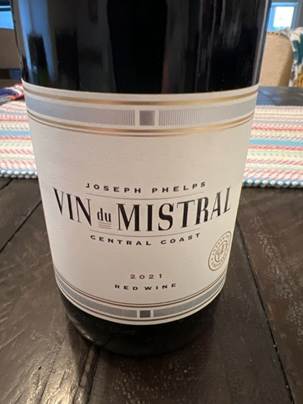
  • The wine may come back.  We remember when Joseph Phelps stopped making their Rhône blend, Vin du Mistral.  It was one of our favorites and then, in 2021, they made it again for one vintage.  Let’s hope that enough tasters ask for it at their St. Helena tasting room that they’ll bring it back again.
  • Find out why the changes occurred.  There may be other reasons why a certain wine may not be available, beyond market conditions.  There may be new ownership or a new winemaker.  If this is the case, the name on the label may be the same name but it is no longer the same winery.  In most cases though, the vineyard is still there, growing the same grapes.  It may be a good idea to shrug off the differences in winemaking philosophy and see what the new winemaking team can do with what you were familiar with.
  • Embrace change.  Remember that every wine changes, from harvest to harvest and over time due to global warming, among other reasons.  That’s one of the reasons to go wine tasting at all, to find novelty and development in the wines of a region that you’re already familiar with.  For example, we often bought a premium Merlot from a Sonoma County winery.  They decided to rip out the vines and plant Zinfandel instead.  We regret that we’ll never taste that Merlot again, but we buy a whole lot of their Zins these days.
  • Get over it.  Nothing lasts forever, especially not wine.