Here’s to the Wines of Yesteryear

In our youth, most people we knew who did drink didn’t drink wine.  Oh, there would be an occasional bottle on a special occasion, but the alcoholic beverages of choice in those days were whisky and beer.  Many of us were the first in our families who took wine seriously, both as an accompaniment to a meal and as a drink that would give unique pleasure on its own.

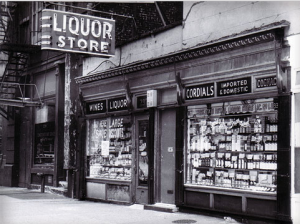
So what were we drinking back then?  By our current standards, it wasn’t very good.  For one thing, we were students and we didn’t have much money.  Even if a Mouton Rothschild could be had for around ten dollars, that was a lot for a starving scholar then.  Also, there weren’t as many wine stores such as we see today; there were liquor stores with a few bottles of red and a few bottles of white somewhere in the back.  (It was a little better if you lived in an area with Italian, French or Spanish immigrants, but not a lot better.)

liquor-store

Photo courtesy of J. Crew

If you were anything like us, the first wine you actually went into a store and bought for yourself was one of these: Lancers, Mateus, Mouton-Cadet or Gallo Hearty Burgundy.  All these wines are still available for purchase.  (One of the reasons for buying Lancers was that it came in a nice clay bottle that you could use as a vase, so it maybe doesn’t count as a wine, but let’s include it.)

Lancers was and is a light bodied rosé from Portugal.  Amazingly, it is produced by the great port house, Fonseca.  It was created for American tastes and it succeeded quite well in that regard.  Described as “moderately sweet” on the Fonseca web site, it tastes pretty sweet to us.

Its competitor for American attention was Mateus, which some of us pronounced mat-OOS and those affecting a European elegance said ma-TAY-us.  We don’t think anyone knows to this day.  It’s also Portuguese, sweet, comes in a pretty, mandolin-shaped bottle and was impressive to bring on a date.  It showed you were too cool for Lancers, which after all had an English name.

But what could be better than a French name, and that of a French baron no less?  Mouton Cadet was originally the name that the French branch of the renowned Rothschild family gave to wines it didn’t think were worthy of being called “real” Mouton.  By the time we were buying it, Mouton Cadet had morphed into a thin, acidic, mass produced wine.  But we liked it.  Just perfect for anyone who knew nothing about wine…and that was us.  By the way, these days it’s not bad for the price.

Finally, Gallo Hearty Burgundy was, as Gallo calls it today, their “original red blend” which of course had nothing to do with Pinot Noir from the east of France.  But it tasted pretty good and showed your fraternity brothers that you were above (sneer) mere beer.  You probably can’t do much better even today for six bucks.

Other than a nice walk down memory lane, what’s the relevance to today’s wine tasters of even moderately good taste?  These wines are where we got our start.  Even if they weren’t very serious wines, we took them seriously.  If we’re honest with ourselves, we liked them back then although we couldn’t have said why.  They brought a little glamor and sophistication into our lives and opened some horizons as to how people lived across the ocean or the continent.

In short, these wines of yesteryear were the first steps that led us to wineries in Napa Valley, Tuscany, Bordeaux and numerous other outposts in Wine Country.  Sure, we can look down our oh, so elegant noses at those bottles we wouldn’t think of buying today.  But consider: there’s probably some wine you like today that won’t be as appealing to you in a few years.  Our tastes grow and change, and they had to start somewhere.

Tasting at Harvest Time

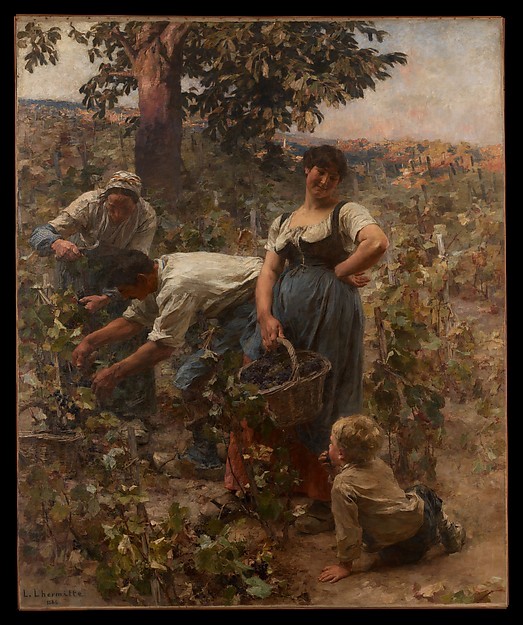
September is a wonderful time of year to go wine tasting.  Wine is necessarily grown in warm climates, and by September the heat has slackened a bit so it’s more comfortable to pass through the vineyards.  And even better you’re there to watch the process of transforming agriculture into art: harvesting grapes, pressing them and turning them into wine.  There’s something romantic about watching grapes being picked, placed in baskets and walked over to nearby trucks that will soon be piled high heading to the press pads.

lhermiteLéon-Augustin L’Hermitte, the Grape Harvest, courtesy of the Metropolitan Museum of Art

September is a terrible time to go wine tasting.  There is a constant threat of rain.  The roads that were never too easy to travel at the best of times are packed with trucks that are heading, full of grapes, to the wineries.  Even worse, you get to be a witness to the transformation of art into industry, turning nature’s bounty into a factory product.  If you get there on the right day, you might still be able to see vines with great clusters hanging from them.  A day later and the vines are bare.  And all you can see as you watch the grapes being harvested are ill-treated migrant farm workers.

img_2561The crush at Saintsbury winery

Okay, you must be asking, which is it?  Is harvest time a good time to go to Wine Country or not.  And the answer, of course, is both.  (If you’re going wine tasting in Australia, Chile, Argentina or South Africa, harvest is likely to be in February or March, but let’s keep this simple.)

For personal and business reasons, we often travel in September and our voyages almost always include wine tasting.  This works better in especially hot years; the 2014 harvest in Northern California began in July in some vineyards.  Thank you, global warming.  August is the usual time to pick grapes in much of Italy.  So we have experienced all the positives and negatives of the vendange, as the French would put it.

The biggest question is how does the time of year affect the wine tasting experience.  If you’re traveling in an area where the wineries you’d like to visit are large, well-funded and likely to derive significant revenue from vinotourism, your wine tasting experience should be only minimally affected.  They have lots of bottles on hand and the tasting room employees are servers, unlikely to be in the fields filling baskets.  But you may not find all the wines you’d like to taste because they have all been previously consumed.  Worst of all, you may find that some wineries are closed, because they have sold out the previous year’s wines and haven’t made this year’s yet.  We encountered this in California’s Central Coast at Linne Calodo and Booker wineries in 2011.  So call before you go.

In areas where the wineries are all or mostly small family affairs, you are indeed more likely to find the doors locked while moms, dads, kids and cousins are out in the vineyards bringing in the crops.   This recently occurred when we were out tasting in Beaujolais.  “Desolé, monsieur” a somewhat grimy teenager would shrug.  The only choice left to us was to taste the wines served in the local cooperatives.  These are open in all seasons and you do get a good education about the grapes and winemaking practices of the area.  Unfortunately, the wines most of them pour are good but hardly representative of the quality that attracted you to that region of Wine Country to begin with.

Should you go wine tasting at harvest time?  Yes, you should, because you should experience all the seasons that pass through Wine Country.  Each month has its attractions and drawbacks, so there’s no perfect time of year.  All the same, if you are new to the fun of wine tasting, it might be better to hold off on being a “part” of the crush until you know better what you are likely to get.

Vineyard Beauty

Something there is that loves a vine.

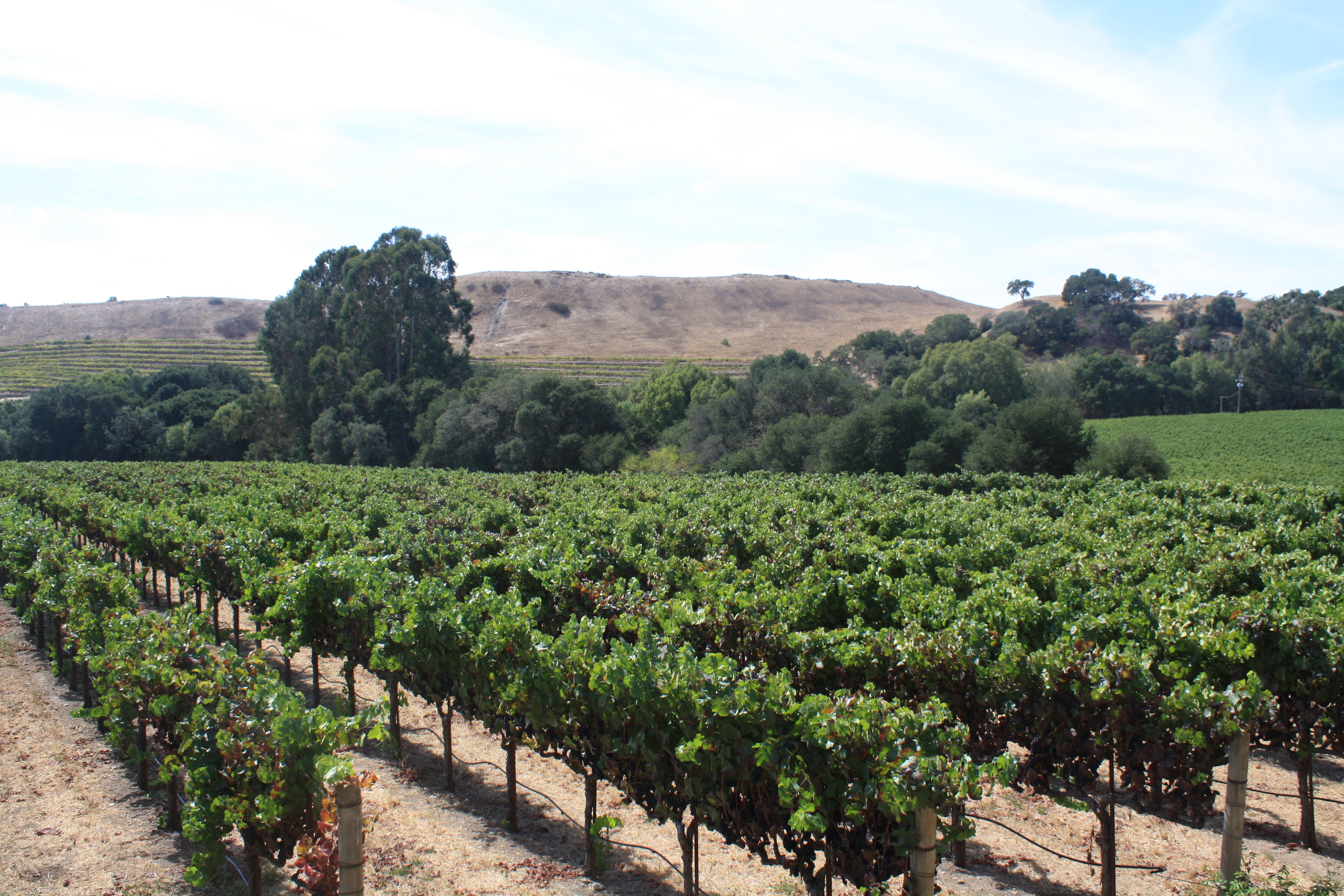
As we have traveled throughout Wine Country, around the world, we always feel a little thrill when we see vineyards.  As we’re driving closer to grape-growing areas, the first to spot some vines growing in the distance will point them out and both our hearts will expand a little in our chests.  The sight of the orderly rows of grape vines marching in orderly rows across a valley or a hillside, like an army of benevolent green soldiers.   Seeing the vineyards adds enormously, for us, to the pleasure of going wine tasting.

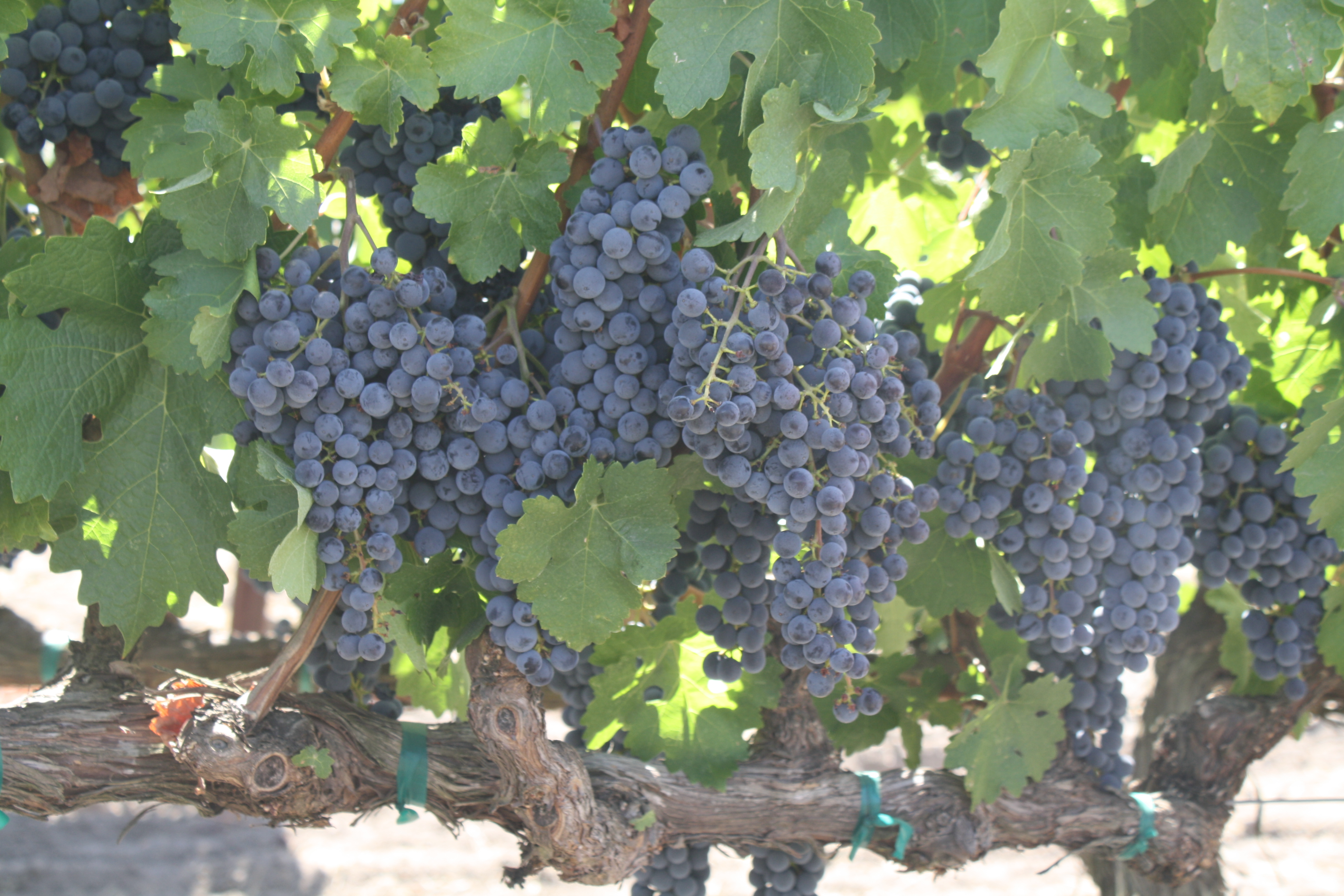
The beauty is even more enticing in harvest season, when the leaves are pruned back and the ripe fruit is hanging from the vines.  (Don’t tell anyone, but we have been known to sneak up on some unsuspecting vines and taken a few grapes.  There’s nothing like the sweetness of these grapes just before they are turned into wine.)  It is hard to count the number of photos we have of big, juicy clusters just hours before the crush.

img_2415Chimney Rock Cabernet Sauvignon, almost ready to pick

What is it about the vines?  We are no farmers although we have read a few books about the agricultural aspects of wine production.  Of trellises, pruning and irrigation we know virtually nothing, so we bring only the amateur’s eyes to our visits.  All we can says is that looking at the sun glistening off seemingly endless rows of vines gives us a jolt of joy.

img_2364

By way of comparison, there are times when we go wine tasting and don’t see vines at all.  In some cases, that’s because we might be visiting tasting rooms in a town.  This is mostly the case in California where wineries that cannot afford to build a palatial “visitors center” take a storefront in, say, Paso Robles, Calistoga or Healdsburg.  (See our previous article on tasting in Napa Town.)  There is a certain charm to wandering from one winery’s offerings to another and another.  There is also the advantage of not having to get behind the wheel of a car, if we are staying in that town.  And while it was once the case that only subpar wineries had in-town tasting rooms, that is not universally the case anymore.  But without the sight of vineyards just outside, there is definitely the sense that something is missing.

That sensation is certainly multiplied when the wineries are far from the fields and the tasting rooms are in the industrial buildings where trucked-in grapes are crushed and aged.  The total dissociation of wine from nature, no matter how good the wine is, leaves a rather empty feeling inside us.

And that is really the point: Wine tasting at its best combines product and place.  You just cannot really understand Burgundy, in our opinion, unless you’ve seen Burgundy.  Of course, the same applies to all of Wine Country.  Wine tasting should engage all the senses, not just taste and smell, and the emotional attachment to the land is a factor in the passion for wine that almost every winemaker speaks of.  Call it terroir, if you please, but actually seeing the soil and the sky and the vines where the stuff in the bottle actually come from adds enormously to the pleasure of the experience of wine tasting.

BYOB

Let’s say that you’re in some wonderful sector of Wine Country and all day long you’ve been tasting fabulous wines.  If you’ve taken our advice, you’ve selected only the best wines to sip even if you had to pay a little more for the experience.  At the better wineries, you could be enjoying a pour from bottles that go for a hundred dollars or in some instances, several hundred.

Then you go to dinner.

Remember that wine you liked so much this afternoon.  Well, with the restaurant’s markup, that could make the price of drinking it with your meal unaffordably high.  But there is a way around it: bring your own bottle.  Remember, most restaurants charge a corkage fee if you bring a bottle with you.  It could be as little as $10 per bottle or as high as $25.

But look at it this way.  Restaurants mark up their wines between twice and three times the retail price.  So if for example you loved a $75 wine, you might expect to pay $150 to $225 for this wine to accompany your meal.  If you bring it with you, it would cost you only $100.  Now, “only” is a relative term, but it certainly is cheaper than the price on the wine list.

If this is your plan, it could change the way you approach wine tasting during the day.  If you know the restaurant at which you plan to dine that evening, call them and find out their corkage policy and fees.  You might even ask what the specials of the day will be.  Then go wine tasting with your dinner in mind.

Perhaps you’re planning on having a steak, a big, luscious steak.  A Cabernet Sauvignon would be just the right wine to drink with it.  And luckily enough, you’re in Napa Valley or Sonoma County (or Bordeaux or Chile)  where they just happen to be famous for big, luscious Cabernet Sauvignons.  As you go through the day, try the Cabernets that would fit your budget with the corkage fee added.  When you’ve found the perfect wine, buy it and take it with you to dinner.

Of course, you might taste several “perfect” wines while you’re visiting the wineries.  If you’re thinking of buying one for your evening meal, it’s a good idea to take a few notes as you go along and then decide which one is most to your liking or fits best with your dinner plans.  You can then go back the winery where you tasted that wine and buy a bottle.

Here’s a little tip that will make bringing your wine even more attractive.  Many restaurants, even some of the best, don’t charge corkage at all.  They may place some restrictions on that policy.  For example, Dry Creek Kitchen in Healdsburg only extends the no-corkage policy to wines made in Sonoma County.  That still gives you a lot of room for maneuver.  Another California restaurant with a no-corkage policy is Hurley’s in Yountville.  We especially appreciate that the sommelier there gives extra attention to wines that are more than ten years old, because they and their corks can be a little more delicate.

There may be other restrictions, such as only certain nights when corkage is waived or a requirement that you buy one bottle off the list before they waive the corkage on the one you bring with you.  A little advance planning pays off.  There are lists on the web, but we’re not vouching for their accuracy.  A few simple phone calls are the best bet.

Meeting the Winemaker

As we state on our front page, Power Tasting is not about wine as such, but about visiting Wine Country.  We offer advice to travelers, not connoisseurs.  The people we generally talk with when we go visiting are servers and tasting room managers, not winemakers.  Still, over the years we have had the occasion to meet many winemakers who just happened to be in the tasting room while we were there.

Perhaps our warmest memory was meeting two generations of the Charavin family at their winery in Rasteau, Domaine des Coteaux de Travers (www.coteaux-des-travers.com/index.php/en).  We were already familiar with their wines and made a point of visiting them.  The winery had only a simple bar in front of the production area.  The young woman who served us was the both the wife of the present winemaker and the daughter of the family that had owned the estate in previous years.  While we were talking with her, her father-in-law, Robert Charavin stopped by and we learned a bit more about the history of the winery.  And then his son, also named Robert, came by in his mud-covered boots.  They were all excited to meet Americans who loved their wines, but not as excited as were to meet them.  It was a unique and educational experience.

Also in the Rhone Valley, we visited Chateauneuf du Pape, an area famed for its hearty and expressive red wines.  Traveling through the sector, we stopped at a winery we had been told was up-and-coming, Domaine Paul Autard (www.paulautard.com, in French).  The woman serving us recognized that our accents were from North America and when we asked a few questions decided to introduce us to the winemaker, that is, her husband Jean-Paul Autard.  He explained that his father, Paul, had started the winery and that he was setting about to create world-quality wines.  We discussed his trips to New York, invited him to call us when he was there the next time (he never did) and he gave us a nice corkscrew that we use to this day.

autard

Jean-Paul Autard (Photo courtesy of Domaine Paul Autard)

One more story.  We have been drinking the wines of David Cofaro for quite some time and visit his winery often.  We’ve gotten to know him and his wife Pat a bit over the years.  In 2015, we got to meet his new assistant winemaker, Josh.  He’s an earnest and thoughtful young man who has some great ideas about how he could improve wines we already thought were pretty terrific.

In all three of these stories, there’s a common element.  There’s more to wine than barrels and terroir.  There are the people and the way they think about wine, their personal histories, their way of approaching what they do for a living with passion and intelligence.  We are not oenologists or critics, so our interactions with winemakers is necessarily irregular.  But when we do get the chance, it adds enormously to our understanding or wine and to the pleasure we get going wine tasting.

Old Times in California #2 – Napa Valley Under Water

In these days of drought, it’s hard to believe that not that long ago the issue facing winery owners was too much rain, rather than not enough.  Beginning on January 8, 1995 there was heavy rainfall in Napa and Sonoma counties, causing the Russian River and the Napa River to overflow their banks.    This had a major impact on tourism as many likely visitors were scared away.  It was not as much of a crisis as it would have been in the summer or at harvest-time, but news reports were pretty frightening anyway: 500 people displaced; roads closed for as much as two days; lost sales for those vintners who only sold at their wineries.

In the midst of all this, Steve was to attend a major conference in his field (that is, information security, which he does when he’s not tasting wine).  The conference was in San Francisco.  Not only that, but his boss was planning to attend with him.  The boss knew that Steve had visited Napa Valley often and suggested that they get to San Francisco a few days before the conference and go wine tasting.  This is how Steve became a chauffeur and sommelier for his manager and said manager’s girlfriend, who came along as well.

Now the relationship among the three was quite cordial but it’s never a good idea to get one’s boss stuck on a road that has been flooded out.  Keep in mind that many well-known wineries had closed in deference to the rising waters.  The Napa River had crested just north of Yountville and the Yountville Cross Road, one of the Valley’s major east-west thoroughfares had been washed out.  That meant that several wineries were difficult to reach and a few were inaccessible altogether.  Steve well remembers pulling up to the old Silver Oak winery, north of the worst inundation, only to find the doors boarded up with sandbags outside.

So it took some maneuvering to find roads that were dry and wineries that were open.  Cell phones weren’t common in those days, so there was no chance of calling ahead and asking if anyone was serving wine that day.  Steve’s manager was busily studying a map, but Steve had been around the region often enough that he was able to stick to the relatively higher Silverado Trail and then make excursions onto the crossing roads that appeared open.  He also had a good enough mental picture of Napa Valley, simpler in that bygone era, to know where the better wineries were.  Or at least he thought he did, which is nearly the same thing.  He just pulled onto a road, found an open winery and pretended that was where he was heading all along.

Now there are some lessons to be learned from all this.  First, while we don’t recommend visiting Wine Country when there’s a major flood, there is a lot to be said for going wine tasting in rainy or cold weather (which we have done several times since).  There are no crowds – heck, there’s almost nobody there – and wine servers can be much more attentive and maybe offer you something they would not consider serving in better times.

Second, wine tasting has become a major tourism industry.  Of course, there would be no tourists if there were no wine, but Napa Valley in particular has been described as Disneyland for adults.  However, the infrastructure is still farm land.  You may not even realize how congested it is until you see Wine Country with nobody in it.

And finally, that visit helped create a better relationship with Steve’s boss, not that it was bad to begin with.  Still, like fishermen who can talk for hours about the big one that got away, Steve and his manager were able to tell increasingly harrowing stories about tasting wine in the face of surging flood waters.

When Napa Flies to New York City

We are member of a few California wine clubs that we visit once a year, but when one of our clubs visits us in New York, that’s special!

Etude Wines, together with their sister wineries Stags’ Leap, Beringer and Chateau St. Jean, was taking a road trip to New York in May. We were invited as club members of Etude, one of our favorite Pinot Noirs in the Napa Valley.  The tasting was held in two private rooms of a steakhouse restaurant in Manhattan, giving us a wonderful opportunity to go to a wine tasting of Napa Valley wines in New York City, without taking a flight.

Each winery was offering the best of their current releases and of winery-exclusives as they call them, which means their top wines.  Etude was serving our favorite Pinot Noir “Heirloom” and their 2012 Rutherford Cabernet Sauvignon (Etude wines have won many awards).  Beringer had their 2012 Steinhauer Cabernet Sauvignon and the 2012 Private Reserve Cabernet. Over the years, Beringer has had more placements on Wine Spectator’s Top 100 list than any other winery in the world, Stags’ Leap was pouring an amazing rosé “Amparo” and the wine they are best known for, their Ne Cede Malis Petite Sirah, Chateau St. Jean had their famous 2012 Cinq Cépages.  And all of them were offering tastes, as many as you wanted!

Although all of them served a variety of wines, leaning more to red than white, each one had different leading wines: pure Cabernet Sauvignons, a Bordeaux blend, a Pinot Noir, a rosé and a Petite Sirah. This gave the attendees a chance to sample some outstanding examples of different wines, with some degree of overlap for comparison’s sake.  Keeping in mind that all the wines offered were top-flight, this was a fascinating treat for the taste buds.

Now the food pairing…. oysters, shrimps, clams, sliced filet mignon on bread, etc.  It was a fantastic idea to hold the wine tasting in a steakhouse and have the opportunity to have a food paring with those wonderful wines.  Some of them are big wines, steak wines, and the Pinot Noir that pair so well with seafood.

Some wineries were represented by their Wine Club “Ambassador”, as they call the person in charge of the wine clubs, so it was an opportunity for them to reach to their sisters’ winery club members and get them into their clubs, but for us a chance to meet those representatives and have a chat about their wines and clubs.

What a memorable wine tasting experience!  Another advantage of being member of wine clubs.

Chalk Hill Road

The reason to go wine tasting is to taste wine.  Well, yeah, but it’s not the only reason.  For one thing, there’s the scenery.  We have found that virtually any place where grapes are grown for wine is beautiful, with rows of vines arrayed across a field or a hillside.  For us city-dwellers, the only way we’re going to see these sights is to drive there.  And not all roads are created equal.

Some are just ways to get from one grape-growing region to another.  Highway 101, which runs through Sonoma County, is one of these.  So is the Long island Expressway, which takes you to the North Fork vineyards.  Others are the main roads that have numerous wineries on either side.  The sight of one famous establishment after the other can be quite thrilling, like a wine shop with buildings instead of shelves.  Napa Valley’s Route 29 is such a road as is the Route du Vin in Burgundy’s Cote d’Or.  If you are a fan of going wine tasting, as we are, you will definitely take these roads one day.

And then there are the roads that are, in themselves, destinations.  They’re just gorgeous, aesthetic experiences when you’re there.  It’s good to know that there are wineries and vineyards nearby but these roads are worth driving on just for the experience of seeing them.   One that we particularly like is Chalk Hill Road in Sonoma.  Assuming you are coming from the aforementioned Route 101, take the Old Redwood Highway exit on the east side and go a short distance to Pleasant Avenue.  Shortly thereafter, turn left on Chalk Hill Road.

The road goes from Route 101 to Route 128, which will take you either to Knights Valley to the south or Alexander Valley to the north.  There are wineries along the way to visit, but not many.  They include some of Sonoma’s finest, including the eponymous Chalk Hill, Verité, and Lancaster.  The drive will take you through forests, fields and hills, with virtually no houses or even wineries that you can see from the road.  There are horses in some of those fields who like to take a run every now and again.  It being California, the hills are usually a light tan, with clumps of trees and greenery to color the view.

 chalkhill1  chalkhill2

Pictures don’t do Chalk Hill Road any justice.  You need to see the dappling of shadow and sunlight as you drive along, feel the peacefulness of a country road with hardly any other drivers on it, hear the sound of nothing more than your car…which almost but not quite spoils it.

We recommend that you make your way there on a visit to Sonoma.  You won’t be disappointed by the wines you try (although you may be horrified by the tasting fees) and you will feel that you’ve gotten more than wine from Wine Country.

Living Large in Oregon

For us, wine tasting is fairly rudimentary: rent a car, drive to the wineries, go from place to place sampling as much as we feel like with ample prudence, then drive back to wherever we started the day.  We watch tourists pour off of buses with snobbish scorn: “What do they know about wine?”  Even worse are the stretch limos that shuttle bachelorette parties from winery to winery, fifteen previously over-served twenty-somethings who scream and giggle and generally drive both winery employees and serious tasters to run, not walk, in the other direction.  And it’s not just giggly girls.    We see long black Cadillacs pull up with a gang of conventioneers playing hooky in Wine Country.  They can disrupt a tasting room from the moment they enter.  Maybe some of these people really do appreciate what they’re tasting, but whether because of noisiness or haughtiness they do spoil the experience for us and maybe everyone else.

And then once – just once – we were the ones filling the limo with people who had little or no familiarity with wine tasting.  At one point in his career, Steve led a national consulting practice and held a leadership meeting on a Friday in Portland, Oregon.  Since there was budget for “team-building”, he invited the consultants and their significant others to take a day trip that Saturday to the Willamette Valley.  The event was held in mid-January, and the day dawned brisk and sunny.

In a rented, chauffeured stretch, nine of us headed for the hills of northern Oregon.  The Willamette Valley is only forty minutes from downtown Portland, if there is no traffic and at that time of year visitors and thus cars are few.  None of Steve’s colleagues had been wine tasting before so there was both expectancy and a little trepidation in the car as we drove south.

If you arrive in the little town of Dundee, you’ll find Argyle winery on the main road.  Argyle is best known for its sparkling wines and Chardonnays and the Pinot Noirs aren’t bad either.  They have a tasting room, with the vines elsewhere in the valley.  Our friends seemed a little ill at ease at first but a few sips loosened them up.  “Hey, this is fun” was the general sentiment.

We continued down the Pacific Highway, had lunch and turned up Archery Summit Road, leading to the Archery Summit, Domaine Drouhin and Domaine Serene wineries.  Each one was higher up the hill and therefore had a better view.  This was really the heart of Pinot Noir country, with several award winning wines for all of us to try.

We all learned a few things that day.  For one, Steve’s colleagues learned about wine tasting.  The day truly did build some team spirit, experiencing new things together.  (It was our first trip to the Willamette Valley, so we were learning as well.)  It was fun to see our friends open up to the wine tasting experience.  Of course, they had all drunk wine before but few if any paid much attention to it.  They had rarely if ever compared wines side by side and tried to detect the differences.  It was our pleasure to share that appreciation with them.

We quickly realized that it’s nice to have someone else do the driving.  Of course, that makes a visit more expensive but it is also less stressful.  We still didn’t want to get drunk, but we could take a few more second sips without worries.  The stretch limo added some glamor, but other than for the size of the group, it wasn’t necessary; just being chauffeured around was more than sufficient.

And we re-learned that wine tasting in the off-season offers its own rewards: no buses, no crowds, and time to savor the wines because the server wasn’t stressed either.  If ever life presents you with the chance to visit Wine Country that way, take it.

Wine Tasting and Education in Your Own Town

We are lucky to live in one of the most exciting and amazing cities in the world, New York City, which has everything and so much to offer.  For wine lovers, there are wine tastings all around the city, usually sponsored by wine stores and often free of charge.  Some wine stores advertise their events in the newspapers, some on their website or in their stores.  It is a great opportunity to discover a new wine or to meet the winemaker.

Once Sherry-Lehmann (one of the finer wine stores in New York) had a tasting of Napa Valley Stag’s Leap Artemis Cabernet Sauvignon (which happened to be one of Lucie’s top favorites) and had invited the founder and very famous winemaker of Stag’s Leap, Mr. Warren Winiarski.  We knew about Mr. Winiarski from the book Judgment of Paris, which told how its 1973 Cabernet Sauvignon won first place against ten top French and California red wines in a blind taste test by leading French wine experts.  Without hesitation, Lucie took the subway with the intention, of course, of buying a couple of bottles of Artemis, but particularly to have the chance to meet with Mr. Winiarski.  She had a nice chat with him, had him sign our bottles and even had a little extra, a kiss on the cheek from the famous Mr. Winiarski.   “What an interesting and charming man!” she still saysThis is an opportunity to meet with the guy that made the wine you love so much, or the one you’re about to discover, and you’ll never forget that encounter with the winemaker whenever you open one of his bottles.

There are so many classes that one can take, from the classes for the beginners, to a Pinot Noir lecture and tasting, to Wine and Food Pairing, to Italian Wines, etc.  Those classes usually include a lecture and a wine tasting, often served with bread and cheese.  It is a great chance to learn about wine without leaving your own town.  Should you have never heard about those classes in your town, we would suggest you walk to your favorite wine store and ask them; if they do not have any wine tasting or classes, maybe you could suggest them to do so.

As we said, living in New York City offers a lot of opportunities where so many wine stores have wine classes and wine tastings.  We have been attending some of those classes and always go away with more knowledge, be it a class to discover different wine making regions of Italy, a tasting of American versus French Pinot Noir, food and wine pairing or Rhône wines.

We love to travel to Wine Country, but we also love to stop at a wine store and have a tasting … without leaving town!