Old and New

Some of our wine tasting trips are certain to be full of novelty.  That’s because we are visiting winemaking regions where we’ve never been before.  Most recently for us, that was our travel to Penedes in Spain, as reported in a previous issue of Power Tasting.  But mostly, we return year after year to certain areas in California, New York and France.  (Even the great Robert Parker specialized.)  Every time we go wine tasting, we face the same dilemma: Do we re-visit old favorites or do we find wineries that we’ve never been to before.

There are several attractions to going back where we have been before.  For one, we like to stop in at wineries where we are members of their clubs.  Tastings are free for us at these tasting rooms, which is appealing in these days of high-priced degustations.  But just as important, we know that we are going to have wines we enjoy.  How do we know?  Because those wines are waiting for us back at home.
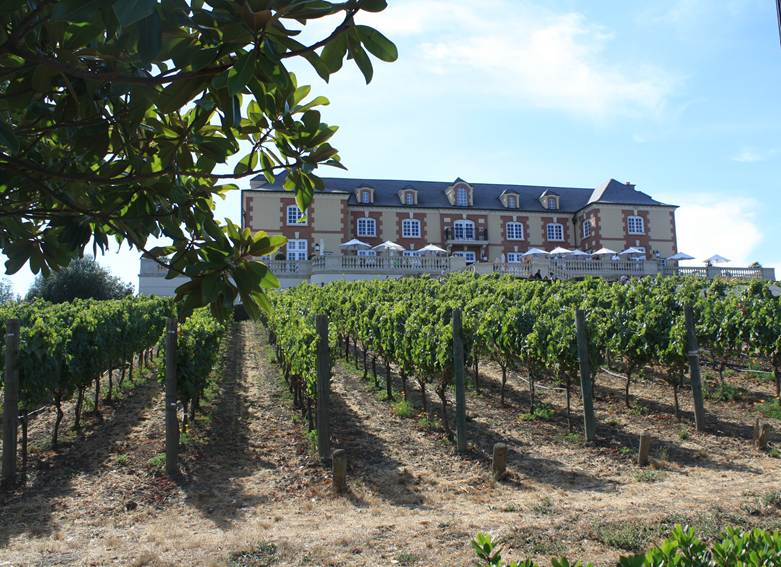
Domaine Carneros in Napa Valley, known for its sparkling wines, but where we prefer their Pinot Noirs.

Then why go out of our way to taste those wines?  Because we never get to taste them side by side.  We recently visited a winery where we regularly buy Pinot Noir as club members.  Tasting each of the wines one after the other, sip at a time, we discovered nuances in wines we knew we liked that weren’t apparent to us before.  We also found a Pinit Noir on their list that we hadn’t previously tried and realized that we really liked it.

Beyond the wines, we know that as members of the club, we will receive an especially warm welcome.  In many instances, we have known the servers and staff for years.  Even those we don’t know seem to go out of their way to give a better explanation of what they pour and maybe find a little something that isn’t generally served to the general public.

On the other hand, we experience a special excitement when we discover a winery we hadn’t heard of before.  There’s a sense of “Where have you been all my wine tasting life?”  In areas we know well, we may have driven past that winery for years, only happening to stop by on one trip. Finding a wine or two that we truly enjoy is like getting a birthday present when it isn’t our birthday.

It is also a unique experience when we visit a famous maison in the US or abroad that we had only read about before.  There is a feeling we get when tasting wine made by a French aristocrat in his chateau, that can’t be replicated elsewhere.  That’s a real chateau, not a faked-up Napa palace!  And if the wine has been known to be great since 1855, so much the better.

There is an old expression, “New friends are like silver; old friends are like gold.”  This applies to wine tasting as well.  We’ll keep our old favorites and visit them again and again.  But we’ll continue to seek out new wines and tasting experiences as well.
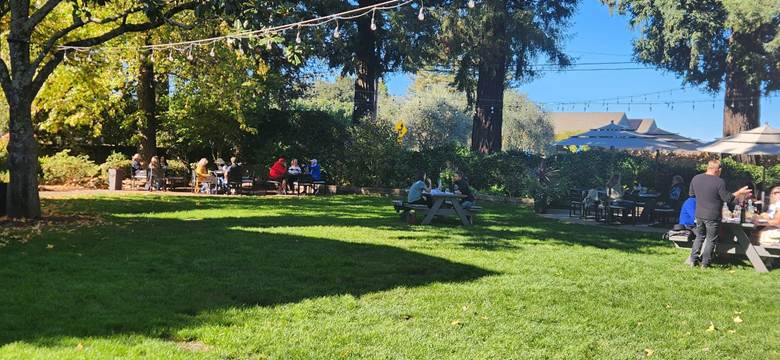
Revisit: Dry Creek Vineyard

In this issue at the start of 2026, Power Tasting begins a new feature that we are calling Revisits.  There has been so much change in the wine tasting experience in recent years, largely spurred by the pandemic.  The great majority of wine tastings are by reservation only and are sit-down affairs.  In some wineries, this has been a positive improvement.  In others it has taken away from the overall experience.  Power Tasting will continue to review wineries as we discover them, anywhere in the world.  But now we will report on ones we have reviewed in the past as well.

There is very little evident change in visiting Dry Creek Vineyard, where we have been stopping for decades.  The spacious lawn, with it picnicking facilities is still there, under the same spreading trees that somehow always seem to have leaves, no matter the season.  The building housing the tasting room is still a vine-covered stone building, though maybe the vines have spread a little further up the walls.

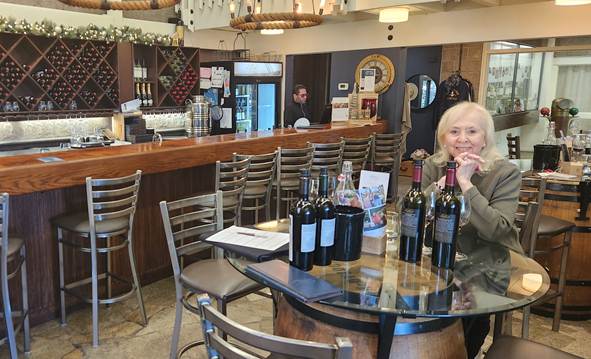
The tasting room also is little changed, except that instead of standing at the bar, visitors can sit on stools at the bar or on tables made of a glass top on a wine barrel.  We always found the servers to be knowledgeable about Dry Creek’s wines and that hasn’t changed.

Also unchanged is the huge selection of quality wines.  Where else could one person do a tasting of only Zinfandels and another only of Bordeaux varietals.  And yes, we still prefer the Wallace Ranch Zin and the Endeavor Bordeaux blend.

There is still a nautical theme to the tasting room, which is somewhat discordant in a place surrounded by vines and 20 miles from the Pacific.  But it’s pretty.

Yes they do ask for reservations, but we’re pretty sure they could accommodate small parties at all times.  So all in all, if you enjoyed Dry Creek in the past, you won’t find much difference.  And if you haven’t tasted wine at Dry Creek, it’s very much worth your while to stop by.

When a Winery Changes

In these on-line pages, we have from time to time bemoaned the loss of a winery or the decision by some winemakers to discontinue making wines we used to love.  This past year has seen a number of winery closures in California, notably including Paraduxx and Newton in Napa Valley.  (Fortunately, new owners bought Newton and are re-opening it.  Still, this is another example of change in Wine Country.)

For the wine tasting visitor, these losses – and to be fair, additions as well – are not novel events.  Wine production has been changing as long as wine has been made.  We can imagine some ancient Roman bemoaning that he couldn’t get his favorite wine from Pompeii anymore.  But it does seem that the pace has picked up in recent years, driven by changes in wine drinkers’ tastes and the decline in sales of alcoholic beverages overall.

Photo courtesy of Cellar Tracker.

So how should you adapt to all this alteration, transformation and shift in the wineries they come to visit and taste?

  • Buy up what’s still available.  The fact that a winery has chosen not to make a particular wine indicates that that particular label didn’t sell very well.  Yes, you loved it but not enough other people did (or at least not at that price) to make it economically feasible to continue making it.  For that reason, there may be a lot left in inventory.  When you visit the winery only to find that wine not on the list, just ask if you can still buy some.  If so, take advantage of the winery’s misfortune while there’s still time and buy, buy, buy.
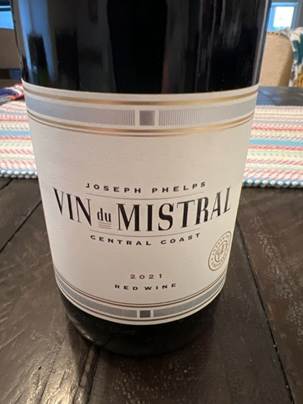
  • The wine may come back.  We remember when Joseph Phelps stopped making their Rhone blend, Vin du Mistral.  It was one of our favorites and then, in 2021, they made it again for one vintage.  Let’s hope that enough tasters ask for it at their St. Helena tasting room that they’ll bring it back again.
  • Find out why the changes occurred.  There may be other reasons why a certain wine may not be available, beyond market conditions.  There may be new ownership or a new winemaker.  If this is the case, the name on the label may be the the same name but it is no longer the same winery.  In most cases though, the vineyard is still there, growing the same grapes.  It may be a good idea to shrug off the differences in winemaking philosophy and see what the new winemaking team can do with what you were familiar with.
  • Embrace change.  Remember that every wine changes, from harvest to harvest and over time due to global warming, among other reasons.  That’s one of the reasons to go wine tasting at all, to find novelty and development in the wines of a region that you’re already familiar with.  For example, we often bought a premium Merlot from a Sonoma County winery.  They decided to rip out the vines and plant Zinfandel as well.  We regret that we’ll never taste that Merlot again, but we buy a whole lot of their Zins these days.
  • Get over it.  Nothing lasts forever, especially not wine.

Lucca, Italy

Tuscany is one of the most popular destinations for wine tasting travelers.  It’s where Chianti comes from.  And Brunello, Vino Nobile and Vernaccia.   And while they’re in Tuscany, many visitors also want to see Florence, Siena and even Pisa, just to see the tower lean.  We’d like to offer another Place to Visit: Lucca.

Some may have heard of the city because it’s famous for producing some of Italy’s best olive oil.  Others may know it as a well-preserved Renaissance town, still surrounded by broad walls.  And it is near the area where Bolgheri, the king of the Super Tuscans, is made from Bordeaux grapes.

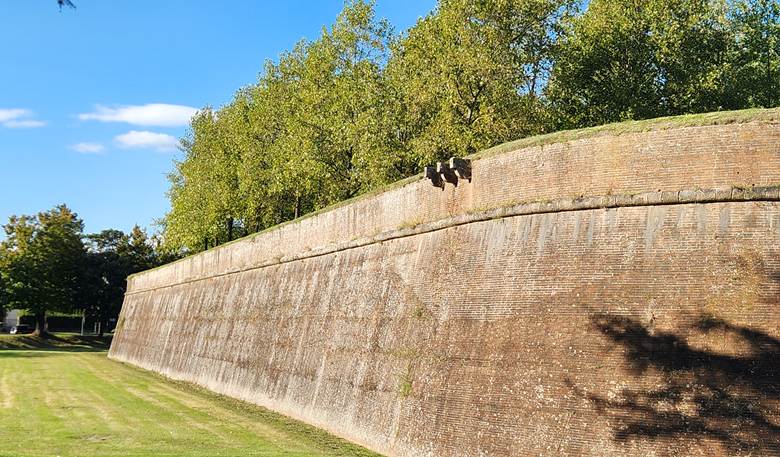
The broad walls of Lucca.

Today, Lucca has its fill of tourists, but not as much so as its more famous Tuscan cities.  And it is well worth visiting for a day.  The city is rich in historic sites (and sights).  The walls were built to protect Lucca from its rapacious neighbors, Florence and Pisa.  As gunpowder changed the nature of war, the Luccans reinforced their walled city with broad earthen ramparts.  The walls worked; the city was not attacked.  Of course, they don’t serve a defensive purpose today, but visitors can promenade among the treetops along the walls today.

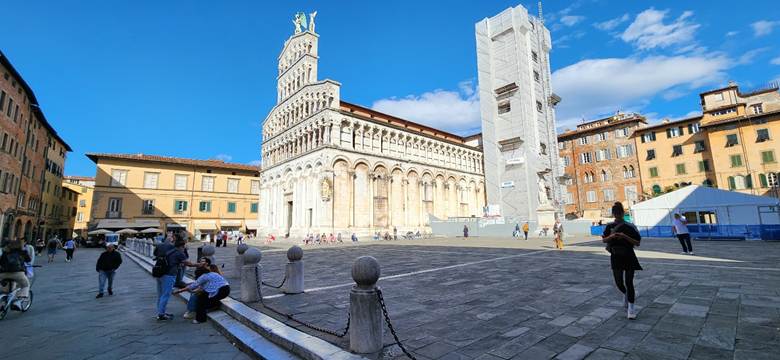
The piazza in front of the Church of San Michele in Foro.

Inside those walls there are two very notable churches.  One is San Michele in Foro, erected on the site of what had been the forum in Roman days.  It is a massive structure dominating what is still a wide piazza and the principle meeting spot in Lucca today.  The other is the city’s cathedral, which also has a bit of history.  There has been a church on that spot since the sixth century.  The cathedral there now was “only” finished in 1204.

As mentioned, Lucca attracts many tourists.  There is a parking lot near the main gate into the city leading onto a long, narrow street that leads eventually to the Church of San Michele in Foro.  It is a long strip of stores catering to visitors.  That’s not to say that everything is tourist claptrap.  The leather goods of Lucca are esteemed as are the woolens made, no doubt, from sheep raised in the hills around the city.

The Piazza dell’Anfiteatro in Lucca.

Perhaps the most popular place for visitors to Lucca is the Piazza dell’Anfiteatro, an oval-shaped space that was once the amphitheater where residents of Luca (as Lucca was in Roman times) saw plays and concerts.  The theater has long been destroyed but the piazza retained its shape.  Today, it is surrounded by restaurants, each with its umbrellas and outdoor tables.  The owners of each one of them will tell you that they alone serve the true and ancient cuisine of Lucca.

One Luccan specialty is a pasta that they call Tordelli Lucchese.  It’s a relatively thick ravioli filled with beef and/or pork, local spices and vegetables, served in a hearty meat sauce.  Even on the warmest days, a bottle of local red wine is de rigeur.  And to eat it where Roman actors once declaimed Plautus adds something unforgettable.

Benovia Winery

As these things often do, our interest in Benovia began in a restaurant.  We wanted a Pinot Noir to go with dinner at Willi’s Seafood in Healdsburg.  Our server suggested Benovia, saying it was the only wine that had been on their list since the restaurant opened.  We were impressed and decided to visit their winery in the Russian River AVA the next day.  We did call in advance, since their website says tastings are by reservation only.  We were told they could squeeze us in.

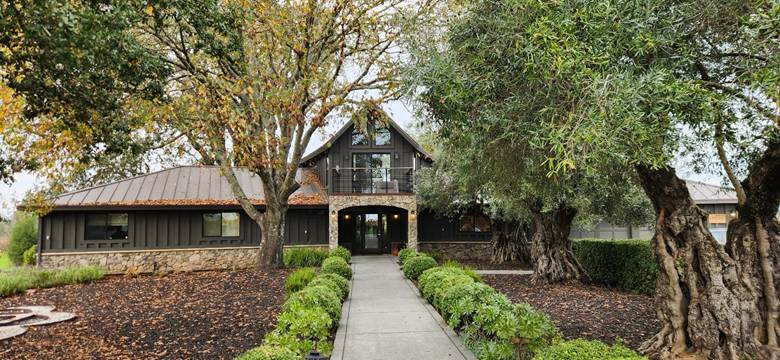
The Benovia “ranch”.

The road to Benovia is not as picturesque as in other parts of Russian River, more industrial than rustic.  As we approached the winery (in November) through the vineyard, we noticed that there was still fruit on the vines.  Or more accurately, there was fruit rotting on the vines.  Evidently the sales of lesser-known premium wine are depressed.  The owners decided it was smarter to feed grapes to the birds than to make wine that wouldn’t be sold.  To say the least, this is a sad trend.

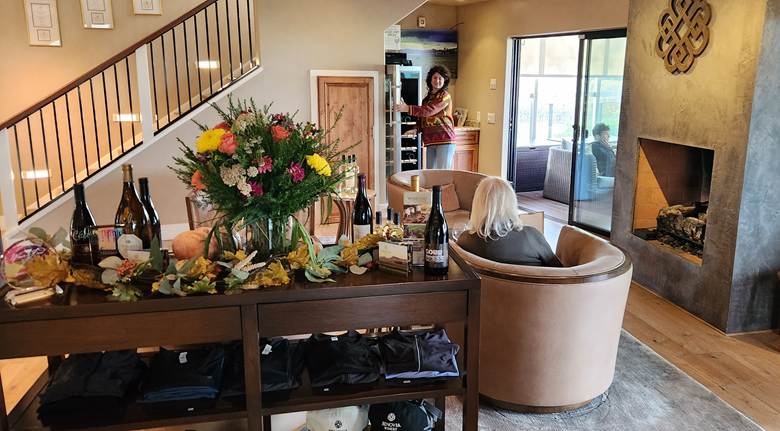
The interior of the Benovia winery, with our server named Izzy.

Beyond the vineyard, we encountered a large factory-like building and then, just beyond it, a rambling ranch house.  On entering, we found an empty tasting room, with one group of people sitting on the patio.  Squeeze us in, indeed!  Nonetheless, we were welcomed warmly and were seated in front of a fireplace (no fire) in a living room setting.  In fact, that typified our visit to Benovia; it’s like visiting friends with a nice house and good taste in wine.

Benovia is a relatively recent arrival in the world of wine, having opened in 2005.  The owners purchased the vineyard around the winery, as well as several other Russian River terrains.  As a result, most of their wines are estate made, which we always consider to be a plus.  Of course, since they’re situated in an area famed for Pinot Noir and Chardonnay, that’s what they make.  They also sell a few wines made from other grapes, which we didn’t taste.

The wines served at the tasting were a good representation of Benovia’s wines.  In many tastings, visitors are offered the bottom of the winery’s list.  A tasting at Benovia spans their price points.  The wines served are a mix of single vineyard Pinot Noir and Chardonnay, from both Russian River and Sonoma Coast.  Power Tasting doesn’t review wine, but we can say that our favorite was the Pinot Noir from the Martaella vineyard, which was the one we drove through to get to the winery.

Benovia is a small winery, producing only 4,000 cases, an amount that is being reduced due to market pressures, as described.  We hope they survive the slump, because we enjoyed the tasting experience there and we also like the wines we tasted, including the one that we had at dinner. 

Many Sonoma County wineries are the result of generations of farmers who grew grapes for making wine.  Benovia isn’t like that.  It’s more 21st century, a winery opened by people who made their money elsewhere.  That’s not necessarily bad and if they are committed to quality winemaking, we’d like to see them encouraged.