Cakebread Cellars

There are some wineries you visit for the gorgeous views.  Others have unique architecture.  Some (not our favorites) cultivate a party atmosphere.  You go wine tasting at Cakebread Cellars (www.cakebread.com) for the wine.

Now, Power Tasting does not do wine reviews, but it’s fair to say that Cakebread makes some pretty fine wine.  They’re best known for Cabernet Sauvignon and we’ve enjoyed their Pinot Noir in the past.  The winery building itself is pleasant enough, but not such an architectural wonder that you’d make a special trip.  The big attractions are an attention to wine tasting as a unique activity and some of the most knowledgeable servers we have ever encountered.

Cakebread Cellars’ winery.  Photo courtesy of the winery.

In the past, we have always indulged ourselves with the reserve tasting.  The ability of the servers to understand each visitor’s level of knowledge and interest and explain the wines in alignment with the individual, have always impressed us.  We don’t know if it is still the case, but pre-pandemic we learned that all the servers in the reserve room were qualified sommeliers.  In one case, a server showed us a book on wine that he had written.  Impressive, right ?

These days the reserve tasting is supposedly limited to Cabernet Sauvignons and they do pour quite a few of them.  We’ve found that there’s usually some other interesting wine behind the bar, just for contrast.  On one visit, we expressed disappointment not to taste their Merlot, so the server ran out and got a bottle to open for us.  This is indicative of their attitude about wine tasting and towards their guests. They clearly enjoy sharing wine and experience with people.  As a visitor, you cannot help but being caught up in their enthusiasm.

We have not tried it, but Cakebread now has a seated group tasting, highlighting library wines.  We’re sure it lives up to the experiences we have had.

Cakebread is very serious about their “by appointment only” policy.  While many wineries use the limitation as a way of managing crowds, at Cakebread no reservation means no tasting.  Of course, this gives the staff the opportunity to really focus on the people who do call or email in advance.  We recognize that the ways and manners of Napa Valley wine tasting have changed since our earliest wine tasting days.  Still, there’s a different feel to such formality that doesn’t always sit well with us.

Jack and Dolores Cakebread were among the pioneers of Napa Valley winemaking back in the 1970’s.  Their sons now run the enterprise, which has grown to include vineyards as far afield as Howell Mountain and Anderson Valley.  Cakebread’s all wood winery building pays homage to those old days, so you can still feel a little of the vibe even if today’s reality is somewhat different.  Cakebread Cellars is an expression of what Napa Valley was and what it has become.  For lovers of the distinctly Californian style of winemaking, this winery is definitely a place to visit.

Wine Tasting Amenities

Wineries are in several businesses.  Of course, their basic business is making and selling wine.  In this regard, their competition is other beverages, from soda pop through whiskey.  Mostly it’s alcoholic beverages consumed in a social setting, with beer brewers their primary competition as an industry.

They also make a substantial amount of money from wine tasting, which is Power Tasting’s subject.  Wineries are in the business of tourism, which is why we now see so many resorts opening in Wine Country.

So when we wine aficionados go wine tasting, we are certainly drawn to specific wineries by the quality of the wine being served.  To a very great extent, we also choose one winery to visit over another based on the overall experience we expect to have there.  Beyond the wine, we are attracted to the obvious big things: location, architecture and other attractions, such as art or panoramic views.

The tasting room at Louis M. Martini winery.

At a much more subtle level, the various amenities offered by a winery make a great deal of difference to the way we feel as we remember our experiences and plan to return.  The first and ultimately the most important is the personal interaction we have with the servers and other employees.  They should make a visitor feel more like a guest than a customer.    No one wants to feel looked down upon or intimidated. To our experience most do a good job of hospitality, but we have experienced some notable exceptions.  We have never returned to those places.

A tasting room should express the personality of the owners.  As more and more winemakers are taken over by big corporations, the tasting rooms have become visitor centers, located in palatial buildings that feel more like show rooms than friendly places to gather and sip.

If the owners collect art or horses or musical instruments or race car paraphernalia, they should share their collections with their guests.  Equally, the more humble wineries that are extensions of farms (which is all a vineyard is) should be rustic without being shabby.

At the most elemental level, wineries should show consideration for their guests no differently than each of us would do in welcoming friends into our homes.  The tasting rooms should be clean and tidy.  Double that for the bathrooms.  We appreciate shady places to park.  If there is bar service, there should be a place to sit if one wants to.  There should be accommodation for those with mobility issues.  Some sunlight is always appreciated as well as a view of the vines or the town, depending on location.

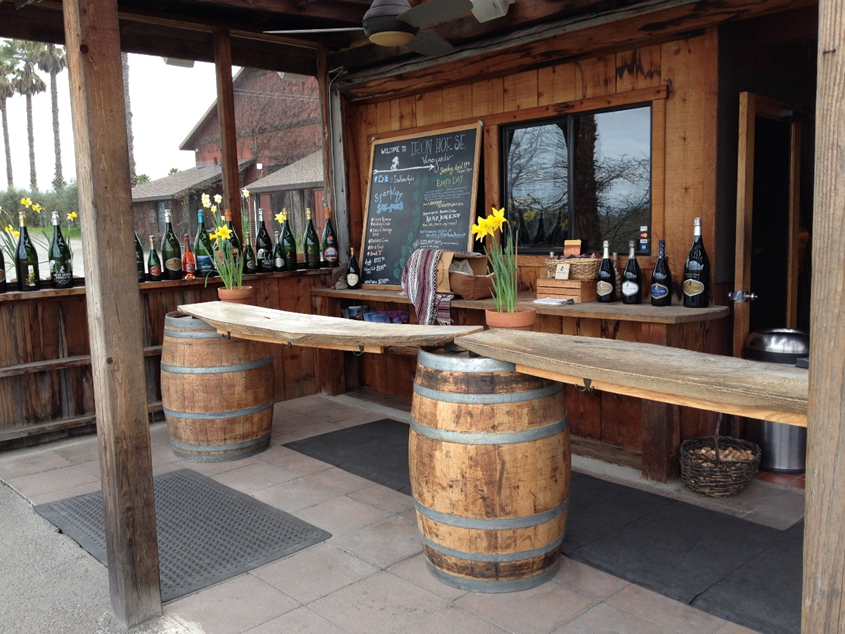
The little things add up, often in a subliminal manner.  Wine tasting venues in our times is about entertainment almost as much as wine.  Serving wine in the barn on a plank and two barrels might have been the way things were done 50 years ago, but in those days the wineries weren’t charging you to sip their wines nor selling their products for three-figure prices. Most winery owners understand that the experience is a part of their business model.  The others need to catch up.

Palermo

Maybe you think that all Italian wines come from Tuscany and the Piedmont.  You can find wine being made almost everywhere in Italy and the biggest wine producer is Sicily. If you decide to visit that island for wine tasting, make sure you also include history, art and food on your itinerary.  You might arrive on a cruise ship or on a ferry, but most likely you’ll fly in.  And in that case you’ll come into Palermo.  Before you head out to the vineyards, you ought to see what this city has to offer.

Now, Sicily generally and Palermo in particular have an image problem – the Mafia.  Yes, there were and still are gangsters in Palermo just like we have them in US cities.  In our travels, we never felt the heavy hand of the Mob.  People did tell us that most of that had been cleaned up.  It’s mostly the tourists who want to see the places they know from the Godfather or take a trip to the nearby town of Corleone.  If you’re a tourist and want to see those things, go right ahead.

The Teatro Massimo

But instead of remembering the fatal scene at the opera house, feast your eyes on the Teatro Massimo, the largest in all of Italy.  It’s a masterpiece of 19th century architecture inside and out.  Even if you don’t feel like taking in an opera, it’s the grandest hanging out and meeting place in Palermo.  So sit in one of the caffés around the perimeter of the piazza in front of the theatre, or loll on the steps with the younger Palermians or watch a political protest arrive.  You’ll feel very much a part of the scene.

Of course, you could go and see a grand performance.  A word of warning: Climate change being what it is, it stays hot in Sicily later in the year than in the past.  They didn’t install air conditioning in the Teatro Massimo, so be prepared to perspire more than a bit.

Just one of the Four Corners

Another sight not to miss in Palermo is the Four Quarters (or I Quattro Canti in Italian).  It’s a crossroads with massive sculptures and fountains on each corner.  They represent the kings who once reigned in Palermo and the city’s four patron saints.  Don’t stand in the middle to see them all; these are heavily trafficked streets.  But do wander about and take in each one in turn.

Palermo may be the street food capital of the world.  Wander through the back streets and markets and try a little of this or that.  Maybe it’s a good idea to ask what you’re about to eat before biting.  They make the most of every animal in Sicily.  We’re generally not big fans of tours, but you can find some street food tours that will take you everywhere and let you try everything (or at least everything you’d like to try).  But, oh, Sicilian pizza! And, ah, Sicilian gelati!  And especially, oh my, Sicilian rice balls (or arancini)!  Here they may be stuffed with meat and peas, or cheese, or tomatoes.  They’re coated with breadcrumbs and deep fried.  Have some – you’re too thin anyway!

Then head around the island and try the wine.

Dry Creek Vineyard

We’ve written about Dry Creek Vineyard (www.drycreekvineyard.com) before, but in a different context.  We’re very fond of this winery and have visited there often.  This year marks their 50th anniversary, which is quite an achievement, and they have been family-run for all that time, which makes the achievement even sweeter.  In the interests of openness, we have to say that we’re members of their wine club, but as we often note, we don’t review wine.  Power Tasting is about the wine tasting experience.

The theme on Dry Creek’s attractive labels is sailing.  As a club member, you can enjoy one of their many member events; pre-pandemic one of them was a sailing day in the San Francisco Bay. Of all the wineries that we know, there is none that has as many club member events as Dry Creek.

The Dry Creek Vineyard winery.  Photo courtesy of the winery.

And we find that there are many reasons to visit the winery and indulge in a tasting.  We do enjoy Dry Creek (the valley) and often spend a day or more in that region of Wine Country.  When we do, Dry Creek (the winery) is always on our itinerary.  Like much of this region, Dry Creek Vineyard specializes in Zinfandel.  They are well known for Sauvignon Blanc and they make some creditable Cabernet Sauvignons and blends as well.

One aspect of a tasting at Dry Creek that is rather unique is that they make seven single-vineyard Zinfandels and four different Bordeaux blends.  Not all are available for tasting at any given time, but it’s rare to have the opportunity to compare side-by-side the same grapes made into wine by the same winemaker (Tim Bell).  If nothing else, it gets you thinking about the relative influence of winemaking artistry and terroir.

The tasting room is in a vine-covered stone building, fronted by an extensive lawn and some of Dry Creek’s vines.  That lawn is a great attraction.  It has shade trees, picnic tables and some lawn games for the kids.  They’ve even put in a bocce court.  It is meant to be welcoming and family-friendly.  We have often seen little ones running around outside while their parents sipped and had lunch at nearby tables.

If you do want to have a little picnic, there’s a special advantage at Dry Creek.  They’re only four minutes’ walk, according to Google, from the Dry Creek General Store, so you don’t have to pack a picnic in advance.  Of course, in California no one walks so it’s a one-minute drive.

Dry Creek’s “insect garden”.  Photo courtesy of the winery.

Another reason to visit Dry Creek is what they call their “insectary garden”.   To be honest, the name put us off for quite a few visits.  Eventually we came to recognize that Dry Creek is rather committed to sustainable farming, and insects form a part of the biosystem that they intend to preserve.  All very scientific, to be sure, but for the visitor it’s a pretty little garden to walk around in just in front of the grape vines.

In these pandemic times, visits are by appointment only.  We can only hope that the disease will pass and the ability to just drop in will return.

How to NOT Buy Wine

One way to think about a winery’s tasting room is that it is a sales showroom.  In the same way that you buy stereo equipment, jewelry or other luxury goods, at a winery they show you many things you can buy, let you try out a few and then, if you buy, get one out of stock.  Let’s face it, wine tasting is temptation.

Photo courtesy of SevenFifty Daily.

Just as there are many reasons to buy a specific wine, there are many reasons not to.  Most obviously, if you don’t like the way a wine tastes, the temptation to buy is much less.  Even if you do, you might not like it as much as others in the same price range.  Or maybe you like it a lot but you can’t afford a bottle at the price quoted.

There is a subtle pressure to buy something.  A nice person has been pouring you wines to taste and chatting pleasantly with you.  It’s human nature to want to reciprocate.  So when the server says, “Would you like to take some wine home with you?”, you may feel like you ought to say “yes”.  (Note that the word “buy” was never came into the conversation.)

  • You have no obligation to buy anything. That’s true in a jewelry store as well, but at least the jeweler doesn’t charge you for the privilege of trying on a ring.  In the old days, when tastings were free, there might have been a bit (only a bit) of a moral imperative.  Remember, you paid for your tasting so you don’t have to buy anything else.
  • Wines at a winery are rarely bargains. In many cases, you’ll find that the same wine sold in the tasting room can be bought back home for substantially less.  There’s nothing wrong with pointing that out to the server.  However, there are some wines that are only available at the winery.  In those cases, you have to decide if the quality difference compared with the wine in the store near you is worth the price.  It might even be instructive to ask the server what differentiates the winery-only selection from their more easily found wine. If you don’t get good answers, don’t buy.
  • You have to take it home with you. If you live near the winery, that’s not a problem.  But if you’ve taken a plane to get to that part of Wine Country, you’re either going to have to put the bottle in your luggage or ship it.  Even if you decide to do one of those things, there are limits.  US Customs only allows you to bring back two bottles per person from overseas.  Even domestic shipping cost can be a significant deterrent as well.
  • Try to strengthen your sales resistance. Remember, you’ve been drinking.  Maybe you’re on vacation too.  Your ability to say “no” is not at its peak.  So if you feel yourself about to say “yes”, turn to the person you came with and ask, “What do you think?”  That can be a pre-arranged signal to turn thumbs-down.  Or if you both are in favor, this may be the time to buy.


Winery Glassware

As we wrote quite a few years ago, there was once a time that wineries gave away souvenir glasses if you stopped by and had a taste of their wines.  In fact, their tastings were free, too!  (And still are in a few places, believe it or not.)  We’re reminded of this because we recently got rid of nearly all of the glasses we had collected on wine tasting trips over the years.  Most of them were tiny and thick and we had too many; we don’t know why we kept them, except for the memories.  A few were of high quality and we kept those, because…well, just because.

But it caused us to give some thought to the role glassware plays in the wine tasting experience.

Photo courtesy of Kendall-Jackson.

In some ways, the quality of the glasses is indicative of the winery owners’ perception of their wine and their customers.  There are still some who serve tastings in small, clunky glasses.  Maybe they just don’t care, or think their customers don’t care or that they couldn’t tell the difference anyway.  Our experience is that many – certainly not all – people we meet in tasting rooms are reasonably familiar with wine and would appreciate a better glass.

At the other extreme, we’ve been finding some really fine glasses in some tasting rooms.  They have copious bowls, no lip (that little bulge you sometime find) at all on the edge of the glass, thin stems and a great feel in your hand.  If you turn the base of the glass slowly in the right light, you may find the mark of an Austrian or German glassmaker, such as Reidel, Spiegelau or Schott Zweizel.  These wineries make, or at least think they make, great wine that deserve great glasses.

But does it really make a difference?  Actually, yes it does.  A glass with the room to swirl the wine will open up the aromas in a way that a poorer glass cannot do.  And your ability to stick your nose in the glass as you sip will enhance your wine tasting enjoyment as well.  There is a sensual pleasure to holding a well-balanced wine glass that you can only understand if you can compare it with the other kind.  That’s why you don’t serve fine wine in jelly jars.

What if you don’t have exceptional wine glasses at home?  Will it make a difference to the wine if you buy some and take it home?  Not exactly.  But wine glasses are part of the allure of wine tasting.  So enjoy those fine glasses while you’re there!

Many of the gift shops at wineries will sell you their engraved glasses.  If your intent is to have a souvenir of your trip, by all means go ahead.  But if you are looking for quality glasses for your home, there are much better values to be had in the stores and on the internet.

And at the end of the day, if someone offers us Château Petrus in a plastic cup, we’ll be happy to take it.

Read the Label

Often when we are in a winery’s tasting room, we ask the servers to show us the bottle.  Of course, it’s not the bottle we want to see; they’re all pretty much the same.  (Actually, that’s not true.  There are Bordeaux bottles with round shoulders and Burgundy bottles with sloping ones.)  What we really want to see is the label, or actually two labels: one on the front of the bottle and one on the back.

The servers usually look at us quizzically.  “Why?” they seem to be asking, but they do anyway?

So here’s the answer to their question and some advice on how you can take advantage of the labels as well.

  • The look of the label tells you something about the wine. Great wines don’t need silly labels.  A classic label gives us an idea of the winery’s owners’ approach to making wine.  A picture of the château or some great art are fine, but a lot of bright colors or unusual type scripts generally indicate that they’re more interested in catching your eye in a shop than letting the wine’s reputation speak for itself.

  • You can ignore a lot that’s on the label. It contains some warnings that you’re not interested in, such as the fact that the wine contains nitrates (they all do) and that you shouldn’t drink and drive (you already know that).  You’ll learn the winery’s address, amount of wine in the bottle and the URL of their web site.  None of this is very important to you but the government insists on it.

  • Look for the interesting information. The label should tell you the name of the winery.  On top of telling you the kind of wine (Pinot, Cabernet, etc.), it might tell you the name of the wine, such as the “Private Reserve” or “My Zin”.  If they care enough to name their wines, it might indicate that this wine is intended to be rather special.  Even more so, some better wines come from single vineyards and they name that location.  By itself, all this data may not mean much, but put together these are all indicators that the contents of the bottle may be something special.  And it it’s not there, that tells you something, too.  (Maybe that’s not the winery’s best wine).
  • Check one number in particular. Perhaps most important information on the label is the amount of alcohol in the wine.  If you’re driving from winery to winery to taste their products, this will help you calibrate your consumption.  For a long time, 12.5% or 13% was the norm.  Now anything less than 14% is considered light.  Moreover, the alcohol level tells you a lot about wine itself.  While there are some exceptions, any wine that contains more than 14.5% is likely to be “hot”, tasting of alcohol rather than grapes.
  • Some labels tell a story. It may or may not be an interesting story.  Some tell the history of that particular wine.  Those on the wines from Ridge winery, for example, give a detailed explanation of the growing condition, the soil, and everything but the name and address of the person who picked the grapes.  And some just tell you whatever the Marketing department felt like saying.

So why do we ask to see the label when we’re wine tasting?  Because it makes us more informed about what we’re sipping and what we might be buying.

Drinking with the Locals

One of the basic tenets we follow at Power Tasting is that we go to taste wine, not drink it and certainly not drink it to excess.  In our travels, we have met some people in tasting rooms who have failed to follow that rule and they were the worse for it.  But if you pace yourself, have breakfast and a hearty lunch, you may from time to time allow yourself what the French call an aperitif and the Italians an apertivo. (In the United States, we just call it a drink after work.)

One of the pleasures of an aperitif in Wine Country is that if you choose the right place to have one, you get to share the space and the experience with the people of the area.  You can just go to the first bar you come across.  If it has a bright neon sign in the window advertising Budweiser, you probably won’t be sipping a delicate Chardonnay.  But you very well might get a pint of one of the brews made in the area and that can be a pleasure too.  And you might be drinking next to the fellows who till the vineyards and pick the grapes that you’ve been trying that day.  If you don’t recognize the names of the ales on draft, ask the person next to you at the bar.  The worst that can happen is he’ll ignore you; the best is that you get to meet someone who’s in the know.

Willi’s in Healdsburg, a great place to meet local folks. Photo courtesy of USA Restaurants.

Many times we’ve taken a glass of wine before dinner at a restaurant other than the one we plan to dine in.  It’s a way to get to see more gathering spots and in some cases to familiarize yourself with the ambience of a restaurant before trying it for a meal.  You may be seated next to other tourists or you may get to meet the people who make the local wines.  If the latter, keep a polite eye on what they’re drinking.  It’s probably not their own because they are surrounded by it all day.  You can learn a lot from what the knowledgeable people of the area are having.

Strolling around the Piazza del Campo in Sienna.

The best way, by far, to enjoy an aperitif is to take it at a café in France or on a piazza in Italy.  We remember with much warmth sitting under the plane trees in front of the Bar Central in a tiny village surrounded by vines, while the piped music played French (and Quebecois) songs while the businesspeople and shopkeepers stopped by for a pastis or a glass of whatever was just growing a mile away.

Or watching the sun decline over the rooftops and steeples surrounding the big piazza that’s in every Italian town.  Half the town would take a glass with us, in order to watch the other half of the population indulge in what they call the passeggiata.  That’s just a walk around the square but it’s so much more.  It’s a chance to see the locals enjoying who’s out and about and to be seen being out and about.

Ah, yes, it must be 5 o’clock somewhere.

Toulouse

Toulouse is not a winemaking city.  It’s the center of France’s aerospace industry, with the headquarters of Airbus there.  But it is surrounded by regions that do make wine, albeit not the most famous in France.  There’s Gaillac to the north, Madiran to the south and Minervoix, the best known, to the east.  It also has history and architecture and food, which makes it well worth visiting when you’re travelling for wine tasting.

The Romans called it Tolosa, and when the city of Rome was overrun by the Visigoths in 410 A.D., the Romans gave the invaders the southwest of France to get them to leave their city.  Toulouse was their capital as it was 800 years later for a large population of pre-Reformation heretics known as the Cathars.  These people were wiped out but the echoes of Catharism are still felt throughout the region.

Toulouse’s Capitole at night.

The current-day toulousains are justly proud of their history, but are more involved in 21st century living than in the past.  For the visitor, it is preferable to sit in their main square, the Place du Capitole, dominated on one side by a building that is part city hall and part opera house.  The other side of the square is lined with cafes, under broad umbrellas.  There you can sit and eat the local sausages, which are the envy of the rest of France, along with a bottle of local wine.

Grand buildings along the Garonne river.

Then take a stroll along the banks of the River Garonne, which starts in the Pyrenees and ends up in Bordeaux (you may have heard of their wines) before debouching into the Atlantic.  There are numerous grand buildings once erected by the elites, mostly in the 19th century.  Not far is what little is left of old Toulouse, since much of the city was destroyed in the many wars that beset the region.

The Canal du Midi begins in Toulouse and connects it with the Mediterranean.  Once a commercial waterway, the canal today is mostly navigated by tourists who get aboard the boats called péniches and visit the many picturesque villages along its banks.  If you don’t want an extended trip, you can take a tour that just goes around Toulouse’s part of the canal for a few hours or, as we did, take a day trip about 20 km. away and back.

You cannot visit Toulouse without indulging in its greatest contribution to French gastronomy: cassoulet.  Now the city’s claim to this dish is disputed by the people of the town of Castelnaudry along the canal to the east and the Gascons further north.  This hearty combination of white beans, confit de canard (duck) and the aforementioned Toulouse sausages has become available in many North American restaurants, but we can assure you that the real thing in the real place can’t be beat.

Power Tasting doesn’t usually get into restaurant reviews, but we have to tell you that we found that Restaurant Emil serves the best cassoulet in town.  Even more, you can buy a large can of it there, enough for dinner for two, put it in your suitcase and have it when the cold winds blow back at home.


J. Lohr Vineyards & Wines, San Jose

There actually is a fellow named J. (for Jerry) Lohr.  He began making wines in California’s Central Coast back in the 1970’s, first in Arroyo Seco and then in Paso Robles.  He also owns a vineyard in Napa Valley but the main production comes from the center of the state.  J. Lohr has two tasting rooms, the original one in San Jose and a newer one in Paso itself, on the less artisanal east side of Route 101.

The J. Lohr tasting room in San Jose.  Photo courtesy of Travel Expert Wiki.

The San Jose site is on a city street, just off a major boulevard.  We’re fond of in-town tasting in places like Healdsburg or Calistoga, where there are several tasting rooms you can walk to.  But finding one in a city of a million people is neither bad nor good, but it is definitely unusual.  For one thing, there’s no place to park; you just find a spot in the street.  For another, there’s no indication that you’re in Wine Country.  The tasting room just stands alone.

It’s a pleasant, brick building covered in vines.  Once you enter, it’s like any tasting room anywhere: a long bar, some tables, wines on display.  And there are quite a few red and white wines available for tasting, that do show off what J. Lohr wines are all about.

And what they are about is, for the most part, easy accessibility.  You may already be familiar with these wines from a local wine shop or on a restaurant menu.  Many are inexpensive and are appropriate for casual drinking.  So why go out of your way to taste them?

The reason is that like many wineries that make their living in the mass market, they also have some wines that defy your expectations.  This applies to J. Lohr.  Yes, there are Chardonnays and Cabernet Sauvignons available for under $15.00.  But there are also single vineyard varietals including Pinot Noir from Santa Lucia Highlands and Cabernet Sauvignon from their vineyard in Napa Valley.  Even these, by today’s standards for such wines, are relatively affordable.

And then there are a few of J. Lohr’s wines that are clearly intended to show what this winery is capable of.  As with other makers of widely sold wines, it’s a pleasure to find out that their winemakers have the talent – and the grapes – to make fine wine.  Power Tasting is about wine tasting, so we’ll leave it to wine critics to say just how good J. Lohr’s top wines are.  We found some of their Signature series wines to be quite enjoyable and certainly didn’t consider them to be casual.

We were in Silicon Valley on business and took a little side trip to San Jose to visit this tasting room.  We wouldn’t recommend a special journey there, but if you are in the area it’s worth a stop.  One of the pleasures of wine tasting is surprises, finding something you enjoy that you didn’t even know existed.  We can’t promise that all their best wines will be available for tasting when you go, but there will probably be something you’ve never tasted before.  Finding the top-end products of wineries you only thought of as making picnic wine is a very pleasant surprise indeed.