Barcelona: The Modernist Architecture

Barcelona is a wonderful, cosmopolitan city, sitting on the coast nestled among Spanish wine regions.  Penedes, where sparkling Cava is made, is to the southwest and Priorat with its Garnacha wines, is just beyond.  In fact if people make a trip anywhere in Spain for wine tasting, they would do well to make a stop in Barcelona, because of its many attractions.

In fact there are so many points of interest in Barcelona that it would take more than one article to talk about them all.  So we will start with its architecture.  The range of the city’s architecture is wide, with Gothic structures such as its cathedral to contemporary buildings such as the Torre Glóries.  But the school of architecture known as Modernism was dominant in Barcelona in the late 19th and early 20th centuries, and one man was dominant among the Modernist architects:  Antonio Gaudi.

The as-yet unfinished Sagrada Familia basilica.

It is virtually impossible to visit Barcelona and not see Gaudi’s masterpiece, the Sagrada Familia basilica.  It towers above rest of the city and is now the tallest church in the world.  We say “now” because it is still under construction.  Gaudi began work on it in 1883 and it was only a quarter finished at his death in 1926.  Its spectacular soaring towers and fanciful decoration make it instantly recognizable.  Tickets are needed to enter the basilica, but it’s free to walk around it in wonderment.

If that were all that Gaudi had designed, he would be a noted architect.  But there are Gaudi creations all around Barcelona.  Among the most famous are the Parque Güell, an urban park full of whimsical creatures covered in bright tiles that has delighted children (and former children) for more than a century.  Another is the Casa Batlló, with its colorful tiled front and its curved balconies.  Crowds assemble in front of every Gaudi building just to gawk.
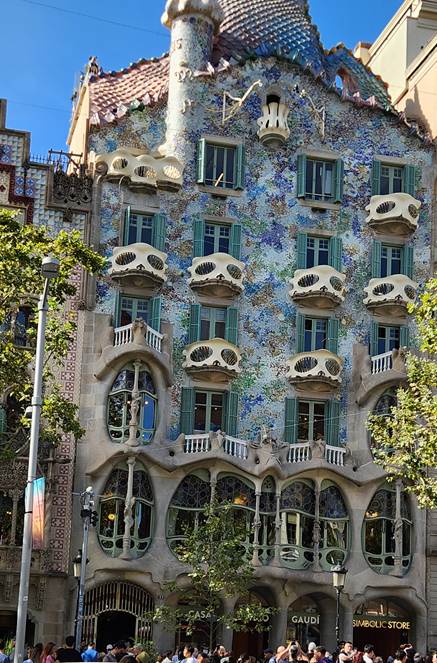
Casa Batlló on the Passeig de Gràcia.

Gaudi is the most renowned Modernist architect but he was hardly the only one.  One of the best ways to take it all in is a stroll along the Passeig de Gràcia, Barcelona’s central thoroughfare.  There you will indeed find work by Gaudi, the aforementioned Casa Batlló.  For instance, immediately next door is the Casa Amatller by Josep Puig.  It is as angular and neo-Gothic as Gaudi’s work is free and curvilinear.  The contrast is both eye-catching and representative of the diversity of Modernism. 
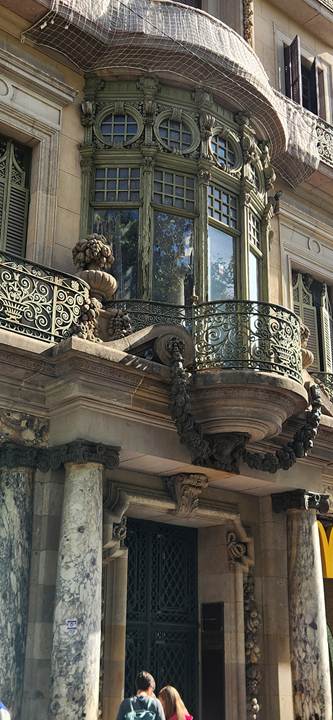
Building detail.

There are classical colonnades, very Spanish grillwork and massive office buildings one beside the other as you walk along the Passeig.  Some of them are occupied and functioning as intended, others are essentially museums because of their beauty.  Sometimes, it’s enough just to sit on a bench and soak it all in, from the entirety of this fabulous street to ornate details that transform a building front into a work of art.  And Barcelona’s almost perpetual blue skies make it all sparkle.

Using Artificial Intelligence for Wine Tasting

Artificial Intelligence seems to be everywhere these days, so why not for wine tasting?  The one thing AI doesn’t have and never will is taste, in both senses of the word.  Chatbots can’t taste wine and even if they could, they don’t have the good taste to tell the difference between fine wine and plonk.  They can only provide information from what has been written about wine, not the beverage itself.

Photo courtesy of Wine Industry Sales Education.

Nonetheless, it can be a helpful tool if someone is planning or is actually on a wine tasting trip.  Here are some tips that we have taken advantage of in our wine tasting adventures.

  • AI can suggest places to visit.  This is particularly helpful if you are planning on tasting in a region of Wine Country where you’ve never been before or, even more so, if you know little or nothing about the wines made there.  There’s no reason to let ChatGPT or Gemini determine where you should go, but they can shorten the time to get started in selecting wineries to visit.
  • Be careful what you ask.  It all depends on the prompts you enter.  If you ask, “What are the best wineries in Bordeaux?” you’ll be directed to the Premier Crus and their equivalents.  That’s good advice, as long as you don’t mind the expense of only visiting the top wineries.  If you ask “What are the best wineries for wine tasting in Bordeaux?” you’ll get a different list, still very fine wines to try, but less exclusive.  And if you enter the prompt “What are the best values for money in wineries for wine tasting in Bordeaux?” you’ll be offered still another list of châteaux.  All in all, it pays to think about what you want to do and be specific in your requests.
  • Don’t trust the answers you get.  Or at least, don’t trust them blindly.  AI chatbots have the nasty habit of just making things up.  If the reply that you get mentions a winery you’re familiar with, all well and good.  But if it’s a name you never heard of, that may be because it doesn’t exist.  So go from the chatbot to the web sites of the recommended wineries and both verify the accuracy of the AI response and learn more about a potential visit.
  • Don’t rely on just one AI tool.  Each one has a different algorithm and data model, so you’ll get different answers from Claude than from CoPilot than from Grok…  It isn’t that one is more dependable than the others; it’s just that they’re different.  It’s just like asking two friends for recommendations.  They’re unlikely to be exactly the same.  But note the recommended wineries that come up on multiple chatbots.  That’s indicative that a particular winery will be a good destination.
  • And you can ask it about lunch after the tasting.  If you don’t know about wines in a given area, you probably don’t know about restaurants, either.  All the tips above apply. If you choose one, AI can give you driving instructions from a tasting room to a café.

Ramey Wine Cellars

Winemaking is part farming, part manufacturing and part art.  A visit to Ramey Wine Cellars (https://www.rameywine.com) is very much involved with the latter two, but visitors don’t get to see anything about the farming aspect except a map of where they grow and source their grapes.  Ramey’s winery is in an area with homes and office buildings, and Ramey looks from the outside like one of those offices. You won’t see lush vineyards and their location in Healdsburg isn’t even in the middle of the attractive area of town around the plaza. 

Located where they are, Ramey doesn’t get any visitors who just happen to be walking by and tastings are truly by appointment only.  The result is those who do make reservations are greeted and treated personally.  We were met and escorted by Sam Tesconi, the Director of Marketing and Guest Relations.  We were the only visitors at that time.

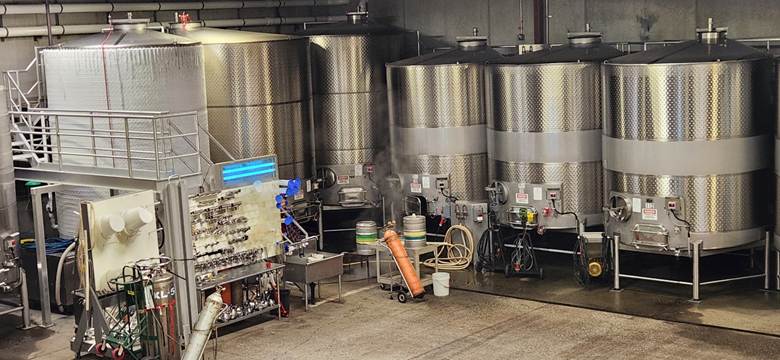
On entering their facility, one sees a large, open room with gleaming steel tanks and a variety of other equipment.  There is also a ceramic aging tank that they’re very proud of.  The barrel room, like the entire facility, is spotless.  For educational purposes, there’s one barrel with a glass head, to allow visitors to see their Chardonnay resting on the lies, which they periodically shake up to maximize the contact with the wine.

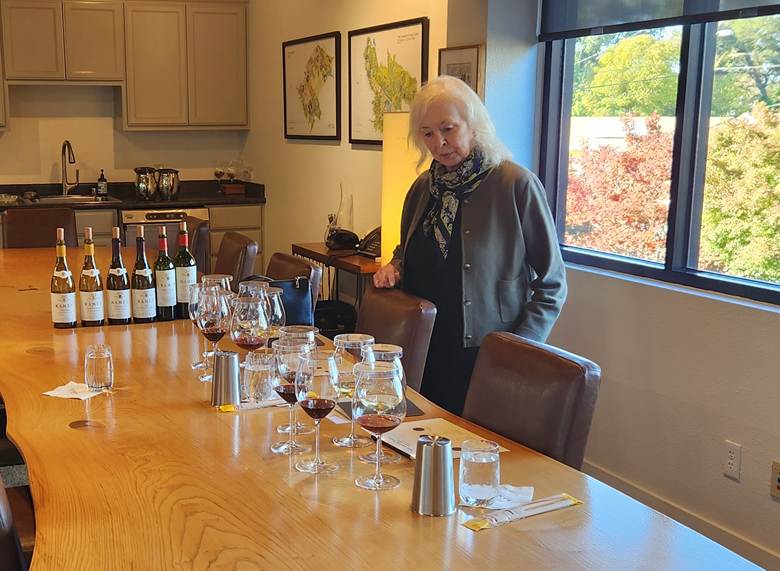
Then it’s off to a tasting – a rather generous one – in one of the six private rooms reserved for that purpose.  We were seated at a long wooden table where places were set with six glasses of wine, two whites and two reds.  We sat down and Mr. Tesconi explained the makeup of each wine and the vineyards from which they came.  Ramey makes wine from both estate and sourced grapes, mostly from Sonoma County but also in Napa Valley and Central Coast.

Ramey aspires to wine greatness and, while Power Tasting doesn’t review wines, we can say that we enjoyed what we tasted very much.  They are best known for their Chardonnays, two of which were served.  There was a notable difference between the wines from Sonoma Coast and Russian River.  The reds were a Pinot Noir, a Syrah and two Cabernet Sauvignons.  Each one had a distinctive character with some stylistic similarity.  It would be hard to pick out one that we would call a clear favorite.

Most tastings feature recent releases with a few years from harvest.  Rarely do we get to taste a winery’s top wines.  In this case, while the white wines and the Pinot Noir were from the 2022 harvest, the reds all had at least seven years of aging and one, the Cabernet Sauvignon from Pedregal Vineyard in Oakville, was from 2014.  We really felt as though we had been introduced to what Ramey wines were all about.

When we visited Ramey, we got a very informative, personable tasting of some rather good wines.  It really didn’t matter that we had to forego the scenery.

Mass Producers

Sometimes in Power Tasting we have used the term “mass producers” with a bit of a sneer.  That’s unfortunate, both because it’s a bit snobby and because it’s not fair.  There’s no definition as to what constitutes “mass”.  Sure, a vineyard that grows enough for 5,000 cases or less is small (or perhaps the winemakers would prefer the term “petite”).  But does mass start with 10,000 cases? 100,000?  A million?

The Gallo factory in Fresno, California.  Photo courtesy of the Fresno Bee.

Yes, Gallo turns out 70 million or more cases of wine a year and they certainly are America’s largest producers.  Most of the wines they make are intended for people who are not sophisticated wine drinkers.  But Gallo also owns numerous labels and some of them make wine of a pretty high quality.  One of these is J, producer of some pretty good sparkling wine that we have enjoyed.  To be fair, these days we don’t buy wine under the Gallo label.  But we sure did when we were younger.

But we do buy Moët & Chandon Champagne.  They make 2.5 million cases annually and that’s still pretty massive.  And that doesn’t include their Chandon bottlings from California and Argentina, which probably add up to the same number of cases.  Of course, the best price we have seen for Moët & Chandon is around $45; there are Gallo wines that sell for less than five dollars.

The point is that quantity is not necessarily relevant to quality in judging wines.  And for those of us who enjoy wine tasting, we should not avoid visiting the tasting rooms of the larger producers just as a matter of principle.  There are several reasons for this. 

One is that makers of lower priced wines often have higher-end lines as well.  Perhaps there is no better example of this than Guigal in the Northern Rhône, that makes a Côtes du Rhône that sells for under twenty dollars and top-ends such as La Mouline, La Landonne, La Turque, and La Reynard that are among the most coveted wines in the world.  In the US, Louis M. Martini (a Gallo label, by the way) sells a lot of their low-price Sonoma County Cabernet Sauvignon but are now making some quite respectable higher-end wines.  And for that matter, the Sonoma Cab is a quite respectable wine for picnics and barbecues or Tuesdays.

Another reason to visit some of the bigger wineries is that even though they primarily sell inexpensive, lower quality wine, the owners often give their winemakers some latitude to choose the best grapes and make a more crafted wine that is sold only at the tasting room.  We have had that experience once at Clos du Val in Napa Valley, which at that time was making 90,000 cases, surely enough to be called mass producers.

Finally, it might make sense to visit a tasting room of a mass producers because there are times that we might be looking for what we call “Tuesday wine”.  Alas, we don’t open Mouton or Lafitte every night at our house; sometimes a simple red is just fine.  And it helps to try them before we buy them.

To Buy or Not to Buy

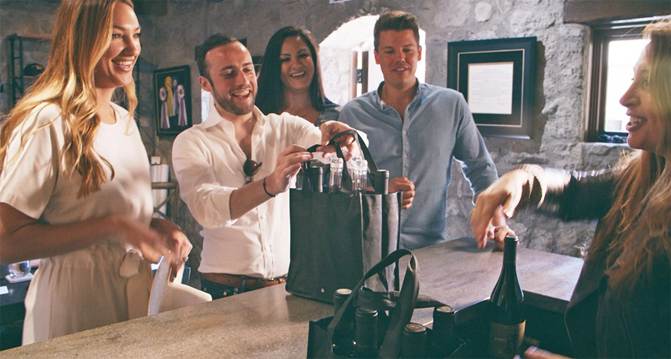
As mentioned elsewhere in this issue, we often buy wine to take home when we go wine tasting.  It seems like a simple proposition: We try it; we like it; we buy it.  But in fact, there’s more that goes into the decision.  If you, like us, are looking to purchase some wine on your trips, here are a few things to consider.

Photo courtesy of Highway 29 Creative.
  • Can you find it in wine shops near your home?  There’s no point in lugging bottles around on a vacation or paying to ship them if you can just walk around the corner and buy the same wines.  It’s more likely that lower-priced, mass-production wines will be available locally than top-end wines, even from the same producer.  If you’re not sure, look up the web site of your favorite store or call them.  You can also use an application such as winesearcher.com to find out if that wine is sold near you.
  • Are you a member of the winery’s club?  One of the advantages of joining a wine club is that you get free tastings at the winery.  Since we know we’ll enjoy the wines they serve (or we never would have joined in the first place) we generally take them up on the offer.  But why buy wines that you know will be shipped to us a few months hence?  That’s particularly true of wines that are restricted for sale only to members.
  • Is the wine only available in the tasting room?  We have found that some producers that sell their wines widely also give their winemakers the chance to make a low-production wine from the best grapes reserved each year for that purpose.  The amount made is so low that they can’t even send it to all their members and only make it available to visitors.  So if you like it, you may want to take advantage of being there at the right time for a special deal.
  • Do you enjoy the wine as it is?  This seems like a silly question, but wine changes over time.  For example, we prefer to age fine wine from Bordeaux for at least eight years from the vintage.  If we’re tasting in that region, we know the wines offered to us will be young and nowhere near the peak quality that gives the label it’s reputation.  So we buy on the wines’ potential.  We use the clef du vin to get an idea of what it’s going to be.
  • Do you have the patience (and the place) to age your purchases?  If not, hesitate to buy wines that demand time.  You might forego Cabernet Sauvignons in favor of Zinfandels that are often at their best a few years from the time the grapes were picked.  As a general rule, white wines need less cellaring than reds, so for example if you find a Chenin Blanc that really appeals to you, buy that instead the same winery’s Syrah.