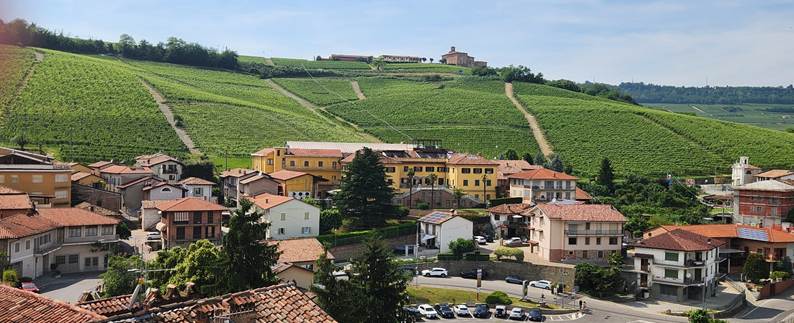
Alba, Italy

The town of Alba, nestled in the Piemonte hillsides, is famous for making three things that give the world pleasure: wine, truffles and chocolate.  Any place whose economy is based on those three is bound to be a happy one.

Let’s start with the truffles.  Of course, they had grown near the roots of local trees from time immemorial.  They were harvested by local farmers and their dogs (not pigs) and used as a flavoring but not as an expensive luxury item.  Then, in the first part of the 20th century, Giacomo Morra, the owner of a local hotel, realized that white truffles, Alba’s specialty, could be a big international business.  He started the annual Truffle Fair that still occurs each October and attracts thousands of chefs and epicures to his town (and his hotel).  Even if you visit Alba in the other eleven months, you’ll find truffle dishes on Albanese menus, if only the less-prized black ones.
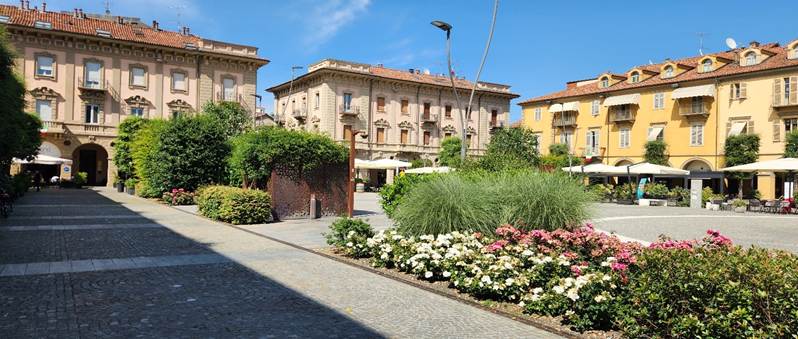
The Piazza Michele Ferrero in Alba.

Alba’s chocolate is forever associated with the name Ferrero, maker of Nutella, Ferrero-Rocher and now Nestlé chocolate bars in the United States.  The primary public square in Alba is the Piazza Michele Ferrero, named for the man who turned a small family confectionary into a global industrial enterprise, still headquartered in Alba.  In recent years the piazza has been significantly renovated and is the focal point of any visit to the town.

And then, the wine.  The local farmers had been raising grapes and making wine for centuries.  The prevalent varietals were Barbera and Nebbiolo.  The former was made by the farmers for their own use.  It was thin and acidic.  In the mid-20th century came the realization that with better vineyard techniques and more sanitary winemaking facilities, Barbera could be an exportable product.  Late in the century, Barbera started to be aged in French barrels and the fuller, fruitier, less acidic Barbera d’Alba entered the market.  (There is also Barbera d’Asti, which is its more acidic cousin.)
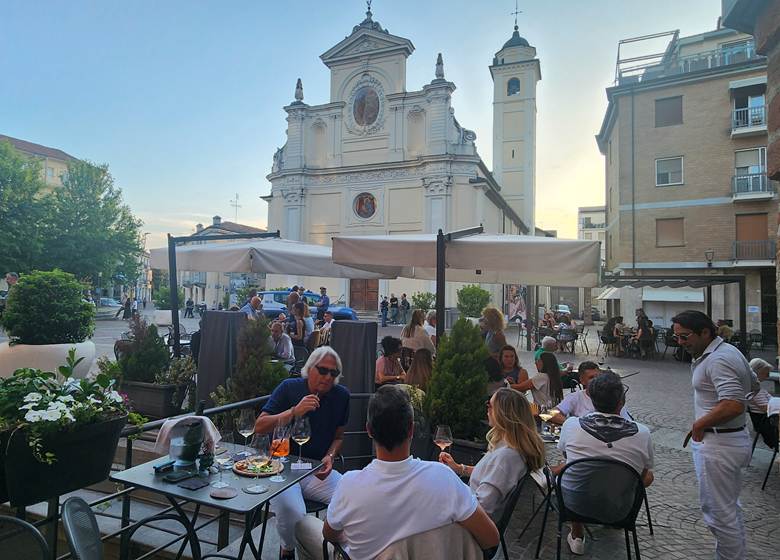
Albanese gathering for an aperitivo in the Piazza San Giovanni Batista.

What the Albanese make is interesting, but it says nothing abouta visiting the town.  In terms of art and architecture, it’s not particularly interesting, though there are some impressive churches.  For those visiting for the purpose of wine tasting, Alba is the place to stay.  It is 15 minutes’ drive from the villages of Barolo to the south and Barbaresco to the north.  Numerous other even tinier villages to the south are also in the Barolo region and make that wine, a subject for a future issue of Power Tasting.

Alba itself is a sprawling town, with only the central historical center of interest to visitors.  That core is graced with piazzas, churches, shops, restaurants, gelaterias and wine bars.  Taking a few glasses in the wine bars and meeting with friends and neighbors appears to be the preferred Albanese sport, one that visitors can also indulge in.  Two of the best wine bars, Roberto Serratto and 100Vini, are located on the Piazza Michele Ferrero; reviews will appear in future issues of Power Tasting.
Marchesi di Barolo

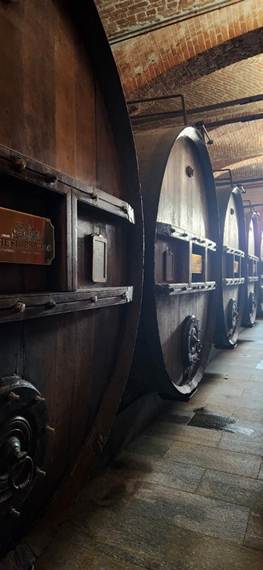
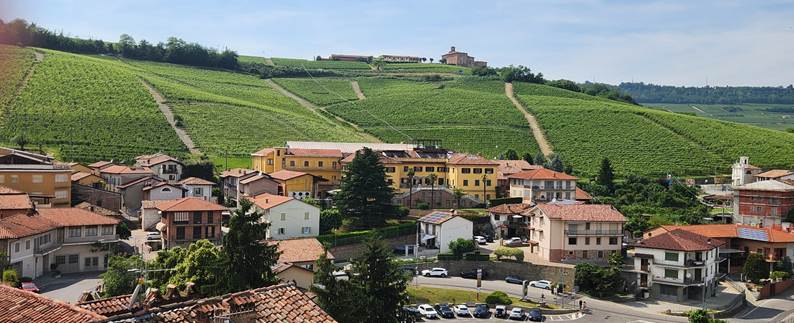
On the main street in the village of Barolo there’s a big yellow building housing the winery of the Marchesi di Barolo.  Barolo as we know it today was first produced by this winery.  Although it is named after the Marchesi, the real “inventor” was the Marchesa Giulia di Barolo, in the early 19th century.  Before then, the wines produced there were sweet and sparkling.  She figured out that with cellaring in large casks, the Nebbiolo grape could be used for a deep-bodied, rich table wine.  You can still see those casks on a visit to the winery because, amazingly, they are still in use.  Alas, the Marchesi no longer owns it, but it is still owned and operated by a local family.

The big yellow building in the village of Barolo is the Marchesi di Barolo winery.

Visitors enter into a covered courtyard with a few touristy photo spots that belie the quality of the wines Marchesi di Barolo makes.    There are numerous tours offered in various languages, so the sit-down tasting room is able to accommodate several tours at a time.  The walls are completely covered with graffiti left by previous visitors, which again detracts from the wine.

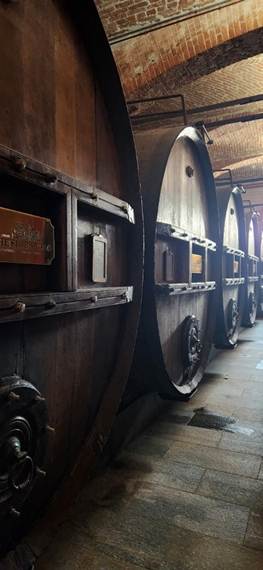
Huge wine casks from the 19th century, still in use at Marchesi di Barolo today.

Those quibbles aside, the tour and tasting are worthwhile.  After all, this is where Barolo was born.  The guides give quite a history lesson, explaining the importance of the Falletti family (that was the Marchesi’s family name), the love story of Tancredi and Giulia di Marchesi and, most importantly, how Barolo came to be.  Seeing those ancient casks makes the history come alive.  You also see that modern Barolo uses neutralized French oak barrels as well as the casks, to provide smoothness and to hasten the development time from harvest to bottle.

Depending on the tasting you choose, you can obtain a good understanding of Marchesi di Barolo wines and, in fact, of Barolo more generally.  You try a Langhe Rosso, which is Nebbiolo but not from the vineyard areas designated for Barolo itself.  They offer a Barbaresco for contrast, a few single vineyard Barolos and a Riserva.  (Marchesi di Barolo also makes wines from other grapes, such as Barbera, Cabernet Sauvignon and Cortese, which were not included in our tasting.)

A few words about the vineyards: the term in Piemonte for single-vineyard wines is MGA (for Menzioni Geografiche Aggiuntive).  There are more than 170 vineyards in the official Barolo region, but some are considered to be the best, including vineyards with names such as Cannubi, Brunate and Monprivato.  So if you see Barolo Cannubi on a label, for example, you’ll know it’s an MGA from a top winery.  Marchesi di Barolo offers four of them.  A Barolo Classico is a wine made from grapes from multiple vineyards.  These tend to be less complex and more approachable when young.

If the wines made today weren’t any good, then all the history of the Marchesi di Barolo wouldn’t matter.  But they are quite good and the best of them are sought after around the world.  So if you don’t know much about either the history or the Barolo wines, this is a good place to start.

Wine Tasting in the Piemonte

In the northwest of Italy there is a section called the Piemonte, which is Italian for “foothills”, in this case the foothills of the Alps.  As is true almost everywhere in Italy, they make wine there.  But the wines from this region are particularly well known, starting with Barolo, considered among the best the nation has to offer.  There are other wines as well.  Barolo and its close cousin Barbaresco are made from Nebbiolo grapes, as is Langhe Rosso, a perfectly fine wine that doesn’t meet the requirements for the Big Two.  (Langhe is a local word for the Piemonte region.)

But as they say in the late-night commercials, that’s not all.  In the reds, there’s wine made from Barbera grapes, centered in both the towns of Alba and Asti.  There’s also wine from the Dolcetto grape, which is dry despite its name; the best comes from Dogliani to the south.  There are some unique whites as well, including Arneis from the Roero subregion north of Barbaresco and Cortese that’s used in Gavi wines, made in the southern reaches of the Piemonte.  You can also find Vermentino and the omnipresent Chardonnay.

Those of us who enjoy tasting wines in the places where they are made have so much to choose from in the Piemonte.  We focused on visits to red wine producers, drinking whites with meals in the oppressive heat that is haunting Western Europe this year.  Winery reviews will be in this and successive issues of Power Tasting.

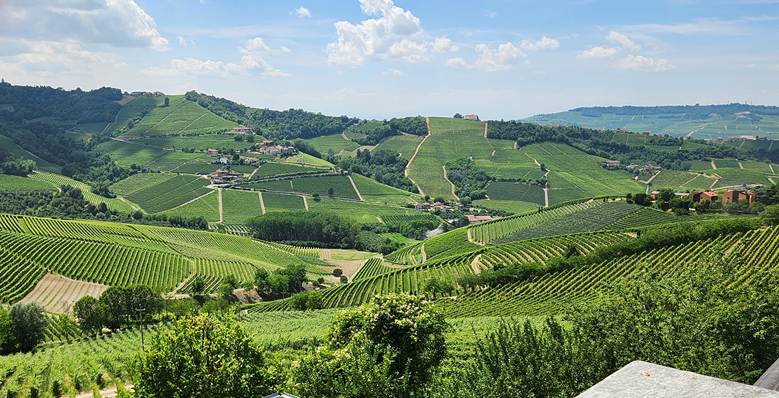
A typical Piemonte vista.

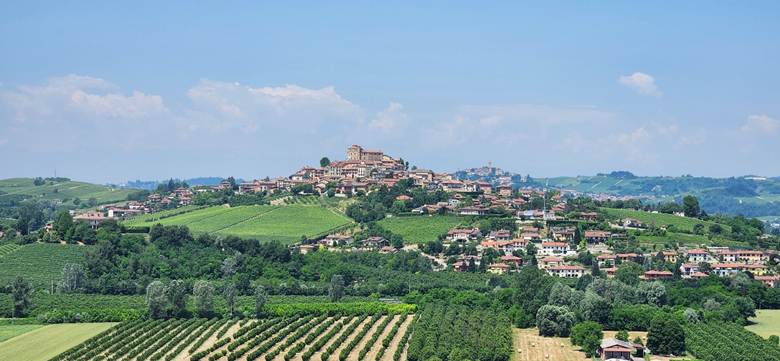
The winemaking areas of the Piemonte are famed for their beauty.  No matter how often you may have seen pictures of the region, including the one included in this article, nothing prepares you for the reality.  It is stunning and there is a new vista to take your breath away around every bend in the road.  (This is European Wine Country so there are many bends in the roads.)  There are many villages on hilltops, built there in medieval times for security reasons.  Seeing them across endless vines is rather special.

The village of Roddi on a hilltop, across the vineyards.  It’s much prettier from a distance than in the village itself.

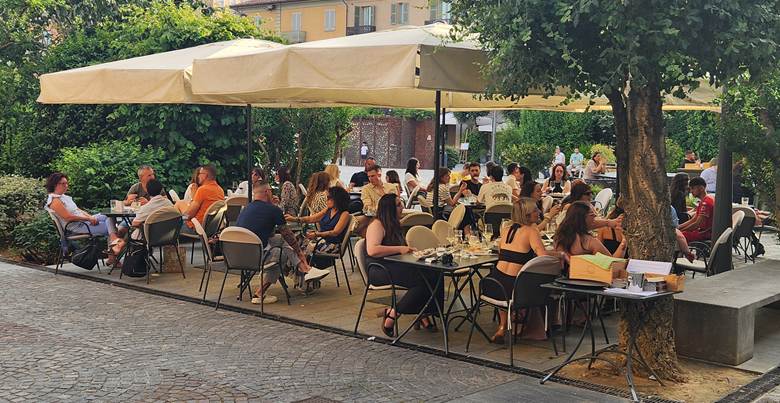
When not visiting wineries, you can sample local wines at the many wine bars that you find both in the towns, Asti and Alba, and seemingly every little village as well.  The wine bars are especially popular in the early evening, aperitivo time.  You can spend anything from a few euros for a simple Arneis to thirty or more for a grand Barolo.  Better yet, every bar, no matter how humble, provides a spread of olives, cheese, salami and maybe a bit of pizza – to go with your drink.  We found that having had a full lunch in a village after visiting a winery, the aperitivo offering was enough for dinner.

Aperitivo time in Alba.

The winemaking area of the Piemonte is rather concentrated.  Alba is in the center, and most of the wineries are only about 15 minutes’ drive from the town.  Even the time to go from village to village takes no more than 20 minutes between them.  It makes it easy to see, and taste, a lot in a short time.

Wine Tasting Appointments in the Piemonte

Wine tasting at the most exclusive wineries everywhere has long been on the basis of “By Appointment Only”.  This applies to areas as widely spread as Napa Valley, Bordeaux and Tuscany.  In the Piemonte, specifically relating to the wineries in Barolo and Barbaresco, they have never been open for casual passers-by to stop in for a taste of their wines.  At one point, there were no organized tastings at all in the Piemonte; you got to try a few wines if you were in the trade or were a friend of the owner.

By the 1990’s wine tasting tourism had taken off around the world and Piemonte had become a destination region based on the quality of their wines.  But the wineries themselves were – and for the most part, still are – small, family owned businesses that are in the wine business, not tourism.  Serving visitors has become a profitable sideline, but no more than that.  To control the distraction from their main business of winemaking and to contain labor costs, almost all wine tasting in the Piemonte is strictly by appointment.  And the tastings can be quite costly.

Here are some tips to get the most out of a Piemonte visit, while working through the appointments.

  • Do some homework.  This has long been advice given by Power Tasting, for wine tasting anywhere.  But many Americans, even knowledgeable wine tasters, are not that familiar with specific Barolo and Barbaresco wineries, so some prior research is called for.  Find out which wineries make quality wines and offer tastings that fit your budget.  Then get on their web sites and make your appointments.
  • Don’t over-plan.  Realistically, you can only visit one winery per day.  That’s because almost every tasting includes a tour as well.  These visits take at least an hour and half.  But there are only a limited number of tours in English.  So unless you’re fluent in Italian, there’s only one or two times you can visit.
  • Use the rest of your time wisely.  Have lunch in the village.  Visit a castle.  Sit in a wine bar and sample the wines of whatever village you’re in.  Enjoy the incredible views.  Who knows when you’ll ever be in the Piemonte again; enjoy it while you’re there.
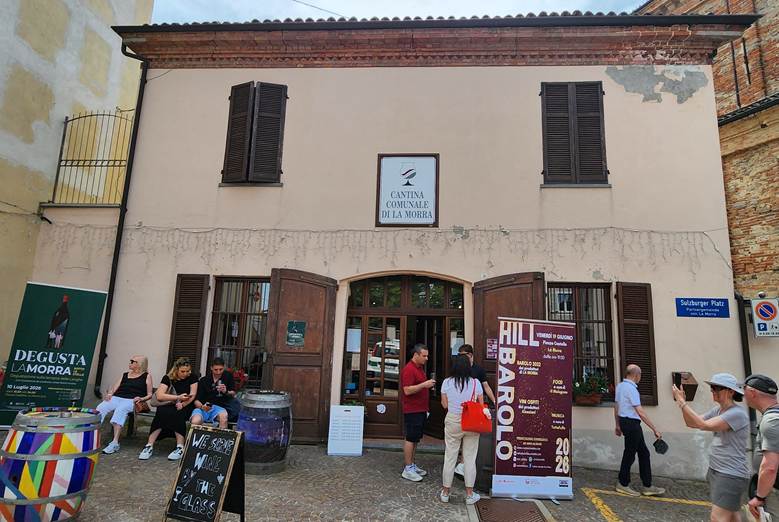
The cooperative in La Morra.
  • Take advantage of the exceptions.  There are a few opportunities for wine tasting without an appointment.  In the village of Barolo, there’s a tasting room of the Borgogno winery where you can just come in and order their wines by the glass.  (Borgogno also offers tasting tours.)  In the little village of La Morra, which also offers spectacular panoramic vistas of the Barolo vineyards, there’s the cooperative, called the Cantina Communale de La Morra.  There’s a huge selection of lesser-known Barolos and other wines to try.
  • Try your luck.  You can knock on the door of a winery, look very apologetic and say that you don’t have an appointment but you’d like to try their wine.  You never know, they might pour you a little.  It worked for us, at least once.

Marchesi di Barolo

On the main street in the village of Barolo there’s a big yellow building housing the winery of the Marchesi di Barolo.  (Well, there is only one street in the village, but even so.)  Barolo as we know it today was first produced by this winery.  Although it is named after the Marchesi, the real “inventor” was the Marchesa Giulia di Barolo, in the early 19th century.  Before then, the wines produced there were sweet and sparkling.  She figured out that with cellaring in large casks, the Nebbiolo grape could be used for a deep-bodied, rich table wine.  You can still see those casks on a visit to the winery because, amazingly, they are still in use.  Alas, the Marchesi no longer owns it, but it is still owned and operated by a local family.

The big yellow building in the village of Barolo is the Marchesi di Barolo winery.

Visitors enter into a covered courtyard with a few touristy photo spots that belie the quality of the wines Marchesi di Barolo makes.    There are numerous tours offered in various languages, so the sit-down tasting room is able to accommodate several tours at a time.  The walls are completely covered with graffiti left by previous visitors, which again detracts from the wine.

Huge wine casks from the 19th century, still in use at Marchesi di Barolo today

Those quibbles aside, the tour and tasting are worthwhile.  After all, this is where Barolo was born.  The guides give quite a history lesson, explaining the importance of the Falletti family (that was the Marchesi’s family name), the love story of Tancredi and Giulia di Marchesi and, most importantly, how Barolo came to be.  Seeing those ancient casks makes the history come alive.  You also see that modern Barolo uses neutral French oak barrels as well as the casks, to provide smoothness and to hasten the development time from harvest to bottle.

Depending on the tasting you choose, you can obtain a good understanding of Marchesi di Barolo wines and, in fact, of Barolo more generally.  You try a Langhe Rosso, which is Nebbiolo but not from the vineyard areas designated for Barolo itself.  They offer a Barbaresco for contrast, a few single vineyard Barolos and a Riserva.  (Marchesi di Barolo also makes wines from other grapes, such as Barbera, Cabernet Sauvignon and Cortese, which were not included in our tasting.)

A few words about the vineyards: the term in Piemonte for single-vineyard wines is MGA (for Menzioni Geografiche Aggiuntive).  There are more than 170 vineyards in the official Barolo region, but some are considered to be the best, including vineyards with names such as Cannubi, Brunate and Monprivato.  So if you see Barolo Cannubi on a label, for example, you’ll know it’s an MGA from a top winery.  Marchesi di Barolo offers four of them.  A Barolo Classico is a wine made from grapes from multiple vineyards.  These tend to be less complex and more approachable when young.

If the wines made today weren’t any good, then all the history of the Marchesi di Barolo wouldn’t matter.  But they are quite good and the best of them are sought after around the world.  So if you don’t know much about either the history or the Barolo wines, this is a good place to start.