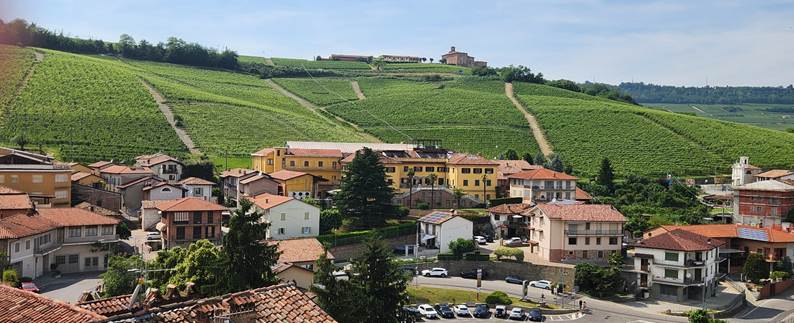
On the main street in the village of Barolo there’s a big yellow building housing the winery of the Marchesi di Barolo. Barolo as we know it today was first produced by this winery. Although it is named after the Marchesi, the real “inventor” was the Marchesa Giulia di Barolo, in the early 19th century. Before then, the wines produced there were sweet and sparkling. She figured out that with cellaring in large casks, the Nebbiolo grape could be used for a deep-bodied, rich table wine. You can still see those casks on a visit to the winery because, amazingly, they are still in use. Alas, the Marchesi no longer owns it, but it is still owned and operated by a local family.
Visitors enter into a covered courtyard with a few touristy photo spots that belie the quality of the wines Marchesi di Barolo makes. There are numerous tours offered in various languages, so the sit-down tasting room is able to accommodate several tours at a time. The walls are completely covered with graffiti left by previous visitors, which again detracts from the wine.
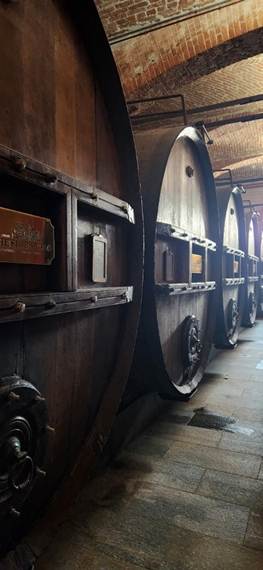
Those quibbles aside, the tour and tasting are worthwhile. After all, this is where Barolo was born. The guides give quite a history lesson, explaining the importance of the Falletti family (that was the Marchesi’s family name), the love story of Tancredi and Giulia di Marchesi and, most importantly, how Barolo came to be. Seeing those ancient casks makes the history come alive. You also see that modern Barolo uses neutralized French oak barrels as well as the casks, to provide smoothness and to hasten the development time from harvest to bottle.
Depending on the tasting you choose, you can obtain a good understanding of Marchesi di Barolo wines and, in fact, of Barolo more generally. You try a Langhe Rosso, which is Nebbiolo but not from the vineyard areas designated for Barolo itself. They offer a Barbaresco for contrast, a few single vineyard Barolos and a Riserva. (Marchesi di Barolo also makes wines from other grapes, such as Barbera, Cabernet Sauvignon and Cortese, which were not included in our tasting.)
A few words about the vineyards: the term in Piemonte for single-vineyard wines is MGA (for Menzioni Geografiche Aggiuntive). There are more than 170 vineyards in the official Barolo region, but some are considered to be the best, including vineyards with names such as Cannubi, Brunate and Monprivato. So if you see Barolo Cannubi on a label, for example, you’ll know it’s an MGA from a top winery. Marchesi di Barolo offers four of them. A Barolo Classico is a wine made from grapes from multiple vineyards. These tend to be less complex and more approachable when young.
If the wines made today weren’t any good, then all the history of the Marchesi di Barolo wouldn’t matter. But they are quite good and the best of them are sought after around the world. So if you don’t know much about either the history or the Barolo wines, this is a good place to start.