The town of Alba, nestled in the Piemonte hillsides, is famous for making three things that give the world pleasure: wine, truffles and chocolate. Any place whose economy is based on those three is bound to be a happy one.
Let’s start with the truffles. Of course, they had grown near the roots of local trees from time immemorial. They were harvested by local farmers and their dogs (not pigs) and used as a flavoring but not as an expensive luxury item. Then, in the first part of the 20th century, Giacomo Morra, the owner of a local hotel, realized that white truffles, Alba’s specialty, could be a big international business. He started the annual Truffle Fair that still occurs each October and attracts thousands of chefs and epicures to his town (and his hotel). Even if you visit Alba in the other eleven months, you’ll find truffle dishes on Albanese menus, if only the less-prized black ones.
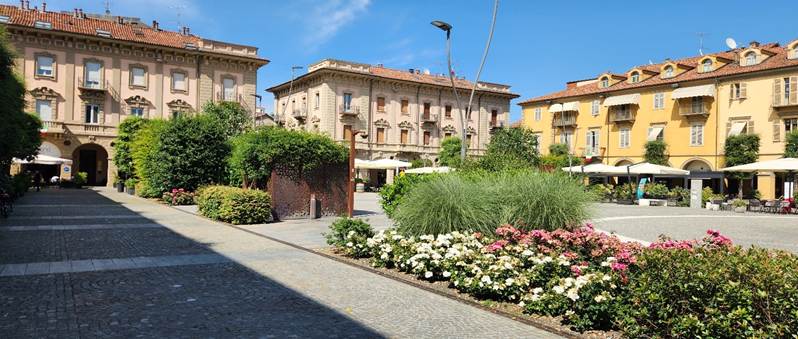
The Piazza Michele Ferrero in Alba.
Alba’s chocolate is forever associated with the name Ferrero, maker of Nutella, Ferrero-Rocher and now Nestlé chocolate bars in the United States. The primary public square in Alba is the Piazza Michele Ferrero, named for the man who turned a small family confectionary into a global industrial enterprise, still headquartered in Alba. In recent years the piazza has been significantly renovated and is the focal point of any visit to the town.
And then, the wine. The local farmers had been raising grapes and making wine for centuries. The prevalent varietals were Barbera and Nebbiolo. The former was made by the farmers for their own use. It was thin and acidic. In the mid-20th century came the realization that with better vineyard techniques and more sanitary winemaking facilities, Barbera could be an exportable product. Late in the century, Barbera started to be aged in French barrels and the fuller, fruitier, less acidic Barbera d’Alba entered the market. (There is also Barbera d’Asti, which is its more acidic cousin.)
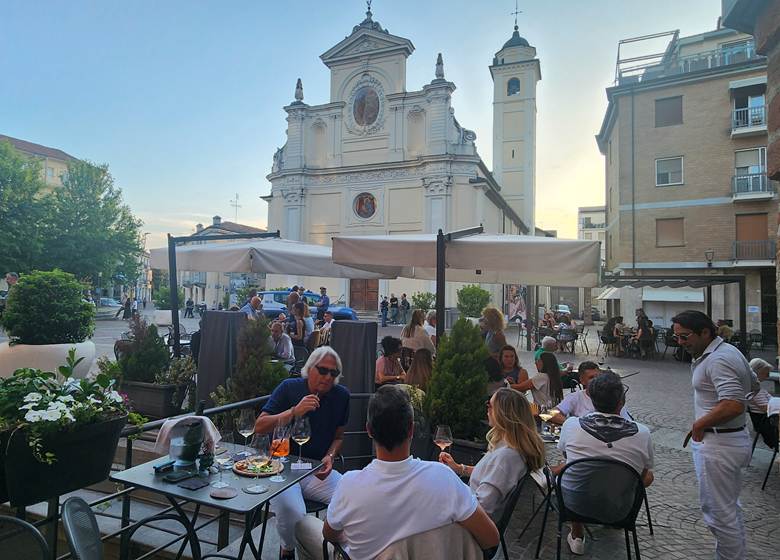
Albanese gathering for an aperitivo in the Piazza San Giovanni Batista.
What the Albanese make is interesting, but it says nothing abouta visiting the town. In terms of art and architecture, it’s not particularly interesting, though there are some impressive churches. For those visiting for the purpose of wine tasting, Alba is the place to stay. It is 15 minutes’ drive from the villages of Barolo to the south and Barbaresco to the north. Numerous other even tinier villages to the south are also in the Barolo region and make that wine, a subject for a future issue of Power Tasting.
Alba itself is a sprawling town, with only the central historical center of interest to visitors. That core is graced with piazzas, churches, shops, restaurants, gelaterias and wine bars. Taking a few glasses in the wine bars and meeting with friends and neighbors appears to be the preferred Albanese sport, one that visitors can also indulge in. Two of the best wine bars, Roberto Serratto and 100Vini, are located on the Piazza Michele Ferrero; reviews will appear in future issues of Power Tasting.