Staying in a Village

There are many wonderful places in the United States where wine is made and tastings are available.  Most are located in small towns, often near large cities, such as Sacramento or New York.  What we don’t have in the US are villages.  Oh, certainly some of the towns are small and picturesque but they lack the atmosphere that only comes from centuries of families living near each other, with only a few roads (or only one), with homes nestled along the roadway.  For those, we have to go to Europe or in Quebec.

We are not immune to the pleasures of Europe’s great cities, so we often take our vacations in the great cities such as Paris, Rome or London.  But every few years we choose to stay somewhere where the pace is slower, there are no famous sights to see and there is no traffic on the streets.  And where the grapes are growing right outside our window.  In this article, we will use the tiny village of Poilhes in the Languedoc as an example, but it could as easily have been San Leonino in Italy, Nyons in France or Widdicombe in England.  (Okay, there are no grapevines in England, but the feel of the place is the same.)

By the way, Poilhes is pronounced something like POU-yeh.  Close enough but not exact.

There is only one road in Poilhes and we were lucky enough to rent a house along it.  It was well equipped and had air conditioning, which is becoming increasingly important for any travels in Europe between May and October, the best times to be in Wine Country of course.  There is a tiny church, whose bell announces the hours and serves as a sometimes unwanted alarm clock.  It’s amazing how quickly we stopped hearing the ringing.
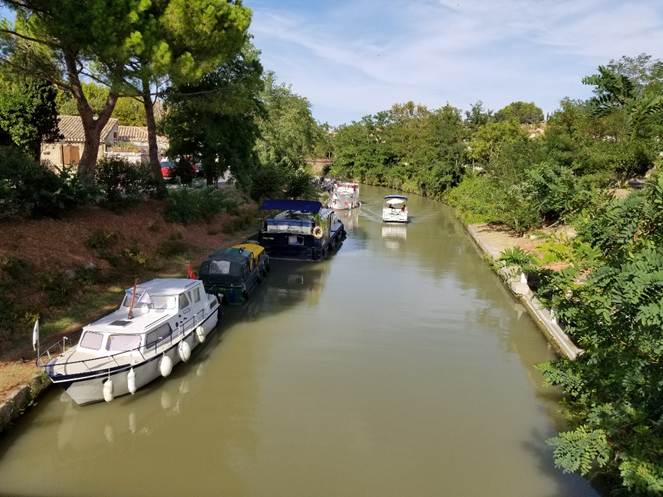
Boats along the Canal du Midi.

We were about 100 feet from the historic and picturesque Canal du Midi, once used for commerce and now only for pleasure boats.  On the other side of the canal from our house, there was the only grocery store in Poilhes, the Épicerie du Canal, which was only open a few hours in the morning and another few in the afternoon.  Upon awakening, we’d throw on some clothes and head to the Épicerie for a baguette, croissants and a pain au chocolat (chocolate croissant in this country).  Let us tell you, there is no better breakfast than freshly made French bread and pastries with country butter and locally made preserves that we bought in the weekly market.
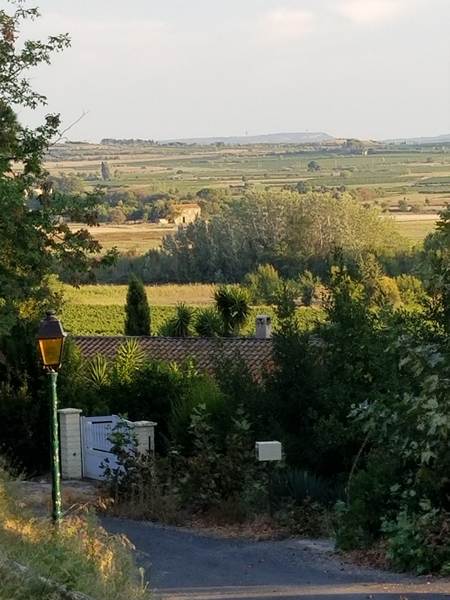
The view just down the road.

What is there to do in a village such as Poilhes?  We took walks by the vineyards. We went to the village farmers’ market and to the ones in neighboring villages.  We befriended one of the cats that run wild in the backyards.  We picked figs off the tree that grew in our backyard.  We learned all about Languedoc wines at the rather superb wine store/tasting room, the Vinauberge.  We snacked under a spreading platane tree at a bistro across the street run by a transplanted English couple, who frankly couldn’t cook all that well.  We dined at a fancy restaurant that was a stopping point for the pleasure craft on the canal.  And of course, we tasted the wines made nearby and all around the village.

We recommend to anyone who would like to get the feel of Wine Country as well as the taste, that they plan a stay in a village like Poilhes.  It’s an experience that will generate a lifetime of memories.
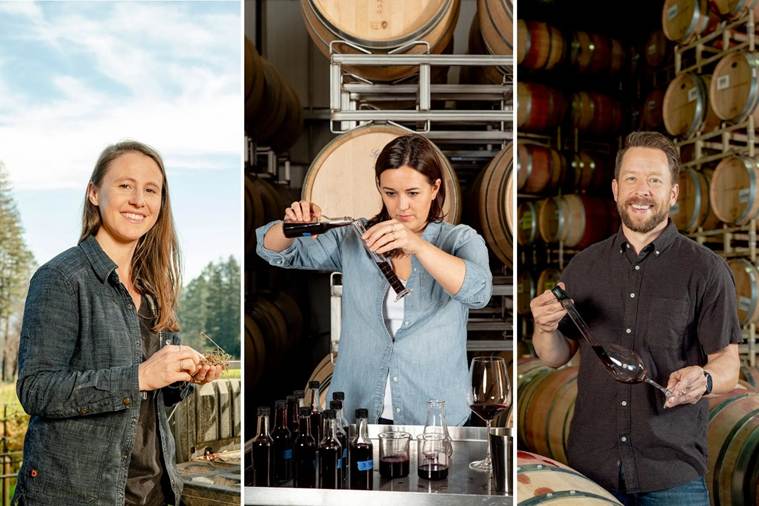
Talking with Winemakers

The servers in a tasting room are, de facto, the faces of the winery.  They explain the background of the label, the vineyard(s) and often the owners.  In Europe, there is often a distinguished history of both wines and nobles that goes back centuries; the serve seems like little more than a vassal.  In the US, especially in California, ancient history often began in 1976, so the current ownership gets more attention.  What you don’t hear much about is the winemakers for that winery.

From our point of view, the winemakers are the stars of the show.  They are the ones who actually create what winds up in our glasses and in many cases they oversee the growth of the grapes that made the wine.  For the most part, they are behind the scenes for actual tastings.  But on occasion, the winemaker happens to be in the room or, in the case of smaller wineries, he or she is also the owner and the server, as well as the lead salesperson and the bookkeeper.

Jaimee Motley, Stony Hill Vineyard; Avery Heelan, Larkmead Vineyards; and Ryan Rech, Beringer Vineyards.  Photos courtesy of Wine Enthusiast.

If you should happen to meet a winemaker, the conversation might be limited to “I like your wine” and “Thank you”.  But such a meeting is a rare learning opportunity.  You should really make the most of it in the few minutes you’re likely to have.

  • A little praise goes a long way.  The winemakers don’t often have direct customer feedback, so if you can say more than the fact that you liked their wine, their ears will perk up.  For example, if you can truthfully say, “We opened your 2018 Pinot Noir last week and it’s drinking real well, with heavy raspberry flavors” the person who made it will be rightly appreciative.  That will open the door for a more in-depth conversation.
  • If you’re just discovering their wines, discuss what you’re tasting at that moment.  A simple question such as, “How do you think this Merlot will change with age” will indicate that you’re interested in learning and might lead to a sale.  You should get a fairly detailed answer. 
  • Modern winemakers love sustainability.  Climate change and water shortages are threats to their profession, so they are all becoming ecologists.  If you ask what they are doing to sustain their vines and deal with changed weather conditions, you’re likely to get a brief lecture on the subject.
  • Ask for recommendations.  Especially in the US, winemakers may be responsible for a wide range of red and white wines.  They are all their babies, and it would be a little rude to ask which of their wines they prefer.  But asking which wines are the best values or the best years for a certain grape indicate that you want to buy some.  And it lets them speak to the specifics of what they have created, not the generalities.
  • It shouldn’t have to be said, but be polite.  If you don’t care for the Sauvignon Blanc, you’d better keep it to yourself.  And there’s no reason for you, an amateur, to be giving your opinion on any winemaking issues you may have to a trained professional.

Lyon

Lyon is the third largest city in France, behind Paris and Marseilles.  It is infused with history, food and an unmistakable joie de vivre.  From a wine tasting perspective, it is ideally situated.  Drive a half an hour north and you’re in Beaujolais.  Go the other direction and you’re in the Northern Rhône; two totally different wine tasting experiences.  But with all those opportunities to visit wineries and vineyards, save time for Lyon itself.

The city is located at the confluence of the Rhône and Saône rivers, and it has been there since before the Romans conquered Gaul.  It has gone through wars, revolutions and invasions and somehow come out with a smile on its face.  A particularly interesting museum is the World War II Centre d’Histoire de la Résistance et de la Déportation which is a must. There is still a bit of history to be seen in the streets of Vieux Lyon.  There is a cathedral, of course, and the small streets still have housefronts that were built in the Renaissance.  There are hidden passageways called traboules to wander in and discover. 

The Basilica of Notre-Dame de Fourvière.  Photo courtesy of thisislyon.fr.

One sight not to be missed is the Basilica of Notre-Dame de Fourvière, across the Saône and overlooking the city.  It is an architectural wonder in itself in a Romanesque-Gothic style.  However, unlike the cathedral that really is Gothic architecture, this church was built in the 19th century.  It is probably the most recognizable building in Lyon and the views of the city from the Basilica are worth the trip.

But if you ask us, the reason to visit Lyon is the food.  The city is widely recognized as the culinary capital of France, although residents of Paris and the Côte d’Azur would argue the point.  We won’t get involved in that argument, but we can say we have had some very memorable meals in Lyon.  The restaurants there can be categorized in two ways: the highest of haute cuisine and the jolliest of bistro food.

The cuisine of Lyon today is dominated by the heritage of one man, Paul Bocuse (1926-2018).  Regarded as the greatest French chef of the last quarter of the 20th century, he inspired what came to be known as nouvelle cuisine, with an emphasis on lighter food, with vibrant flavors derived from the freshest ingredients.  The temple of French gastronomy in Lyon is Monsieur Paul’s namesake restaurant just out of town in Collonges.  A meal there is a lifetime experience.  He also opened four restaurants in Lyon that feature the top of classic French dishes; we especially remember the onion soup at one of them.

A traditional Lyon bouchon.  Photo courtesy of Discover Lyon Magazine.

At the other extreme are the bouchons, small bistros that feature traditional lyonnais dishes.  These include quenelles de brochet, airy puffs of chopped pike served in a rich sauce Nantua; salade lyonnaise, salad served with big chunks of bacon and a poached egg; and saucisson en brioche, sausage baked into brioche bread.  Of course there are wines lists, but the thing to do is to order a pot of wine (pronounced poe).  They hold 250 milliliters, enough for two glasses and they cost very little, typically around 10 euros.  So you order a pot, then another and another and before you know it you’re rolling out into the streets of Lyon.

Beringer – A Revisit

Many of the reasons to visit Beringer winery in St. Helena (www.beringer.com) for a wine tasting remain the same as they have been for decades.  The grounds are sculpted; many of the buildings retain a nineteenth century charm; and the wines, to our taste, are among the best that Napa Valley has to offer.  And let’s not forget a visit to their gift shop that has top quality chinaware and wine related articles.

As with almost all Napa Valley wineries, there is no longer a bar where visitors can be served, standing and generally milling around.  There are only seated tastings, in good weather served on the veranda of the Rhine House, built by the original Beringer brothers.  Just as at many other Napa Valley wineries, we feel that the way the wines are served detracts from the overall wine tasting experience. 

Wine tasting on the veranda at Beringer.  Photo courtesy of the winery.

[We need to clarify that we are referring only to the tastings of Beringer’s top quality wines.  There is, as there has long been, a simple self-guided tour of the property that comes with three tastes of some of their more commercial wines.  These may be best known, but are not comparable to the Private Reserve and single-vineyard wines one is served at the more expensive tastings.]

Visitors to the Rhine House are seated outdoors, which is a bit of a shame, because the interior of the building is so attractive, with burnished wood and fittings all about.  Yes, we could wander in there after our tasting, but it’s not quite the same as doing so with a glass in hand. 

The servers at Beringer are quite knowledgeable but in some case they can be rather chatty.  We appreciate being given background on the wines we are being served, the geology of the vineyard, the method of production, and so on.  A brief conversation about where we are from and why we chose to taste at that winery is fine.  But we want to be served and left alone to enjoy the wine, the views and the afternoon sunshine through the trees.  We don’t want to know where the server is from, how she came to work there and what she does in her spare time.  We are there to taste wine, not to make a new, temporary friend.  Alas, we found our server at Beringer – as at many other fine wineries – to be too talkative.  It is more of a distraction than anything else and it definitely distracts from the wine tasting experience.

Of course, the wines are the attraction and they didn’t let us down.  Our most recent tasting included a Private Reserve Chardonnay, a single vineyard Merlot, two single vineyard Cabernet Sauvignons and the famous Private Reserve Cabernet.  When we expressed a liking for the Merlot, our server brought another one from their library collection, unbidden.  That sort of thing also used to happen when we stood at the bar inside, but these circumstances made the little extra feel more personal.

All in all, a visit to Beringer is still one of the premier experiences available in Napa Valley.  It’s just not the same as it was.