Marchesi Di Grésy

The people of the Piemonte in northern Italy say that “Barolo is the king and Barbaresco is the queen”.  If that’s so, then the Barbaresco wines produced at the Marchesi Di Grésy have a fair claim to being the king of the queens.  We suppose a little background is necessary to substantiate that claim.

For starters, the full name of the winery is Tenute Cisa Asinari dei Marchesi Di Grésy.  (That’s “Cisa Asinari Estates of the Marquises of Grésy” if Google Translate is to be believed.)  The plural of Marquis is earned, because the French family, escaping the Revolution, have been making wine in this region since 1797.  However, it is only in relatively recent years that the wines made from the Nebbiolo grape in this region became recognized as something special.  Marchesi Di Grésy only started making wine under its own label in 1973 and it was only in 1980 that Barbaresco was granted DOCG status.
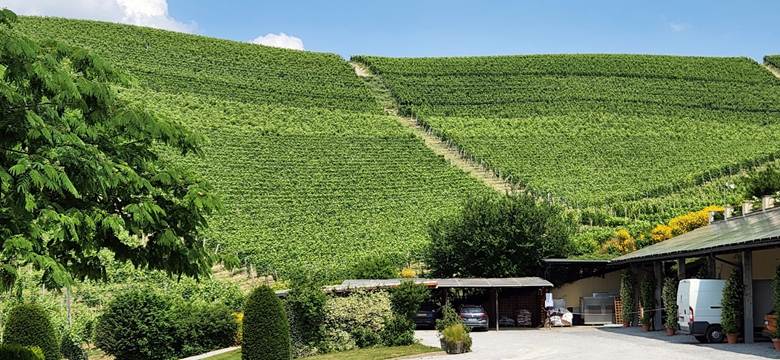
A portion of the Martinenga vineyard, behind the Marchesi Di Grésy winery in Barbaresco.

Marchesi Di Grésy makes wines other than Barbaresco.  The Chardonnays and Barberas are quite nice, but that’s not the reason to visit.  Right behind the winery is a steep hill, rounded in the form of an amphitheater.  That’s where the Nebbiolo is planted, in a vineyard known as Martinenga.  It faces south (a requirement for Barbaresco) and the soil and drainage are prefect for the Nebbiolo grape.

All of this explained in far more detail by a tour guide, who we found to be quite knowledgeable.  The tour is offered in English, making it easier for Americans.  As usual, visitors are shown the barrel room and pressing facilities, which for the most part are no different than other tours around Wine Country.  One interesting note is the use of large casks of Slovenian oak for aging in addition to French barrels, 20% of which are new every year.  (Other wineries use only aged, neutral oak barrels.)  The wines are aged a year in the casks and two years in the barrels.
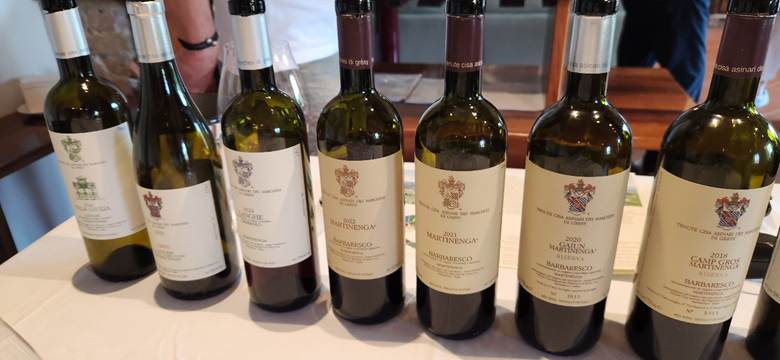
The wines served at a recent tasting.

Of course, after the tour comes the tasting.  This is where a visit to Marchesi Di Grésy excels.  Experienced wine tasters are used to being told about the top wines but being served the lesser ones. Not so at this winery.  The tasting begins with two Chardonnays and a Langhe Nebbiolo.  The latter wine comes from the outer regions of the Martinenga vineyard that aren’t directly southern facing and thus can’t be called Barbaresco.

Then it’s on to the wines that can use that designation.  [A little Italian wine naming convention is needed here.  A single vineyard wine in Italy is called M.G.A., for Menzione Geografica Aggiuntiva (Additional Geographical Mention).]  Since all the Barbarescos come from the vineyard just outside, they are all MGAs.  You get to taste two harvests of their basic Barbaresco. (Some basic!)  But within the vineyard there are certain parcels that produce exceptional wines, Camp Gros and Gaiun.  Most wine tastings we have had in wineries around the world don’t open their top riservas.  But at Marchesi Di Grésy, visitors really do get to sample the full range of the wines from a top producer.

We found the tour and tasting at Marchesi Di Grésy to be one of the most rewarding Wine Country experiences we have had.  All that, and the Marchese even came in to say hello.
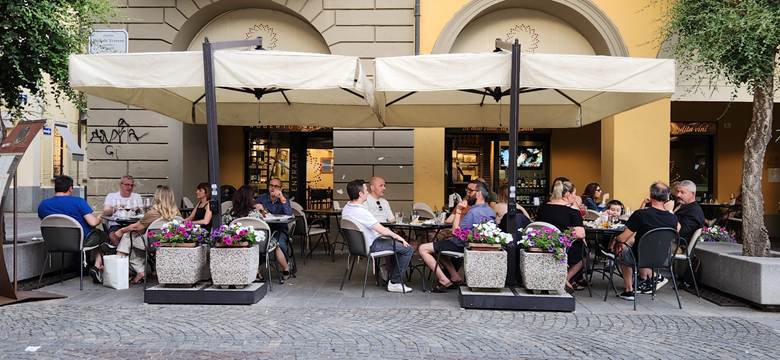
Roberto Sarotto, a Wine Bar in Alba, Italy

This is the latest in an irregular series of articles introducing readers to some of the great wine bars of the world.  Some of them are in frequently visited cities, like Paris or London.  Others are in wine making regions, such as the wine bar featured in this month’s edition.

Roberto Sarotto is a wine maker in the town of Alba, which is at the center of the Piemonte in northwest Italy.  The region is the source of some of Italy’s finest wines.  Signore Sarotto produces just about all of them: several Barolos and Barbarescos, Dolcetto and Barbera among the reds; Arneis, Gavi di Gavi and Chardonnay among the whites.  There’s even a choice of rosatos (Italian for rosés), sparklers, Grappas and other wines. 

But Roberto Sarotto is not satisfied to be only a winemaker.  He has also opened a wine bar at a prominent corner of the Piazza Michele Ferraro, the primary square in Alba.  In good weather people gather to taste his wines under the umbrellas outside.  Of course, it does rain in Alba and these years the summer heat can be oppressive, so there are tables inside where the air conditioning accommodates tasters.

Almost all the wines on the extensive list are available for purchase by the glass or the bottle. The exception is the wines designated as “Bottiglie Museo”, which we Americans would call library wines rather than museum bottles.  The prices range from a low of €7.50 for a glass of Mosto d’Uva, which is essentially non-alcoholic grape juice to a high of €36.00 for a well-aged reserve Barolo.  There are plenty of wines by the glass to choose from that are €10.00 or less.  Barolos and Barbarescos are on the list in the twenties and thirties of euros per glass.

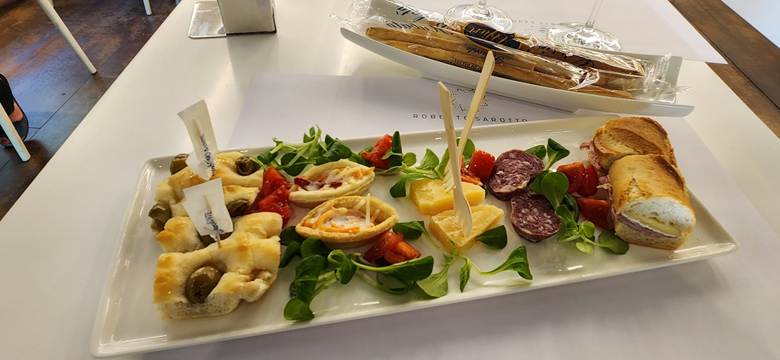
A typical aperitivo plate at Roberto Sarotto.

But a tasting at Roberto Sarotto is more than wine.  In the land of the aperitivo, no bar will serve you wine without a little something to munch.  In most cases it’s olives or potato chips.  At Roberto Sarotto, they serve you a repast.  As illustrated here, you will receive an assortment of bites that may include pizza rustica, local cheeses and salamis, a ham sandwich and breadsticks.  The actual selection varies from day to day but it is always ample.  It certainly could be a lunch or an appetizer before dinner.

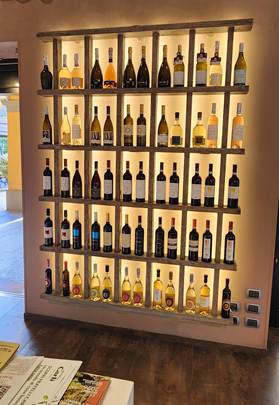
A display of (some of) the wines available to try.

There are positives to having such a wide selection from a single winemaker.  Visitors can sit and have a vertical of an individual wine or a horizontal across multiple subregions of the Piemonte.  However, despite all the different wines, they are all from the same winemaker; they only serve their wines, as in a tasting room not a wine bar.  There is a stylistic similarity among them.  If you have only one day in Alba, we recommend a visit to Roberto Sarotto.  If you have a little more time, taste there but also try other wine bars for greater variety of styles.

This is a little gem of a wine bar, nestled in a major sector of Wine Country.  And if you ask nicely when it’s not too busy, you can even get a tour of the cellar below the bar.

Wine Tasting Geology

We never studied geology in school.  It just seemed boring: rocks, rocks and more rocks.  Okay, it’s a noble science but it wasn’t our thing.  So we guess we missed the lessons about how the type of soil affects the taste and aroma of wine.  The lectures would have been okay; but we’re really sorry not to have done the lab work.

Now, when we go wine tasting, we don’t get down on our knees and run our fingers through the dirt.  Since we skipped the class, we wouldn’t know what we were looking at anyway.  But we have learned that there are some general characteristics of certain soils in different regions – or within a region – that differentiate one wine from another.  It’s not that one is better or worse than another, which is a matter of taste, but it adds to our pleasure in tasting wine to know where it came from. 

If you’d like, here are some tips.

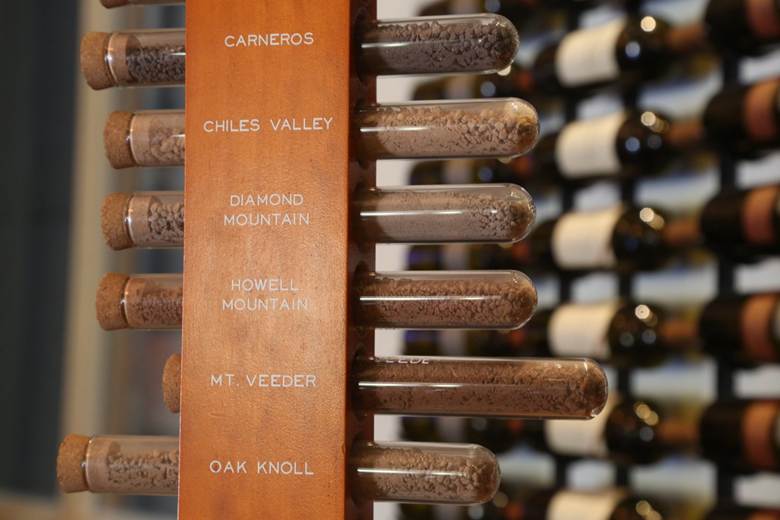
A display of soil types from the different vineyards that go into Conn Creek wines.  Photo courtesy of The Napa Wine Project.
  • Get the lay of the land.  Start with understanding that softer soils produce softer wines and stonier, harder ones have more flavors that come from the rocks.   Limestone and chalk are in the ground beneath the vines of Champagne; is there any softer wine?  Sandy soil or sandstone creates lighter colors and less tannins.  At the other extreme, where once there were volcanos, or where pressure created schist or slate, wines are dense and contain a lot of mineral and fruity flavors. 
  • Find out what kind of soil is predominant where you are going.  For example, the land south of the city of Bordeaux is full of gravel (hence the wines are Graves), which is little stones.  To the east, clay and limestone predominate in the soil of St. Emilion.  Think about it: Which of those wines are softer on the palate?  In St. Chinian, the vineyards to the north are made of schist and are big and bold, while those to the south are of limestone and are much softer and rounder.  California is big, so there are a lot of different types of soils.  But in the prime locales of Napa Valley and Sonoma County, it’s likely to be rocky on the hillsides (naturally) and sandier in the valleys.  For those who can distinguish between mountain and benchland wines, that’s a big part of the reason.
  • Ask your server.  In many countries in Europe, there are rules about what you can grow, where you can grow it and which grapes can be used are very strict.  So the soil will be very specific to individual vineyards.  American winemakers have more latitude.  Many California wines, for example, are made from single vineyards and it’s interesting to know what the underlying soil is like.  Even more so, when winemakers blend juice made from grapes grown in different vineyards, they are trying to balance exactly the tastes and aromas of the different soil types.  Your server ought to know how the soils affect the wines.  If he or she pleads ignorance, try to get an answer from someone more knowledgeable.
  • See if there’s a soil display.  Many wineries, in California and elsewhere, have displays of the different types of soil where they grow grapes.  Take advantage of it and try to make the connection to the wines you taste.  Again, a server who is an educator should be able to help you understand.

Milan’s Canal District

Milan is an ancient city, with Celts and Romans living there since well before the birth of Christ.  Yet compared with Italian cities like Venice or Rome itself, there isn’t that much history on display.  That’s because Milan was in the middle of so many wars over the centuries that a lot was destroyed.  Thus, the Milan Olympics’ closing ceremonies were held in Verona’s Roman amphitheater, not in Milan.

Oh yes, Milan has it’s fabulous cathedral and the castle of one of its Renaissance ruling families.  They’re well worth visiting but they’re not where you go for a good time.  If you’re looking to mix your history with a little fun, the place to go in Milan is the Canal District, known in Italian as the Navigli.

First the history part.  Venice is a lagoon; its canals are naturally made.  But Milan isn’t close to water, so to supply the city they had to build canals.  Way back in the 12th century, the Milanese recognized that they needed to get supplies into the city in bulk.  Horse-drawn carts couldn’t carry the necessary load anymore.  So first they built the big canal, the Naviglio Grande, that connected them to the Lake Maggiore and the rest of Europe beyond.  Other canals were built later on, but the one you want to know about is the big one.

Over the centuries the district where the canals are became run down, as trains replaced canal boats.  Starting in the 1980’s, artists and designers started taking up space in the abandoned lofts and workshops along the canals.  (Sounds like Soho in New York City, doesn’t it?)  Where there are artists, there are galleries.  Where there are galleries, there are cafés (or caffés, in this case).  And so, little by little, the Navigli was reborn, this time as a tourist destination.

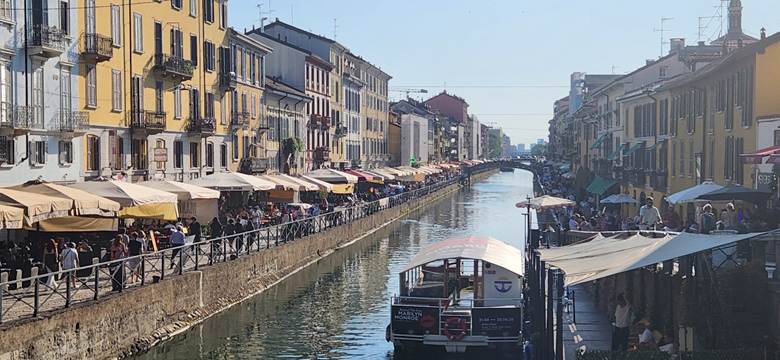
Milan’s major canal at 6:30 on a summer evening.

The funny thing is, there’s plenty of local Milanese there, too.  Italy’s national sport isn’t soccer.  It’s getting dressed nicely and taking a walk and looking around at all the other people taking a walk.  There’s even a word for it, the passeggiata. And there’s no better place for a passeggiata than a long walkway with plenty of places to stop for a glass of wine or a Campari.  Actually, two walkways, on either side of the canal.

You can certainly visit the Navigli during the day.  By all means, drop into the galleries, have a little lunch, get a little sun.  But you’re missing the best time of day.  Starting around five o’clock, or a little later in mid-summer, the sunlight fades and the people come out for a stroll.  You can be a part of the parade or you can sit on the side in a caffé and watch the parade go by.

There are many restaurants along the Naviglio Grande.  Many are pizzerias or pasta joints just for the tourists.  But there are some good restaurants as well.  Most of them serve Milan’s specialties, Veal Cutlet Milanese and Risotto Milanese.  These restaurants also have pastas with a bit more to offer than simple red sauce.  One can spend hours there having a first aperitivo at one caffé and then on to the next caffé for another aperitivo and, and, and…with some snacks offered with them while watching the passeggiata.