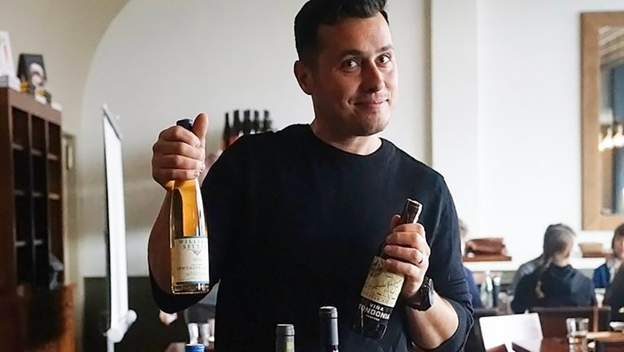
Pinot Noir Tasting

Our experience with Pinot Noir has been rather strange.  For a long time, we just didn’t care for wines made from this grape.  Too thin.  Too acid.  Too pricy.  We would continue tasting Pinot Noirs in our travels but we never got that kick that lovers of Burgundy wines have written and talked about.  Then on one wine tasting trip about a decade ago, the light bulb came on.

Pinot Noir grapes.  Photo courtesy of LaCrema winery.

We were in the Carneros region of Napa Valley at the Etude winery.  They’re equally well-known for their Cabernet Sauvignons as for their Pinot Noirs, so it was our intent to savor the big California boomers.  Since Pinot Noir was included in the tasting, why not try it?  That was the moment that changed everything; we became club members from that moment and still are.

On that trip and since then, we have been all over Carneros and have found many other wineries specializing in Pinot Noir.  Saintsbury and Domaine Carneros (yes, the same maker of California sparkling) are particular favorites.  But we have expanded our horizons.  We were dining at the late, lamented Hurley’s restaurant in Yountville and they had a weekly special wine from a place we’d never heard of, Santa Lucia Highlands.  Another aha moment and we’ve been buying wines from there ever since.

We’ve enjoyed Pinot Noirs from the Santa Rita Hills near Santa Barbara, from Russian River and Sebastopol in Sonoma County, and in Oregon’s Willamette Valley.  We enjoyed them in Burgundy’s Côte d’Or quite a while ago, but then seemingly lost our taste for them (and regained it, too).  To this day, we prefer California Pinot Noirs to the originals from France.  That may have something to do with the astronomical prices for grand cru Burgundies.

So were we wrong in the days when Pinot Noir didn’t appeal to us?  Not really, but did our taste change or did the wines?  To this day, we find some very well-regarded wines from Russian River and Green Valley in Sonoma County to be thin, acid and overpriced, just as we did in the past.  As you can read in our opening statement on Power Tasting’s front page, tasters need to know what they like.  That implies that we need to know what we don’t like, as well.

In general, we go for more robust Pinot Noirs, so some wine educators have told us that we want wines made for Bordeaux drinkers.  There’s probably a little truth in that, but we think it misses the point.  There are Cabernet Sauvignons that we don’t care for (and Syrahs, and Chardonnays, and Tempranillos and, and, and…) and many others that we love.  We always appreciate well-made wines that respect the nature of the grapes and reflect the hand of capable winemakers.

We don’t want a Pinot Noir that’s like a Cabernet Sauvignon.  We like Pinot Noirs that show the complexity of the grape, with subtle aromas and some deep notes that accompany the overall roundness that Pinot Noir can achieve.

That’s not too much to ask, is it?

Winery Tours, Part 2: for Experienced Tasters

Several years ago, we wrote about winery tours from the perspective of those who had never taken one before.  For anyone with even the least interest in wine, a tour can be very educational.  There’s really nothing like seeing the process, especially if you can visit Wine Country during the crush.  It really does show you how difficult the winemaking really is.  And in many cases, a tour is a prerequisite for tasting the wines.

Seeing the grapes for Amarone drying at Quintarelli in Valpolicella,  Italy.

But what if you have some experience in wine tasting?  Maybe you have taken numerous tours in the past, so why take another one?  There are a number of good reasons, even if you think you’ve seen it all.

  • You haven’t seen it all. We don’t want to get into the argument about the winemaker’s skill vs. terroir, but surely the way a wine is made has some impact on how it tastes.  Otherwise, they’d all taste pretty much the same.  At any winery, they have a particular way that they harvest (or instruct vineyard owners to harvest), clean the grapes, press them, vinify the juice, blend different varietals, age the wine and bottle it.  If you have been on tours before, you’ll recognize the differences at one winery versus the others you’ve seen.
  • You may be with a less experienced taster. Taking a tour with a friend gives you the opportunity to add your own point of view that the tour guide may not have.  Careful not to be a wine snob, though.

The barrel room at Groth in Napa Valley.

  • Refreshers aren’t a bad idea. Yes, you’ve taken tours, but when was the last one?  It’s not that things have changed all that much (although there have been technical advances) but it’s a good idea to keep yourself up to date.
  • A tour can give you an idea of the quality of the wines. For example, some wineries are sparklingly clean, others less so.  A winery that cares enough to hire and train knowledgeable tour guides is probably more concerned about the tiny details of making wine.  If your guide can’t answer your questions, this will tell you something about management’s perspectives on their customers.  So pay attention to the details.
  • Tours can be fun. Some wineries’ tours are little more than exercises in industrial engineering and about as accessible to the general public.  But we’ve been on others that take you into the vineyards to show you where the grapes you’ve tasted came from.  Quite a few these days combine the tour with the tasting and have bottles stashed in the vineyards or in the barrel room, so you’re tasting as you’re learning.  Quite a deal!

The underlying answer is that there’s always something new to learn.  You don’t have to tour every winery you visit.  For one thing, that can be expensive and repetitive.  But taking a tour every now and again is good for brain as well as your palate.

How to Change Your Mind About Wine…and Not

In our earliest years of wine tasting, we thought that only wines made from Cabernet Sauvignon were worth drinking.  Oh, well, we were young and foolish.  Of course, we’ve broadened our tastes significantly in the intervening time.  Each time we realized we really liked a wine we hadn’t cared for before, we had to change our mind.

The same applies in reverse.  There were some awfully sweet wines like Mateus and Lancers that we wouldn’t be interested in anymore.  Perhaps if we tried them again we might like them, but we doubt it.

Changing your mind about anything isn’t easy, wine included.  So here are some tips for revising your opinions specifically about wine, but maybe broader than that.  Many of these lessons we learned in Sonoma County, the theme of this issue.

Photos courtesy of Kazzit and the dailymeal.com

  • Keep your mind open. You’ll never improve your taste if you aren’t able to accept the possibility that you might learn to like wines you hadn’t liked before.  For the longest time, we weren’t particularly fond of Pinot Noir.  We found them too thin, too acid.  But we have learned to appreciate some Pinot Noirs, especially those from Carneros and Santa Lucia Highlands.
  • Keep trying. Maybe your ability to appreciate certain tastes and aromas has expanded.  Or maybe you’ll find a winemaker who does a better job than those you have tried before.  One of the advantages of wine tasting in Sonoma County is the vast range of varietals that are available there.  Often one winery will have a dozen different ones.  So if you try wine made from grapes you haven’t cared for in the past, you’ll still be able to sip others you know you like.  Maybe you’ll be surprised.
  • Differentiate the same types of wine from different areas. There are still some Pinot Noirs that don’t appeal to us.  We just can’t get our tongues around this varietal the way they make it in Sonoma County’s Green Valley.  But there are some just a bit south in Petaluma that do please us.  Is it terroir?  Specific winemakers?  Sheer luck?  Whatever the case, we went from “We don’t like it” to “We don’t like some of it” which is one way to change your mind.
  • Go back, you may love it. Sometimes a winery just has a bad year.  Here’s an example.  We have always loved the Zinfandels from Limerick Lane.  But in 2011, the winery changed hands and the new owners, by their own admission, didn’t make wines that lived up to the potential of their vines that year.  We dropped out of their club and didn’t visit again for several years.  When we did we were delightedly surprised.  Now we visit whenever we are in Healdsburg and buy some of their Zins every year.
  • Recognize that your tastes change. It may not be the wine that changes, but you.  Whether your tongue has become more sophisticated or you just have learned to like more wines, go with it.  There’s no reason not to accept your tastes for what they are, as long as you are ready to change them when given the opportunity.

Visiting Sonoma County

For many bygone years, a wine tasting trip in California meant travelling to Napa Valley.  Oh, we knew there were vineyards on the other side of the Mayacamas range in Sonoma County.  And occasionally we’d drive over the Oakville Grade and emerge on Route 12 in the Sonoma Valley region.  We’d visit a few nearby wineries and then scamper back to the familiarity of Napa Valley.  No disrespect to Chateau St. Jean, B.R. Cohn or Arrowood (our most frequent Route 12 visits) but we were missing an awful lot of what Sonoma County has to offer the wine enthusiast.

In the late ‘90’s we decided to dedicate an entire trip to Sonoma County.  It was very different then, much more rustic with simple wineries and not many places to eat.  Even though the main road is a highway (Route 101), Sonoma County’s Wine Country is vast.  Not knowing where we were going nor what we liked, we spent a lot of time driving from one winery we had heard something about to another and wasting a lot of time getting from place to place.

The view in front of the Stonestreet winery in Alexander Valley.

We’ve learned that the smartest plan is to visit one region per day.  Fortunately, there is a fairly consistent mapping of grape varietals with specific regions, so we have a good idea of the type of wine we’d be trying each day.  For example, Sonoma Valley was and is all about Cabernet Sauvignon and Merlot and so are Chalk Hill and Alexander Valley.  If you’re a Pinot Noir fan, you should head straight to Russian River and Green Valley.  And while you’ll find Zinfandel everywhere, they specialize in it in Dry Creek and Rockpile.  Chardonnay and Sauvignon Blanc are everywhere.

Old Zinfandel vines in Dry Creek Valley.

There are three towns where you’ll find most of the restaurants and hotels: Sonoma, Santa Rosa and Healdsburg.  If you did nothing but visit the main squares in each, and sip in the tasting rooms there, you’d have a pretty nice visit to Sonoma County.  All the same, we recommend that you get out into the countryside.

There are still plenty of wineries that are reminders of the way the county used to be.  They’re small, out of the way and their tasting rooms are nothing fancy.  Some have wines that are probably not worth being on the top of your list, but we have chanced upon more than a few that have been favorites of ours for many years.  It’s a good idea occasionally to let serendipity be your guide and try some wines you’ve never heard of.

At the other extreme, there are quite a few wineries in Sonoma County that have deservedly great reputations and should be considered for your visit.  Among these are Jordan, Verité, Rochioli, Martinelli, Ridge and Chalk Hill (including their Chardonnay).  Even before the pandemic, may of these were by appointment only, so check before you go.

Sonoma County may have once been Napa Valley’s little brother (at least in the opinion of the Napans).  In no way is that true today.  You can taste, dine, sleep and tour just as well in both these sectors of Wine Country.  There are many similarities, which is why we term them both together as Napa/Noma.  But Sonoma has a distinct personality in its wine, geography and attitude.  It’s a destination in itself.

The Russian River and Its Bridges

Long before the Russian River became synonymous with Pinot Noir and Chardonnay, it was a river…and of course it still is.  As the Russian River approaches the Pacific through Sonoma County, it is quite a beautiful river, at that.  It begins in Mendocino County and flows south, flowing pretty much along Route 101 (or vice versa, we suppose). As it enters Sonoma County, the river runs between Route 101 and Route 128, the main drag of Alexander Valley.  At Chalk Hill, it hangs a right and proceeds southwest to the ocean.  For those who come to Sonoma County for wine tasting and would like to do some touring as well, it’s this last stretch of the Russian River that’s the place to visit.

If you proceed south down Westside Road, you can catch occasional glimpses of the river, although you may be more attentive to the wineries that are there.  As Westside turns west and becomes River Road, you’ll see and pass over the river often.  In fact, it is the bridges that are for us the main attraction.

Wohler Bridge.  Photo courtesy of mattegray.net.  We recommend this site for a virtual tour of Russian River’s bridges.

One of these is the Wohler Bridge, where Wohler Road crosses to meet Westside Road.  It looks pretty rickety, but it must be pretty secure since it’s been there for 100 years.  It’s a one-lane bridge so you have to be careful that no one is coming the other way before you cross it.  Also be on the lookout for tourists (they could be us) having their picture taken while standing next to the bridge.  Nearby wineries include Gary Farrell, Moshin and Rochioli.

Hacienda Bridge.  Photo courtesy of historicbridges.org.

The Hacienda Bridge is at the point at which River Road merges with Westside Road.  You may see swimmers or boaters in the water.  We’ve always been there for the purposes of wine tasting, so we’ve never dived in ourselves.  There are many resorts in this area as well.  Korbel and Porter Bass are wineries in this area.

It’s likely you’ll want to visit in nice weather, which is a generally good idea.  It’s particularly important for the Russian River.  That pleasant waterway, well used for boating, rafting and swimming, can become a raging torrent in the winter months.  Flooding occurs frequently, roughly every other year since 1940, according to the San Jose Mercury.  There’s a lot to be said for going wine tasting in winter, but it’s probably not a good idea to plan on an excursion along the Russian River.


Foppiano Vineyards

If you’d like to have a glimpse of what Sonoma County used to be while still tasting wines that might appeal to more modern tastes, Foppiano vineyards is a winery to add to your list.  One reason it’s like what Sonoma County once was is that Foppiano was there back then.  It was founded in 1896 by Giovanni Foppiano, an Italian immigrant from Genoa.  To the present day, there are many Sonoma Country wineries with Italian names; in this case, the Foppiano family still owns and runs it.

Foppiano’s winery.  Photo courtesy of Sonoma County Tourism.

The winery is a little bit out of the way although it’s easy enough to find if you start in downtown Healdsburg.  Just head down the Old Redwood Highway and there it is.  (It’s tougher to find coming off Route 101.)  It’s hard to miss, with “L. Foppiano Wine Co.” written in big letters on the side of their production building.

The Foppiano orange tree, in full (sour) fruit.

Foppiano is located in the northeast corner of the Russian River Valley, although it doesn’t feel that typical of the region.  The general image of Russian River is of winding lanes through the forest and alongside vineyards.  Old Redwood Highway and the roads that feed into it are straight as an arrow and the landscape is open and flat.

Foppiano’s tasting room.  Photo courtesy of TripAdvisor.com.

Foppiano’s tasting room is housed in a little white clapboard house with a huge orange tree outside.  (They’re happy to let you take any oranges that fall, because they’re terribly sour.)  The building backs up to their factory, so the overall impression is “rustic industrial”.  The impression is softened by the vineyards that surround the buildings.  The tasting room is a bit dark with a simple bar, lit by big windows that overlook the vineyards.

As is often the case with smaller Sonoma County wineries, Foppiano produces an extremely wide range of wines.  There are Sauvignon Blancs, Chardonnays, Pinot Noirs, Cabernets Sauvignons, a Cabernet Sauvignon, a Zin, a Rosé, some sparklers and even a Carignane.  With that many varietals, it is unlikely that all of them will appeal to all tastes.

However, there is one varietal for which Foppiano is best known: Petite Sirah.  A hybrid of Syrah and Peloursin, this grape was developed in France but is now largely grown only in California.  Many use it as a blending grape to provide color and depth; Foppiano began bottling it as a varietal in 1967.  Their Petite Sirahs are dark, unctuous and deeply flavorful.  Prepare for blue teeth if you try some.  In our opinion, even though their wines are drinkable on release, they really need several years cellaring to knock of some of the rougher edges.

With 125 years of history, Foppiano has certainly seen a lot of changes, both in their vineyards and in the life of Sonoma County.  For most of those years, they produced jug wines and in tribute to those days, they still sell half-gallon growlers of Petite Sirah.  We see Foppiano as a bit of a throwback to a slower, less frenzied time when the roads of the county were filled with tractors, not tourists.  As the song says, these are the good old days, but it’s pleasant to visit the good older days, too.

Visiting France, Visiting California

If you, like us, are from the East Coast, getting to either California or France is roughly the same hassle.  Once you have to get to the airport and wait for your plane, the difference between a six-hour and an eight-hour flight is not all that big a deal.  However, when you get off the plane in California, you’re still in the USA.  Everybody speaks your language and most things, aside from the vineyards, are just like home.  You can’t say that about a trip to France.

If the only purpose of your trip is wine tasting, the overall experiences of the two sectors of Wine Country are roughly equivalent.  The most famous regions – Napa/Noma, Burgundy, Paso Robles, Bordeaux, Santa Barbara, the Rhone Valley – will offer you many wines you might have heard of, if not already tasted.  While California has some out-of-the-way wine producing areas, such as Temecula or Amador County, wine is made almost everywhere in France.  And some of the less familiar locales, including Alsace, Beaujolais and the Languedoc, make world-class wines.

Lyon is known as the culinary capital of France.

It’s when you want to do something other than tasting wine tasting that France excels.  Yes, we love San Francisco and Los Angeles but they’re not Paris or Lyon.  There are few if any California experiences that can top a stroll along the Seine or eating onion soup at a sidewalk café.  Of course, it helps if you can speak French but honestly, it’s not essential.  Most French people can and will speak English.  They have the reputation for being arrogant and snobbish (as do New Yorkers) but we’ve never experienced any problems. (The nose in the air attitude of Parisian waiters is as much a part of the show as anything else.)

The Big Sur.  Photo courtesy of Wikipedia.

California and France both have attractions when it comes to natural beauty.  There’s an unmistakable charm to the French countryside. The grandeur of some parts of California are matchless.  The French Alps are stunning and Big Sur, Yosemite and the redwood forests are treasures.  Centuries of wars have left scars across France; earthquakes and fires have done the same in California.  If you’re travelling to see marvelous scenery (in addition to wine tasting, of course) both will offer you more than you can take in on any one trip.

You can get memorable meals in California.  French Laundry and Spago are temples of gastronomy.  But France!  Yes, the French are justly famous (or infamous) for small portions of unknown ingredients with rich sauces.  But there’s hardly a village in the whole country where you can’t get a perfectly roasted chicken that you’ll remember forever.  We mentioned onion soup, but did we tell you about pâté?  Or cheese?  Or cassoulet?  Or, or, or?  On the other hand, if you’re in the mood for Mexican, Chinese or Japanese cuisine you’re going to do much better in California.

Altogether, it’s an individual decision as to which makes a more desirable vacation.  If you feel more comfortable in familiar surroundings, choose California.  If you like the exotic, France is a better choice.  We’re in the latter category, but then we speak French.  Either direction, you’ll taste great wines.

The Experience of Wine Tasting in Bordeaux and Napa Valley

It’s impossible to draw meaningful comparisons between wine tasting in France and California.  They’re both too large with too many wine growing regions to be able to say anything about one place without having a counterexample from another.  So let’s narrow the scope of the comparison to the two premier winemaking regions in each.  That would be Napa Valley and Bordeaux, although the people of Burgundy might make a claim as well.

We suppose that there were people who traveled to both regions for wine tasting in the 19th and early 20th centuries.  We can only speak to the wine tasting experiences of the last quarter of the 20th century onward.

Let’s stipulate a few differences up front.  They speak French in Bordeaux; their history goes back thousands of years and the restaurants all serve French food.  In Napa Valley, they speak English (and a lot of Spanish); the history there is hundreds of years old and the restaurants there serve cuisines from all around the world.

Château Palmer in Margaux, in the Medoc.  Photo courtesy of The Drinks Business.

Both are beautiful, but in different ways.  Napa Valley has a broad lowland with mountain ranges on both sides.  Bordeaux has three major vineyard areas: Macon on the left bank of the Garonne River, Pomerol/St. Emilion on the right bank and Graves/Sauternes south of the city of Bordeaux.  It’s easy to drive the length of Napa Valley in a few hours.  You need a few days to see all of Bordeaux.

Franciscan winery in Rutherford, Napa Valley.

Napa Valley’s wineries have evolved from farmhouses to what we term Napa Palaces.  In Bordeaux they have real palaces, or at least châteaux.  There are few if any rustic wineries left in Napa Valley.  In Bordeaux many of the smaller producers don’t have the magnificent castles that the famous names have, although they all seem to call themselves Château This or Domaine That.

In our earliest travels to both, it was a simple matter of driving up to a winery and asking for a taste of their wines.  If money ever changed hands it was only a few dollars; in Napa Valley they would throw in a free glass.  There are still some places where walk-in tastings are available in Napa Valley.  Those in Bordeaux are generally lower quality houses, mostly in the town of St. Emilion.  The better Bordeaux tastings have long since been by appointment only.  This trend was apparent in Napa Valley too, prior to the pandemic.  Now it’s more of a general rule.

In Bordeaux, a tasting means blends featuring either Cabernet Sauvignon (Macon and Graves) or Merlot (St. Emilion).  There are some whites, most based on Semillon grapes.  Napa Valley tastings offer much greater variety: all the Bordeaux grapes, and those of Burgundy and the Rhône.

The wineries in Napa Valley are closer to one another.  You can easily visit five or six wineries and not travel more than a mile.  That’s just not the case in Bordeaux.  On the other hand, traffic is much worse in Napa Valley (especially on Route 29) than on the main roads in Bordeaux.

So finally, which region makes better wine?  That’s a question often debated at our dinner table and it has not yet been resolved.  You’d better decide for yourself.

Taittinger and Domaine Carneros

Champagne is a sparkling wine.  If it’s really Champagne, the grapes are grown and the wine is made in the Champagne region of northern France.  Sparkling wine made in California isn’t called Champagne, with a few exceptions.  There are a few, such as Korbel and André that had been using the word historically, so they were allowed to continue using it.  (Many of us had our first taste of sparklers that come from those two producers, but if you’re into wine tasting, you probably haven’t had any of their wines for decades.)

The Taittinger visiting facility in Reims, France. 

Many of the better French producers have established wineries in California.  Among them are Moët & Chandon/Domaine Chandon and Mumm/Mumm Napa.  Taittinger in Reims developed Domaine Carneros in 1987, and the Napa Valley site is among the most visited wineries in the region.  Although the two wineries have the same ownership, they are operated completely independently.

Domaine Carneros, surrounded by vines.

For the wine-tasting visitor, there is a broad comparison between the French and American wineries.  The French winery is essentially a factory complex on an urban street.  Grape vines are nowhere to be seen.  The site was an abbey in pre-Revolutionary times, but nothing remains of it, except its cellars.  Domaine Carneros is also a factory but it looks very much like a French château.  In fact, it is modeled on (but is not a replica of) the Taittinger family manse in Champagne, nowhere near the factory.  The California site is surrounded by vineyards and rolling hills, one of the most appealing vistas in Napa Valley.

The caves at Taittinger, showing the gate used by the monks in pre-Revolutionary Reims.

Both locations offer interesting tours.  At Taittinger, they walk visitors through the caves where they age their top Champagne.  You can see where the monks of the ancient abbey managed the wines in their time.  Even better, you can see a section of the cellars that were dug out by the Romans when Reims was called Durocortorum.  There’s nothing in California to beat that, but then a tour at Domaine Carneros actually gives you an understanding of how sparkling wine is made.

The tour at Taittinger concludes with a glass of Champagne; for an extra fee you can have Comtes de Champagne, their premier offering.  The California tour includes a tasting of several of Domaine Carneros’ sparkling wines, including their top wine, Le Rêve (“the dream” in French).  Better yet, even without a tour you can sit on their expansive veranda and order sparkling wine by the glass.  Sipping while taking in the view is quite a treat.

Taittinger makes only Champagnes.  Domaine Carneros also offers some excellent Pinot Noirs and have recently added a Merlot.  These still wines are also available for ordering at the winery.

The question remains: Which winery makes the better wine?  Domaine Carneros makes excellent California wines, but they’re not Champagne.  And Taittinger is one of the most reputed houses in the Champagne region.  If all you want is a loud pop and some bubbles, Domaine Carneros’ Estate Brut Cuvée will do quite nicely.  On the other hand, if you want to celebrate with the real deal, stick with Taittinger.


Comparing French and California Wines

As mentioned elsewhere in this issue, we endlessly debate the relative qualities of French and California wines.  The famous Judgement of Paris tasting in 1976 established the world-class status of California wines and created the false impression that California makes better wine than France across the board.  Of course, the question of “better” is a foolish one; both make excellent wine (and some plonk, too).

If you’d like to play along with us in this game of comparing the two, it’s quite simple.  Just go out and buy some Californian and French wines.  Open them.  Taste them.  Reach your own conclusions.  Here are some tips on how to make the most of it.

Photo courtesy of Salon.com

  • Ignore the extremes. If you have the wherewithal to compare Château Petrus and Screaming Eagle, don’t let us stand in your way.  But what will that tell you?  And don’t bother comparing Two Buck Chuck with a French wine for under five dollars. (Actually, we don’t know any.)  The best idea is to choose wines in the range that you would normally buy or maybe a little more expensive, to give you a better range for comparison.
  • Avoid varietal mismatches. There’s no point to comparing a Zinfandel with anything made in France.  The French don’t have that wonderful grape. Likewise, don’t look for a Savoyard Chasselas in California.  You won’t find it.
  • Recognize your preconceived notions. If you know up front that you prefer, say, a Chablis to a California Chardonnay, there’s not a lot of reason to try a side-by-side test for your favorite.  Rather, you might use the opportunity to ask your wine merchant to suggest California whites that most closely approach a real Chablis and see if you can tell the difference.
  • Consider price points. There’s no question that a $100 white Burgundy is going to be superior to a Castle Rock for eleven bucks.  And you can say the same if the countries are reversed.  For most people, the choices they make when they go into a wine store are based on what they’re willing to pay on that particular occasion.  Interestingly, it might be better to try comparisons, over time, of wines at somewhat different prices.  You may find that you prefer a $25 California Pinot Noir to a $40 red Burgundy.
  • Use the same glasses. It’s important that you use the same type of glasses for both the California and French wines.  Believe it or not, the way a glass is made does affect the way wines smell and taste.  The good folks at Reidel insist that there is a perfect glass for each varietal, but we’re a bit skeptical.  The point for the purposes of comparison is that they be the same, affecting the wines for better or worse but equally.
  • Be honest with yourself. If you start out believing you prefer one country’s wines over the other, it’s hard to change your own mind.  The best would be if someone else pours the two and doesn’t tell you (a blind tasting).  Of course, the other person now knows which is which and may not be able to overcome his or her prejudices.  Just try your best.