Walking In…and Out

Prior to the pandemic, many wineries in Napa Valley put up signs that said, “By Appointment Only”.  There were advantages to the wineries, particularly lower operating costs, more controlled visitor traffic and potentially simpler compliance with land-use restrictions.  Afterwards, reserved tastings became ubiquitous in Napa Valley and elsewhere.  Part of the reason was the same cost savings, but we believe that more of it was to make winery visits “fancy”, thereby justifying higher and higher tasting fees.
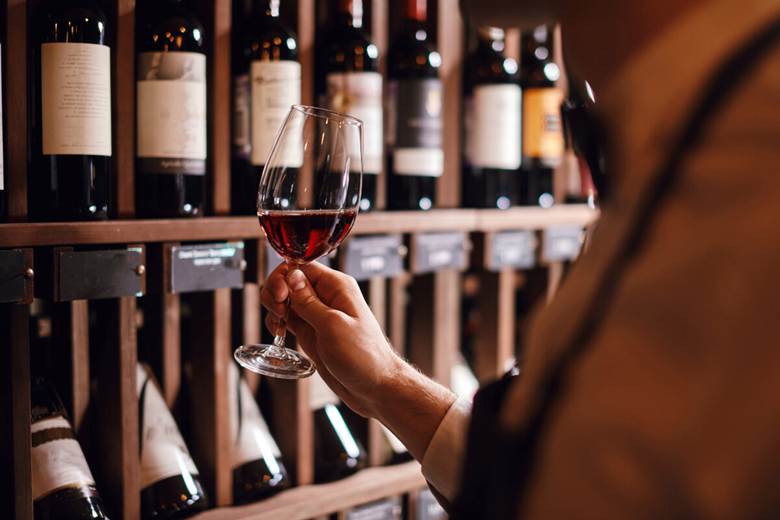
Photo courtesy of Downtown Napa.

Of course, reservations did make for a more pleasant experience, eliminating crowded, noisy tasting rooms, especially on weekends and holidays.  But it also eliminated serendipity and the ability to change one’s mind.  We have found that in many cases it is still possible to walk into a winery and enjoy a tasting, but it’s worthwhile to know the ins and outs of getting in.

  • Some wineries really mean that reservations are required.  These are the ones that are either very popular, very snobbish or both.  It always seems crowded, to our eyes, at places like Domaine Carneros, one of Napa Valley’s most enjoyable tasting experience, or at Robert Mondavi, which attracts visitors because of its name and its place in wine tasting history.  You can try calling from the road, but all too many calls go to an answering machine.
  • Most wineries aren’t full most of the time.  You have less chance of just walking in at 2:00 on July 4 weekend.  But on a random Tuesday, there are usually many empty tables at even the most exclusive tasting rooms.  It’s a good idea to be just a little apologetic.  If you arrive and just ask to be served, you’re more likely to be rejected.  On the other hand, if you look a little sorrowful and say, “Gee we don’t have a reservation but could you squeeze us in” your chances are better.
  • Increasingly, wineries are using their bars for walk-ins.  As wineries moved to seated tastings, they didn’t tear down their bars.  We have found that many of them are accepting walk-ins but are serving them at those bars.  In some cases, there’s a reduced tasting list, but more likely it’s the same wine without the table.  We actually miss standing with other visitors at the bar, so it’s not so bad.
  • You may just get a limited taste.  In some cases, a tasting room may be completely full and they really can’t accept walk-ins.  Napa Valley wineries are in the entertainment business as much as winemaking, so they don’t like unhappy visitors.  We have found that if they really can’t find room for you, they’ll offer you a splash of one of their wines before sending you on your way.  This has happened to us and we plan to make a reservation at one of those wineries the next time we’re in Napa Valley.  We don’t know if that would have been the case if we were just shown the door.
Wine Tasting in Napa Valley: Yesterday, Today and Tomorrow

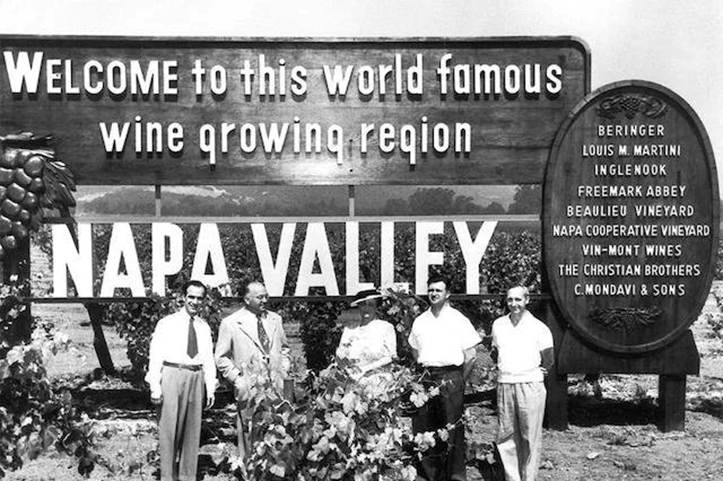
Like many Americans who enjoy wine tasting, we remember a time when we only went to Napa Valley.  Of course, wine was being made in other parts of California but we never heard about those places.  We’d been traveling to Napa Valley for at least a decade before we made it to the other side of the mountain, to Sonoma County.

Photo courtesy of K&L Wines.

We didn’t know it then, but we were being served wine by men and women who were creating an industry, yes, but also a lifestyle and artistry in making quality wines.  We are sure that we were served by Louis M. Martini himself.  Was that Warren Winiarski at Stag’s Leap, Mike Grgich at Grgich Hills, or Charles Wagner at Caymus?  It’s too long ago to remember for sure, but it might well have been.

Photo courtesy of Cellar Pass.

Wine was poured into tiny glasses (that we got to keep) and it was free.  From the producers’ points of view, wine tasting was advertising.  They thought that a happy sipper would turn into a contented buyer, and this proved to be true.

The pioneers are all gone now, and for the most part their vineyards have been bought by international corporations.  To the degree that our taste memories are accurate, Napa Valley wines, led by Cabernet Sauvignon, are just as powerful as then, but have a little more finesse.  Have they really changed or is it our faulty memories?  We’ll never know.  

What we do know is that wine tasting in Napa Valley has become more formal, sitting at tables instead of standing at bars, with servers who are far removed from the cultivation of grapes and the creation of wine.  And it costs a lot more.  Wine tasting experiences are richer, with architecture, design and education almost as important (in some cases, maybe more) as the wine.  Tastings last at least an hour, often more, instead of quick sips, thank you and goodbye, as in the past.

We see a few possible futures for wine tasting in Napa Valley.  It may become an avocation that only the rich can enjoy (or maybe it has already happened).  Prices will remain high and appointments will become even more mandatory.  This has certainly been the recent trend, especially since the pandemic. 

Another trend, which is already apparent in some wineries, is a two-tier experience.  The best wines will be served to those willing or able to pay the high prices.  For a lower but not negligible fee, people will be offered sips of lesser quality wines, often at a bar instead of a table.

The worst possibility is that the trend towards snob-appeal will drive enough people away that vineyard owners abandon wine tasting, except on a very exclusive basis.  It would not be the first industry that misunderstood its market and shriveled.  Ask the people at Kodak, Nokia and Blockbuster; they’ll tell you what can happen if producers misread their customers.

Of course, we hope that wineries in Napa Valley flourish and continue to make excellent wines.  We just hope that they make wine tasting more approachable.

Visiting Carneros

We visit the Carneros region often for the purpose of wine tasting.  There are several excellent wineries there, one of which is featured in this issue.  If you go, we urge you to look around and enjoy Carneros for more than just the wine.

A view across Carneros.  Photo courtesy of WineryHunt Sonoma.

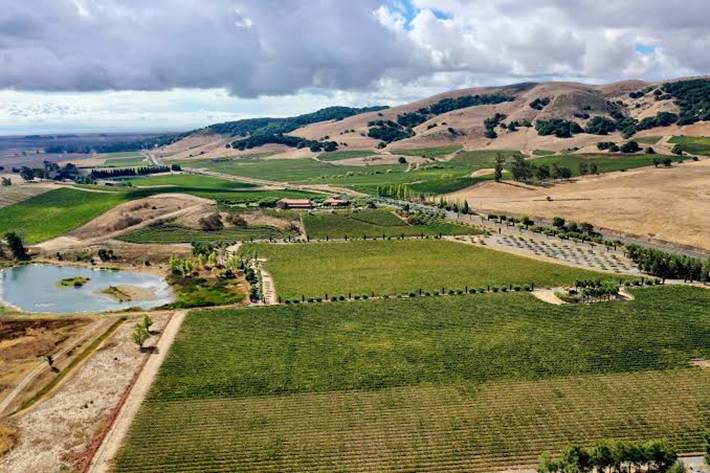
Carneros cuts across the southern end of both Napa Valley and Sonoma County.  Actually, it is a bit of a misnomer to say that it’s in Napa Valley.  There are rolling hills but for the most part it’s flat, with the mountains to the north.  The main road across Carneros is Route 12, also known as the Sonoma Highway on the Napa side and the Carneros Highway once it enters Sonoma.  Just to confuse things, it is also Route 121 over much of its length. 

Unlike other crossings between Napa Valley and Sonoma County, there are no hairpin turns and switchbacks.  What there is, is a lot of traffic.  If you get off the main drag to visit a winery or just to take in the scenery, you’ll find it difficult to make a right turn and left turns are death defying.

Nonetheless, we recommend that you do get off the highway.  In lots of ways, Carneros is different than the rest of both Napa and Sonoma.  It’s a great deal more rustic, with fewer wineries or any other businesses, for that matter.  There are fewer shady lanes, such as the Oakville Cross in Napa Valley or River Road in Russian River.  But there are open vistas, with the best views coming from the hilltop winery, Artesia.  We suggest that, in addition to tasting wine, you drive around and take in the atmosphere of Carneros.

And somehow, the air feels different.  That’s because much of Carneros is so close to the northern end of the Bay Area, San Pablo Bay.  The Carneros region gets cool, maritime breezes and overnight fog plus abundant sunshine. These make ideal conditions for certain grapes: Chardonnay and Pinot Noir.

Chardonnay is grown everywhere in both counties, but with rare exception, Napa Pinot Noirs come from Carneros.  We find that Carneros Pinot Noirs have a unique combination of power and subtlety.   That’s why we so open many bottles from there.  There is one winery situated in Napa Valley, Etude, that grows its grapes down the road in Sonoma County.  Is it a Napa wine or a Sonoma one?  They get around by simply labeling their bottles as Carneros.

There aren’t many places to eat in Carneros.  The Carneros resort has two restaurants, the Boon Fly Café and Farm.  The former is casual and there’s always a crowd waiting to get in.  Farm is an upscale restaurant, better suited to a fine meal than a snack between tastings.  The Stanly Lane Smokehouse is a deli just off the Sonoma Highway, and is good for sandwiches.  Bloom Carneros is a casual place for lunch on the Sonoma side.

Carneros is more laid back than much of the rest of Napa Valley.  In some ways, it brings a Sonoma vibe to Napa.  Once you get off Route 12 on the Sonoma side, the roads are small and winding; it’s easy to get lost.  But you’re never that far from the town of Sonoma and there are a lot of signs that point the way. 

So if you’d like to put the country in Wine Country, we recommend a few hours spent in Carneros.

Bouchaine Vineyards

It is Power Tasting’s policy not to write bad reviews of wineries that we visit.  There are so many that we can wholeheartedly recommend, so there’s no reason to be negative about any of them.  After all, just because we don’t enjoy a particular winery doesn’t mean that others won’t.

We bring that up because we had visited Bouchaine Vineyards (www.bouchaine.com) in the past and didn’t have a particularly good time.  The winery’s own web site describes the previous site as “a pair of ramshackle buildings”.  So no review appeared in Power Tasting.  A few years ago, we decided to give it a second chance, but they were so busy that we couldn’t even get a walk-in tasting.  So we recently did the right thing and reserved in advance.  Ramshackle no more, Bouchaine has a beautiful tasting facility with lovely views.

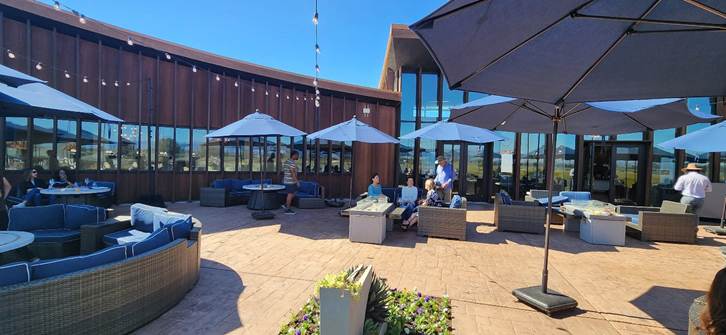
Tasting wine on the terrace at Bouchaine Vineyards.

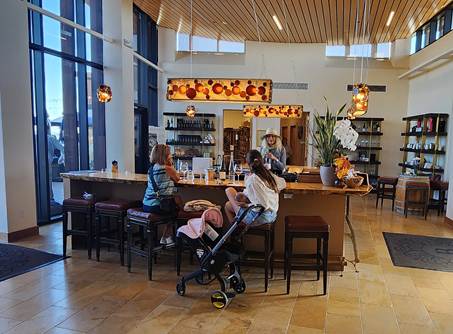
We say tasting facility rather than tasting room because Bouchaine offers several different experiences.  There is a handsome wood bar where visitors can taste their wines indoors.  Outside is an expansive terrace with view across Carneros vineyards towards San Pablo Bay.  And there is a garden, where families can picnic and the grownups can enjoy a more limited tasting.  The building is all wood and glass, large and impressive, but not really a Napa Palace.  It’s sleek but not stuffy, more welcoming and comfortable than palatial.

The interior bar area.

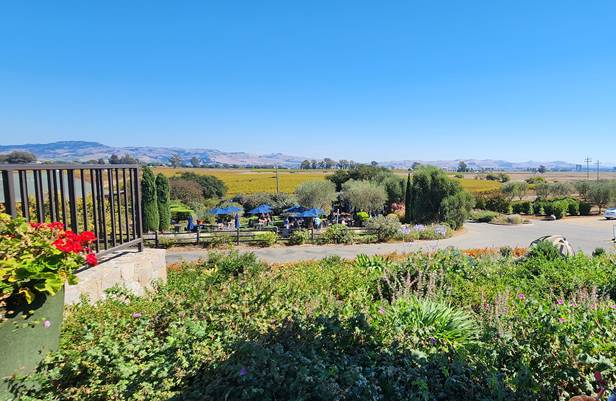
Between the main building and the garden there’s a small hill covered in flowers and other vegetation.  The view includes vineyards, olive trees and foothills in the distance.  Sitting on the patio with a splash of wine in your hand, looking out across Carneros, makes for a very pleasant experience on a sunny day.

The view from Bouchaine’s terrace, with their garden tasting area down below.

We have bought some Bouchaine wines over the years so we knew that the house specialty is Pinot Noir.  Yes, there are white wines for tasting as well, including some unusual ones, such as Pinot Gris and Gewurtztraminer, which we found quite aromatic.  But in honesty, we were there for the reds.  There’s more than Pinot Noir, including credible Syrah and Merlot.  But there are five Pinot Noirs on their tasting menu and a few more that they don’t list.

Those Pinot Noirs are all estate grown, except for one from the nearby Gee Vineyard, which we found to be among the more enjoyable ones we tasted.  Visitors have the opportunity to taste a Dijon clone and a Pommard clone side by side, which is quite an interesting experiment.  (We preferred the Dijon, but that’s just us.)

The servers are quite knowledgeable and are happy to expound upon the qualities and distinctive flavors of each wine.  Perhaps because our server knew that we would be writing about Bouchaine, we got more details than we believe most visitors get.

The overall experience of a tasting at Bouchaine is like being on the patio of a cocktail bar with ample sunshine.  The wines appealed to us and the ambience made us feel that we wanted to stay a while and enjoy ourselves.  So we did.

Editorial: Is There a Limit to the Cost of Wine Tasting in Napa Valley?

We swore we would never go back to Napa Valley again.  It’s too expensive, we said.  The wineries are too snobbish, we said.  There’s great wine in other places, we said.  But there we were, driving up Route 29 one more time.  Why did we do it?  Because there are wineries we knew or wanted to get to know.  Because there are restaurants that we love.  Because Napa Valley is just so beautiful, any time of year.

All of that doesn’t negate the fact that wine tasting in Napa Valley costs way, way too much.  There are many wineries where the basic fee for tasting is $150 and surely inflation will push more of them into that financial stratosphere.  At some point, it has to stop.  (Doesn’t it?)

From the wineries’ points of view, there is no reason to stop charging whatever the market will bear.  If people will pay those prices, why lower them?  And if wineries were solely in the tourism business, that would make perfect sense.  But they are basically in the wine business and they need to have people buying their products in wine shops and online, not just taking sips while on vacation.

We have read and have seen with our own eyes that sales of wine are decreasing.  Grapes are being left on the vines to rot and feed the birds.  Young people – potentially the wine drinkers of tomorrow – are drinking beer and cocktails instead of wine.  Wine tasting, as enjoyable as it is, should be an advertisement for the products a winery makes.  Choke off easy entry to the enjoyment of wine today and there will be fewer customers tomorrow.

So if the winemakers of Napa Valley feel secure that they can continue to thrive by selling to Silicon Valley zillionaires, then that’s a strategic decision they’re entitled to make.  After all, Tiffany, Porsche and, yes, Moët et Chandon do quite well selling luxury products.  There are many superb wineries in Napa Valley but there are more that fall below the level of “superb”.  Inflating prices for tastings may be good for their owners’ egos.  Many of them made a fortune elsewhere and then bought a vineyard.  Those wineries need to lower their tasting prices to attract more visitors…and sell more wine.